
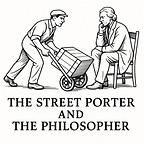


Ben Brophy, vice president of strategic engagement at the Mercatus Center at George Mason University, joins Rebecca Lowe and Henry Oliver to reflect on the first season of The Street Porter and the Philosopher. They discuss questions that arose across the episodes, including the extent to which a work of art can count as liberal, how artistic experiences can contribute to a good life, and why classical liberals should appeal to the arts and philosophy alongside economics. They also look ahead to a new season focused on big arguments, including episodes on pluralism, the relation between liberalism and conservatism, and the possibility of alien life…
TRANSCRIPT
REBECCA LOWE: Welcome to The Street Porter and the Philosopher. I’m the philosopher, Rebecca Lowe.
HENRY OLIVER: I’m Henry Oliver.
LOWE: The Street Porter and the Philosopher is part of our Substack project, The Pursuit of Liberalism, which is dedicated to refocusing classical liberalism on the arts and philosophy, alongside economics.
OLIVER: This is our first podcast season, and it’s all about liberalism in the arts. We’re covering everything from paintings to novels, the reading crisis to the future, and even the idea of liberal culture.
LOWE: We’ve applied a division of labor under which we each speak with some fantastic guests.
OLIVER: We’ve got academics, writers, an editor, even a bureaucrat. At the end, Rebecca and I are going to do a review episode.
LOWE: For a full transcript of this conversation, including helpful links to the references mentioned, you can click on the link in the show notes or description. And don’t forget to visit pursuitofliberalism.com.
LOOKING BACK AT OUR FIRST SEASON
BEN BROPHY: Welcome to this episode of The Street Porter and the Philosopher. My name is Ben Brophy, and I’m neither a street porter nor a philosopher, but I do have the joy of being colleagues with Henry and Rebecca. Today, we’re going to do a retrospective episode where we walk through the season and think about what we’ve learned, what was interesting, and what’s ahead.
LOWE: You’ve clarified that you’re neither a street porter nor a philosopher—
BROPHY: I like that line.
LOWE: —although I think I’d push back on some of that. I also like the implication that Henry—this is an implication we have throughout this podcast—that Henry must be a street porter. [laughter]
BROPHY: Yes, very clearly.
OLIVER: Ben can be an honorary street porter for the day. [laughter]
BROPHY: Oh, thank you.
OLIVER: Yes.
BROPHY: I appreciate that.
OLIVER: There you go.
BROPHY: See?
OLIVER: There you go.
LOWE: I think—
BROPHY: So much more welcoming than philosophers.
LOWE: Ben is quite a bit of a philosopher, however. So . . .
BROPHY: I, you know . . .
OLIVER: A secret philosopher.
BROPHY: Secret, yes. Don’t tell anybody.
LOWE: Secret!?
BROPHY: Don’t tell anybody.
LOWE: Have you ever spoken with this guy? [laughter]
BROPHY: All right. With that being said. Rebecca, I’ll start with you. Looking back at the first season, did you end up making the show that you thought you were going to make, or did it turn into something different?
LOWE: Oh, man. Asking a philosopher a question like that! You know, predicting the future, the coherence of the question... No, I like this as a question. I think, yes, broadly so. I think it was fun. I think we got to talk with some very interesting people. I also think this show is quite like Henry and me. Henry’s episodes are quite Henry. My episodes are quite me. But it also brings together some of our shared interests—
OLIVER: Yes.
LOWE: —and shared personality traits.
BROPHY: That’s good. We love this.
LOWE: My episodes are a little more argumentative. Henry’s are a little more—
OLIVER: Freewheeling. [laughter]
LOWE: You said it.
BROPHY: Kind? [laughter]
LOWE: Kind! Yes, yes…
BROPHY: No, I’m kidding.
LOWE: That’s a very interesting comment, Ben Brophy. [laughter] I like to think that the way the philosopher shows respect is by giving objections to the people who can take the objections. The people I interviewed could take the objections. They seemed pretty happy at the end of my episodes!
The other thing I think that we did succeed in, in terms of matching our hopes and goals for this season, I think we did a pretty good job of considering the relation between the arts and liberalism. Which is something we feel very strongly about.
OLIVER: Yes.
LOWE: We think it’s under-discussed. And I think through a method of different kinds of conversations with different kinds of people about different kinds of art objects—I’m saying that partly because Henry hates it when I say the term “art object.” [laughter]
OLIVER: I’m happy to say “books,” “paintings.” [laughter]
LOWE: I want to introduce some taxonomizing. [laughter] I think we showed that this relation is alive and well, and that it’s something worth investigating as liberals.
BROPHY: I’m tempted to ask what an art object is, but I feel like that will get us way off course.
OLIVER: We’re going to need another hour.
BROPHY: Yes, let’s not do that.
LOWE: I wasted my childhood and teenage and early 20s reading aesthetics literature [laughter] and thinking about these questions. “Art object” is a term the philosophers use often when they are thinking about the arts.
BROPHY: OK. All right. Henry, what about you? Anything? Did you make the show that you thought you were going to make?
OLIVER: Yes, more or less. I think I agree with what you said. I would just add that we did it in a liberal way. We went about it in our own independent styles, but it is unified, as you said. And I think part of what we’re trying to do is model that kind of approach as well.
It was very different interviewing Celeste than it was interviewing Sunil because they are doing different things. They have different personalities, they have different projects, and you want to be able to showcase that and work out, how is that relevant to what we’re doing? So, some shows, it’s more uniform, and they do a certain way of doing things. What we’re doing is, like, it will be different with every person in a way.
THE CONNECTIVE TISSUE
BROPHY: Was there any connective tissue that you saw throughout the episodes? Is there a thread that ties it all together, or are these ad hoc one-offs? How did you see it?
OLIVER: I’m tempted to say that I don’t want there to be a thread. I don’t like all this unifying of things all the time. All this neat packaging for marketing—I know, I’m so sorry.
BROPHY: How dare you?
LOWE: You’re managing to annoy both the marketing expert [laughter] and the philosopher with this claim, Henry Oliver!
OLIVER: What a surprising coincidence. [laughter]
BROPHY: It might not be a philosopher or marketing person. It might just be the two of us, honestly.
LOWE: I think that’s true. This funny combination. I would add, I do think one unifying feature is that if you look at the tagline of our Substack—
BROPHY: Yes.
LOWE: And we host this podcast through our Substack—we have this idea, which I think you and I both believe strongly, and I think Ben Brophy does as well. I’m just going to put you on the spot here. But I know this from our many conversations, that—and one of our mutual friends one time said this—you’re not going to really win the war as liberals with supply-and-demand charts. We think that’s very very important. Don’t get me wrong. Describing the world, using the tools and methodology of economics, modern economics, is incredibly important. But we need to use other kinds of arguments too. So, the tagline of—
OLIVER: Yes.
LOWE: —our Substack is something like “refocusing classical liberalism on the arts and philosophy, alongside economics.” And I feel as if we instantiated that in some sense, or part of that, through this season. By talking about the arts as liberals, thinking about those relations explicitly, and bringing it back to the value of liberalism, I think.
OLIVER: Liberalism fragments very quickly and very readily. That is particularly true of economics, and it can also be true of social issues as well. But when we talk about the arts and ideas, actually there’s a lot more unity. And I think that was one of the most interesting things, is that we had a lot of different sorts of liberals in the episodes. Some of them may not even think of themselves as liberals. But there is a cohesion there that, if we’d talked about economics, would have been much harder to achieve without being more intellectually sectarian.
LOWE: It’s sometimes the case, and the philosopher would say this, when you take the edge case, or when you take the case that you’re not quite sure about, it can help you firm up your grip of the thing. So, by asking something like: Can a piece of work, can a piece of art, be liberal? Or this composer, because he did these particular things, or this artist, because she did these particular things? Does it mean something to say therefore that they’re liberal, or to take that from it?
It just forces us into thinking: But what is liberalism? What is it to be a liberal? Whereas, if you take the really obvious cases, they can be central examples and they can help you work out from that. But sometimes then to clarify around the edges, taking less-sure cases is methodologically valuable. And I think we did that quite a bit.
OLIVER: But this is one of the differences. I would just never do any of that. [laughter] I’m just always going to stay on the edges and be like, “If you can work out why this is relevant to liberalism, whoopee for you. That sounds boring. Let’s just talk about paintings or something.” The relevance should make itself known. Those are two different approaches, and I think that’s important. That’s a liberal approach.
OF STORIES AND SURPRISES
BROPHY: Let me push back on you, with your own words. [laughter] You wrote a paper somewhat recently that I had the chance to review, which was a lot of fun. You referenced George Eliot talking about something along the lines of, “Stories are just more persuasive than harder sciences.” Do you recall this?
OLIVER: So, before she became a novelist, George Eliot was an intellectual. She translated things. She translated Spinoza. She was writing essays. She was editing. She wrote this long essay called “The Natural History of German Life,” in which we can see her talking herself into the type of novelist she is going to be.
She says that trying to make persuasions based on generalized arguments and statistics—which is what’s happening in this period with economists and sociologists and all these social sciences that are coming up—she says, “No one cares. What we need is the picture of life that only a great artist can give.” Now she’s often quoted as saying that art is the nearest thing to life, right? And that’s what she means by that. It’s a picture of life that only the great artist can give, and that will be persuasive.
So, submerged within George Eliot are all the liberal, humanistic, Spinozan ideas, but they never come out in, like, propositional form, and you could never do that kind of approach. She wants you to come to that in another way.
I think that was basically what I was trying to do in some of those episodes. But, as I say, different people should be interviewed in a different way, and if we just said, “No, no, this is our format,” I think it would have been much less interesting.
BROPHY: That’s good. Rebecca, was there anything that surprised you throughout the season?
LOWE: I was surprised sometimes actually, at how much, for all Henry’s saying this, I found many of his episodes very philosophical. [laughter] I was thinking this morning about your nice episode with Celeste, which I enjoyed so much.
OLIVER: Yes, she was great.
LOWE: She was really awesome. And I love Soutine. I’ve seen his paintings in exhibitions. I’ve seen them in many places around the world, and I’ve liked them, but I didn’t really know that much about him. I must read her book.
OLIVER: It’s a great book. We recommend it.
LOWE: Yes.
BROPHY: Yes.
LOWE: It made me think, this interesting conversation you guys had about whether sometimes great artists can be justified in leading certain kinds of lives, which otherwise might seem problematic in some particular kind of way, whether because they seem too thin, or whether because the people around them suffer. This makes me think straight away of the great thought experiment in Bernard Williams about Gauguin.
OLIVER: Yes, yes.
LOWE: And that’s a particular thing, talking about moral luck, but it’s a very similar kind of notion. And I like that I think you guys implicitly were doing some kind of philosophical thing. I don’t think it really surprised me because I think you’re more philosophical than you like people to think. [laughter] Henry has this fantastic grumpy persona where he does this implicit mode of arguing.
OLIVER: An English persona.
BROPHY: English.
LOWE: That’s right, yes.
OLIVER: Yes. [laughter]
LOWE: I can argue about the distinction between Englishness and grumpiness if you want, but as Oliver Traldi, our friend, if he were here, he’d be like, “You’re at risk of being both under- and over-inclusive here, Henry.” [laughter]
But the other thing I think didn’t surprise me but I was glad about, is that a lot of these episodes were very fun. We, as our little gang here, Ben and you and me, and these other people, we have a lot of fun—
OLIVER: Yes, yes.
LOWE: —when we’re talking about these serious matters. I think we do it in a serious and deep way, but we have light moments in it. And I think sometimes people don’t see that—
BROPHY: Yes.
LOWE: —from the outside, particularly if they just read our work. And I love how we had that. So, one of my favorite moments was, there are many moments actually, in the episode with Zena and Hollis. I felt like we were talking about a very big and important matter, the Declaration of Independence. And it’s a very serious matter. There are some very dark things that are associated with that time. But we had some real moments of, I think, beautiful joy. It wasn’t that I wasn’t expecting it, but I was delighted that it came about.
OLIVER: I think those two are such a good example. Hollis will say things like, “The Declaration of Independence is like a pitch deck for a startup.” [laughter] And you can see Zena like, “What is happening? I cannot even talk.” But they’re still having fun and they’re exhibiting the real values of scholarly investigation and liberal thinking. It’s an amazing thing actually.
LOWE: It was really lovely actually.
OLIVER: Yes.
LOWE: I got to know them properly this year. We were all at a conference in Texas, and in the evenings, we’d escape and go and have a drink. And we were sitting around this fire pit, because we’re in America and we have these fancy things. Somehow or other, we decided to read the Declaration of Independence. Or, I ended up reading it, because I think Hollis thought it was very amusing having the English person reading it, like a “breakup with America.” [laughter] This was her line. She has these brilliant lines.
BROPHY: Yes, yes.
LOWE: Then we had such a—it was a moving moment, but it was also a fun moment. And then when we were thinking about these episodes, I was like, “We need to recreate this!”
I haven’t yet watched that episode because actually we’re recording this before it comes out. Although I remember recording it quite well. So I’m interested to see how that came over in the studio because sometimes recreating a moment like that—we did it slightly differently in the studio. But I do think we got some of that sense of intensity and seriousness, but also joy, that manifests in the friendship that I have with these two women. My guess is that that comes across pretty strongly in the episode.
BROPHY: Yes. As a watcher and a listener, the thing that I appreciated most is it felt so much like the conversations we just have in the office all the time, about everything that’s bad and wrong with everything Henry says. [laughter] I think that’s just a ton of fun, for sure.
LOWE: I like how my catchphrase to Ben is, “It’s bad and wrong!”
BROPHY: That is, yes.
LOWE: I one time said this in the pub. [laughter] The guy in the pub, the bartender, was walking past just as I said this. He looked at us and was like, “Oh, no, the philosophers are here again!” [laughter]
BROPHY: Yes, we have a reputation there now. I think every time I go in, the bartender’s like, “OK, what do you want?” “We’re here.” Anyway, our reputation precedes us.
BROPHY: In other surprises, Henry. I think you learned something about Hayek that perhaps you didn’t know.
OLIVER: One of our guests was Erwin Dekker, who is a researcher here at Mercatus. He specializes in the history of ideas. He wrote this wonderful book. It is a few years old, but it’s new to me. It’s all about Hayek and Mises and that circle in Vienna. He sees them as economists, but he sees them as part of the avant-garde of their time. And what they’re worried about is the decline of civilization. He calls them “students of civilization.”
So, we’re used to Hayek being concerned with “the moral order,” as he calls it in The Fatal Conceit, and all these sorts of topics. Cass Sunstein actually just blogged about, is Hayek a traditionalist, compared to, he says, Mill is not a traditionalist. Erwin’s book really goes into the details of—puts them in their context in their intellectual history and sees them as these—he calls them students of civilization. I found that very interesting. We had a really good conversation. Hayek is sometimes talked of in these abstract terms, and it’s very interesting to see him in the mix as one of these people.
LOWE: This was nice preparation for me. You guys also—we talked about this, and you guys did a little event in the office, as well. This was excellent for me because I then, a couple of weeks after, went off to Vienna for a conference on some of these— [laughter] So this was very nice. And I was thinking about some of Erwin’s claims. I’m interested in that period, partly—or at least I’m interested in what was going on in Vienna in the first half of the 20th century, partly because of the philosophical impact—
OLIVER: Yes, yes.
LOWE: —of people like Wittgenstein. But also, I’ve been a long—I’ve had a bit of interest in Stefan Zweig, because I like Richard Strauss very much, and he often set Zweig. I think Zweig’s memoirs also brilliantly chronicle the downfall of what was going on in Vienna, this place where it seemed to be the apex of human civilization. And then within such a short amount of time, you have this catastrophe.
OLIVER: It’s a great book about the twilight of liberalism—
LOWE: That’s right.
OLIVER: —in that period.
LOWE: That’s right.
OLIVER: Yes, yes.
LOWE: So, I think, just on my selfish level, you guys having been talking about these things informed my trip and the conference I was going to.
OLIVER: We gave you talking points.
LOWE: You did. [laughs] Not that I need more Hayekian talking points, but you know.
OUR MOST POPULAR EPISODE—AND THE OTHER ONES WE LOVED
BROPHY: A vain question. You guys might have peeked, so you might know the answer. What do you anticipate will be the most popular episode?
LOWE: I did look at the stats, so I know the answer. [laughter]
BROPHY: But there are episodes yet to be released, including this one.
LOWE: That’s right! Also, who knows? Maybe one of our guests will go and do something astonishing tomorrow, and then that episode will gain the derived—
BROPHY: That’s right.
LOWE: —interest. But also, who knows? Maybe this episode will be the—
OLIVER: Yes. I’m not surprised to see that it’s the Cass Sunstein episode.
LOWE: Yes, that did pretty well.
OLIVER: Yes.
LOWE: They all did pretty well, actually.
OLIVER: They all did very well, and they all deserve to do well.
LOWE: Yes.
OLIVER: The guests are all fascinating, but he’s got a—there’s a certain interest in Cass Sunstein—
BROPHY: Of course.
OLIVER: —that’s obviously well-merited by the record of his work. And to have someone like that talking not just about liberalism, but about Bob Dylan and these other—
LOWE: I actually assumed it—
OLIVER: —things, that is quite fun.
LOWE: I assumed it was actually the Bob Dylan effect. I mean, I think Cass is awesome, and I really enjoyed that conversation. And yes, of course, he does have a great reputation. But Bob Dylan is a cultural phenomenon, right?
OLIVER: I imagine there are a lot of Bob Dylan podcasts that no one listens to.
LOWE: How many Bob—
OLIVER: I can see there being a lot of Bob Dylan content that’s not doing so well. I think there’s a long tail.
LOWE: How many Bob Dylan philosophy interview discussions?
OLIVER: Yes, exactly. That’s what I think is this.
BROPHY: Yes.
LOWE: Cass did a funny tweet where he’s something like, “This is not one of my usual ones!”
OLIVER: Exactly, exactly.
BROPHY: Which is what we want.
LOWE: I know.
OLIVER: It’s nice—
BROPHY: Yes.
OLIVER: —to see him in these different contexts. That’s what I think.
LOWE: We did do full-on philosophical debate in that episode, and it was fun.
OLIVER: That’s also why I thought the Sunil episode was great—
LOWE: Yes.
OLIVER: —because you don’t get a lot of bureaucrats on podcasts like this. His work is so fascinating and gives a completely new perspective on the reading crisis. It’s just great to get that data out of him. I don’t think you can get that somewhere else.
LOWE: I loved that episode. I think it was a great start to the season as well. It’s also this funny meta-irony that we’re saying, “We don’t just want to do the stats,” but then we start with the stats.
OLIVER: Start with the stats. [chuckles]
LOWE: That said, of course, because we don’t just want to do that, doesn’t mean we don’t want to do it at all.
OLIVER: That’s right.
LOWE: So I think it’s important for us to underline that we do think the empirical sciences are important.
BROPHY: Yes.
LOWE: We don’t want to do away with them. We just think there’s a division of labor which hasn’t been sufficiently well applied here.
OLIVER: But also, in the reading crisis discourse there are so many surveys which just give you this snapshot, low-quality data. It’s easy to just say, like, we know reading’s in decline. That’s obvious. We don’t really know why or what’s going on. You can just pull all this terrible data and say, it’s this or it’s that. Sunil actually gave a really, really thorough and detailed outline of what we know and what we don’t know. It’s actually fascinating how much we don’t know, and how much more detailed work could be done. Proper studies could be done. And, at the moment, I think a lot of the discussion is just based on vibes. I thought it was great to draw that out.
BROPHY: It tackled a few things that are very much just in regular conversation, particularly for parents. “All right, what about a book versus a Kindle versus an audiobook?” These are things that people are talking about constantly, especially as it pertains to children. I felt like it spoke to a very real question that’s out there in the zeitgeist, if you will, so it’s helpful.
OLIVER: That’s right. But also, everyone else who talks about it has an ideology, or they have an opinion, or they have an agenda. But because he’s a bureaucrat, he’s scrupulously honest. Right? He really said, “Well, we don’t know that much about that,” or “Yes, that’s true but it’s not a very big difference.”
I think that’s actually really helpful because, particularly kids and parents and stuff, it can get a bit scary, and a bit like, “Oh, my god, what’s going on? What should I do?” Then he says, “Well, people do retain less on Kindle, but it’s not that much less. Or it’s less in certain ways or certain types of reading. Or it’s less at different ages.” It’s actually quite reassuring to know that the headline claim, it’s not made up, but it’s inflated sometimes.
BROPHY: Yes. I imagine reading anything is better than not reading, right?
OLIVER: Yes.
BROPHY: This is overall a good thing.
LOWE: I sometimes find this funny, this claim that kids aren’t reading anything, at the same time as the kids are only spending their time on their phones. [laughter] It’s like, what do you think they’re doing on their phones?
BROPHY: Yes.
LOWE: Maybe some of the time they’re playing the little games, but most of the time they’re reading. Just because they’re reading shorter—again, then we can go, and that’s one of the things I loved about this, that there was this honesty and then this digging down. I also thought it was fun. One of my favorite things about this podcast is our little intro, which our colleague Melody did. I mean, the whole thing is beautifully shot and edited, but I love this little intro, particularly the bit where Henry says, “Even a bureaucrat!” and we kind of giggle. [laughter]
That’s partly, I think, because there’s this implicit idea that bureaucrats are not fun, but also it’s funny that liberals have the bureaucrat. I love how Sunil comes across. He’s such a nice guy, and he’s so smart, and he is fun. And I like the chemistry between you guys. I felt like it was a great beginning, to that end, because it also dispelled some myths. Don’t get me wrong, I’m a skeptic of bureaucracy, but bureaucrats are like—
OLIVER: Bureaucrats, they may not be fun as a class, but Sunil is fun.
LOWE: Also, Mises does tell us that we don’t do away with all the bureaucrats. [laughter] We sometimes forget these things, I think.
WHY DID WE DO THIS, AGAIN?
BROPHY: Yes. We touched on this a little bit earlier, but I’ll ask again just to put a finer point on it. You guys spent an entire season of podcasts on arts and liberalism. Why? Why is this important? Why have you done it? There are a lot of people who might not necessarily make the connection straight away, so I’m curious what motivated you to do that.
OLIVER: I think that’s the answer. People might not make the connection straight away, and that’s why it’s interesting. The question is really: Is there a connection? Because, obviously, the relationship between liberalism and the arts is quite vexed. It’s quite difficult to think of a genuinely liberal work of art. The question of whether there should be such a thing as liberal art is, I think, an open question. And so, it gives you a lot of different ways to talk about these subjects that are bringing a new perspective or opening things up in a new way.
Soutine is a very liberal story in many ways, or it touches on many key liberal ideas. But it’s hard to say that, like, looking at his painting of a pheasant is a liberal experience in any ideological sense. I think that’s quite an interesting distinction and a lot of good discussion can come out of that.
BROPHY: But where do you land? Is there a connection, or is there not?
OLIVER: Well, there’s obviously a connection in the sense that Soutine had to go to Paris. Paris is a liberal place. The production of his art is therefore happening in a liberal context. It brings up questions about immigration, about people moving, what it’s like to live in a different country and so on. There’s that great book, Sunny and Sonia, that we read—
LOWE: Yes, great book.
OLIVER: —last year.
LOWE: Great book.
OLIVER: I don’t know if you could say that’s a liberal book in the sense that it “espouses liberal values.” But it’s clearly a liberal book in the sense that it is about what it is like to be in the Indian diaspora. What is it like to leave one culture and live in another? These are core liberal concerns. So, I think sometimes it doesn’t have to be a liberal book, in the way that some books are Marxist or conservative, in order for it to be of interest to liberalism.
LOWE: I really enjoyed thinking about some of these questions. Again, it enabled me to go back to thinking about some of these issues in aesthetics that I used to think about much more than I do now. And I’m interested in things like the nature of things and what is an art object? Does it mean anything to say that it’s liberal?
But I think for me, the easiest way to make the arguments about the relation are probably causal claims around things like, “Liberal culture produces certain kinds, or tends to producing certain kinds, of art.” And “What is the impact on art in terms of people’s values?” You get this causal arrow question: Which way does it fly? Does it fly both ways? Those questions have some element of empirical consideration there.
I think there are also some other kinds of answers that we gave throughout the season. Something like, when an art object, in some sense, displays some notion of something like experimentation, when an artist is anti-conventional, there are these kinds of types of arguments you can give.
Cass and I had an argument in our episode about whether any of these Bob Dylan songs are explicitly political. I think, for instance, some of those—and I think it was particularly around whether they’re protest songs. For me, some of the songs that I particularly enjoyed listening to by Dylan—just generally and in preparation for this—I don’t know that much about Dylan, but I’ve recently started listening to more of it. There are some of these songs which seem explicitly about particular instances of injustice, and they’re about actual people.
I think he wrote these songs within a particular period of time. Cass has much more awareness about Dylan’s own take on these and, I think, some of his distancing from the more political narratives. But me listening to these things, or indeed the more, kind of, antiwar songs—again, I think Cass has his own view on that. It seems to me like those kinds of things where there is language, and the language itself explicitly engages with some kind of liberal notion, it’s much easier to make arguments that that instantiates something about liberalism. When you come to figurative art, or when you come to music without text, I think it’s much, much more difficult.
We had a nice argument in our philosophy working group yesterday about abstract art and meaning and intention. I love thinking about these kinds of questions. And I feel like we did a pretty good job of covering the bases, and coming up with different kinds of arguments for when and when not it makes sense to think of art objects in these ways.
WHEN LIBERAL DEMOCRACY IS NEITHER LIBERAL NOR DEMOCRATIC
BROPHY: How does the Christopher Scalia episode fit into this?
OLIVER: That was such a fun episode! It’s really good that we brought this up. I think a lot of what we’re talking about is ideologically liberal, right? Are you a classical liberal or whatever kind of liberal? There is a way of talking about being liberal as in liberal democracy, and I think that’s a much narrower set of ideas. An awful lot of people agree on the value of liberal democracy, and then after that are conservatives or progressives or whatever they are. And the book, Democracy, that we discussed with Chris, is all about how does liberal democracy actually work?
So, it’s not about the ideas. It’s about how politicians scheme and connive and lie to each other. And who’s got the secret letter that if it comes out that he said the thing and did the backroom deal and he’s trying to get married to this woman. Is it because he wants her money and does she want to marry him because then she’ll be the first lady? It’s a really fun book about the dirty work of Washington. And what does power really look like? Because it’s easy to say, “Oh, liberal democracy is so fantastic,” and all these high ideals. But then the day-to-day business of liberal democracy might be neither liberal nor democratic.
LOWE: I’m going to hold back [laughter] from pushing back against this idea of this being a narrower sense in which we use “liberal,” because I want to say I really enjoyed reading that book. This episode came about broadly, I think, because you and I and Chris had dinner at your house—
OLIVER: That’s right.
LOWE: —and we’d all been reading this book. It’s a fun book. It’s a very American politics book. It’s a very DC book, isn’t it?
OLIVER: Yes, and Henry Adams, you see, was such an insider—
LOWE: Yes.
OLIVER: —but he never really got anywhere, so he’s the perfect person to write about how things work because he knows it all. He had published it anonymously, but it’s not really on the line for him in the way that—
LOWE: It’s a very short, quick read.
OLIVER: Yes, it’s fun. It’s fun.
LOWE: Also, for an English person, there are all these implications and you’re like, “Oh, I know this is clearly getting at some particular person, but I’m not quite sure who this person is.” It’s an intriguing book, isn’t it?
OLIVER: I think it sold a lot of copies at the time because there was a general sense of, “This character could be one of these three people.”
LOWE: That’s right.
OLIVER: “And this guy is clearly some”—and so, there was a lot of that intrigue. Whereas for us, it’s settled into being an insider’s look. And we obviously love films like that or TV, like The West Wing or whatever. People love the, “How does it really work in the White House? What are the moral compromises that people have to make to achieve the good thing?” And I think people who work in DC who haven’t read that book would find it both amusing and instructive.
LOWE: It was a really fun episode.
OLIVER: Yes. Chris is great.
LOWE: He is awesome, isn’t he?
OLIVER: Yes, yes.
LOWE: Yes, I really enjoyed that very much.
BROPHY: I would just say, from my experience, Veep is a much closer picture of reality than The West Wing, [laughter] as far as I’m concerned.
OLIVER: Well, you know there’s this thing in England now where an MP will go on the news and say something, and people will put it next to a scene from—
LOWE: The Thick of It.
OLIVER: —The Thick of It, and it’s almost word for word.
BROPHY: Yes.
OLIVER: And you think, “Are they doing that on purpose or do they not know? This is horrible how close it is.”
LOWE: It’s also funny how that’s expanded. That was the little joke that people like Henry and me, who’ve worked in Westminster, used to always have. We would just make these little jokes, and now it’s become much broader and much broader. [laughs]
OLIVER: The monster’s woken up. [laughter] When I worked in Westminster, I used to have to walk over to the Department of Education to get my boss to sign letters. And I would go into this vast building full of people, and you’d be walking along, and they have TVs up on the wall. It’s supposed to show the news or the House of Commons.
LOWE: Yes, yes.
OLIVER: Most of the time, it was showing The Thick of It, and no one was watching it, and they didn’t realize. They were just sitting there. It was like replicating what was on the TV. It was hilarious.
BROPHY: That’s so funny.
OLIVER: And now it’s broken out into the wider world—
LOWE: Into the real world.
OLIVER: —and that’s bad news for England, I think.
LOWE: I don’t know... I want people to know the truth! This is like the aliens. This is our version of the aliens!
OLIVER: This is Disclosure Day.
THE EPISODES THAT MADE US THINK
BROPHY: Henry, what was the most interesting thing you learned, if anything, throughout the season?
OLIVER: Oh, by far, it was some of the claims made in the Sunil episode. Some of the things I was talking about before about what we don’t know about the reading crisis. Like differences between different demographics, whether those are ethnic demographics or other things about why certain groups read more or don’t read more or whatever. There’s actually quite a lot of work to be done to investigate all of that. I was very interested in that.
BROPHY: Rebecca, how about you?
LOWE: I enjoyed the conversation that Henry and Celeste had about color. I really enjoyed that. And it struck me—I hadn’t thought of it before, but I do very much associate Soutine with red.
OLIVER: Yes.
BROPHY: Yes.
LOWE: Yes, that made me think. I don’t know if that’s something I learned, but it’s certainly something that, in some sense, made me think a little harder.
OLIVER: The section of your episode with Tyler as well about whether liberals can be pacifists—
LOWE: Yes.
OLIVER: —that was very good.
LOWE: I enjoyed that.
OLIVER: That was very good.
LOWE: That’s something I’ve thought about on and off for a long time, and haven’t ever written anything about but had these views about. It also engages pretty strongly with what was my first interest in political philosophy, which is social contract theory. And thinking about pacifism, in terms of—at least absolute pacifism—and whether it’s coherent for a liberal to be a pacifist. I really enjoyed that.
I think we had, again, a pretty good—although actually that’s one of the few things I think Tyler and I agreed upon [laughter], albeit for different reasons. We tend to disagree quite a lot about philosophy, which I really enjoy. I think it’s a great part of our friendship.
But I would say the color thing did stick with me. Yes, it made me think pretty hard.
OLIVER: Yes, I liked that.
LOWE: There is also this theory, isn’t there—it’s probably been debunked—that a lot of successful—and again, we can think is “successful” in terms of meeting demand, is it in terms of being critically acclaimed—that the color red plays a very significant role within successful pieces of painting. There is this general claim. I’ve read some things about it. Whether that’s true or not, once you hear that claim, you can’t help but be influenced by it. And I was reminded of it when I watched and read your episode.
OLIVER: Yes, I asked that question because I feel like he’s a lot more red than other artists. Maybe it’s the use that the red is put to, or something.
LOWE: So there is one painter who he makes me think of, and I just thought of this, this moment, is Rouault. I don’t know, if Celeste were here, I’d ask her. There’s something about the similar, slightly boxy, slightly abstract, figurative people, and the use of red. Another painter who—and actually there are some great religious Rouault paintings that you’d like, Ben. Yes, I must ask Celeste about that.
OLIVER: Rembrandt is good at red. But I don’t know, I’m not sure about that general claim about red. I can think of a lot of un-red—
LOWE: It might still be the case that even though there are a lot of un-red paintings—
OLIVER: It’s where it comes, yes—
LOWE: —that are successful. That nonetheless—
OLIVER: Sure, sure, sure.
LOWE: —you can do the whole—
OLIVER: No, but it’s very interesting. It’s very interesting.
LOWE: My understanding is this is a pretty mainstream claim, but once you hear it, then it’s hard to get rid of it. And it may, of course, then, in itself, have an impact on your own notion of what is striking. That said, red is just clearly a striking color, whatever that means.
OLIVER: We want to know what you learned. [laughter]
BROPHY: The thing that caught my attention the most was certainly Sunil’s episode on reading. Rapt attention was paid because I’ve got young kids. It’s like, “All rright, I’m thinking about how best to get information into those little heads.” That was the thing that I was paying the most attention to.
The thing I knew the absolute nothing about was Rebecca’s episode with Tyler. So that entire episode for me was, “This is all new.” British composers, I knew nothing, so that was very interesting. And of course, listening to Rebecca and Tyler go back and forth is always fun, even though she let him get away with some stuff! [laughter]
LOWE: Yeah…
BROPHY: But it’s OK.
OLIVER: You must have been feeling charitable that day!
BROPHY: Yes.
LOWE: I’m aware that . . . [laughter] So, the other episode I recorded with him was an episode of my philosophy podcast. And I did not let him get away with anything [laughter] on that one!
BROPHY: That’s fair.
LOWE: So, sometimes you’ve got to—
BROPHY: Yes.
LOWE: Also, I think there was an element of, you know, I’ve loved Benjamin Britten’s music since I was about 10 years old. I know that Tyler is less keen on it than I am, so I was very glad that he agreed to do this. [laughter] And he listened to a lot of—this sounds like I’m saying I didn’t push back because I was glad that he had spent the time thinking about Britten. And that’s not true, actually. It’s maybe because we were broadly in agreement more than we often are on philosophical matters, in that episode. Certainly on that central question of the liberal-pacifist thing, we found points of agreement.
I think also we do both think that the War Requiem is a wonderful piece of art. He also agreed with me, which I was quite surprised about, I made this very big claim partway through that Benjamin Britten is the greatest-ever musical setter of text. And he said yes, he agreed with that. I was surprised by that.
But I thought that was very fun. I really enjoyed that.
BROPHY: Yeah, it was great.
LOWE: And like I say, I’ve loved Benjamin Britten’s music for 30 years. And I don’t, most of the time, talk about it or think about it. You have limited time in your life.
BROPHY: Of course.
LOWE: I spend most of my time thinking and talking about philosophy.
BROPHY: Yes.
LOWE: So, being able to do philosophy about Benjamin Britten, that’s just going to be joyful for me.
AND NOW, ALIENS
BROPHY: Yes, it’s awesome. So, this entire season was about arts and liberalism. To do a little bit of a teaser for next season, get the people excited. As I understand it, you guys are going to talk about ideas in liberalism. Dare I say “arguments” in liberalism? Talk to me about what you guys have plans... [laughter]
OLIVER: There may be some arguing. [laughter] There may be some arguing, yes.
LOWE: I’ve persuaded Henry of the benefit of arguing!
OLIVER: Implicit arguing, in my case.
LOWE: Uh huh.
BROPHY: So, what do you guys have on deck?
LOWE: Big ideas! We have our favorite upcoming episode, which we haven’t yet recorded, but we’re very excited about. We’re calling—whether it will actually be called this in the real world, who knows?
OLIVER: Oh, it’s going to be called this!
LOWE: The big alien episode!
OLIVER: The big alien episode.
BROPHY: OK, I need more context. [laughter]
OLIVER: We’re going to talk a lot about aliens.
BROPHY: What they are, and if—
OLIVER: What are those red orbs?
BROPHY: These are good questions.
OLIVER: I mean, come on!
LOWE: Do the aliens exist?
OLIVER: Is this not keeping you up?
LOWE: If the aliens exist—
BROPHY: Oh, I don’t worry about it.
LOWE: —what are our obligations to them?
BROPHY: [laughs] Of course.
LOWE: What is our likelihood of knowing whether the aliens exist? We will also, on top of this—
OLIVER: Can we maintain a liberal democratic constitution if aliens come down and take over?
BROPHY: And if they’re tiny, can we smush them, is a question…
OLIVER: No! Oh, Ben. [laughter] Oh, OK.
LOWE: You know there is this very interesting argument. Who is it, here? I think it’s Shelly Kagan, who I also mentioned in one of our episodes. It’s very funny, I enjoy reading Shelly Kagan, even though he’s a consequentialist, and I don’t like that. He’s a very inventive philosopher. And one argument he makes in his book, How to Count Animals, is that—I’m pretty sure that’s where I heard this argument first—that we are very biased towards large animals. [laughter]
BROPHY: It’s true.
LOWE: It’s something like, if the insects were the size of cats, we just wouldn’t treat them so badly. So, smushing the tiny aliens—
BROPHY: Yes, if they are people-sized, it’s going to be harder for me. [laughter]
OLIVER: But are they not God’s creatures as well? [laughter]
BROPHY: [chuckles] Yes, I’m being facetious, clearly.
OLIVER: No, sure, but—
LOWE: So, one frustration I had with the Project Hail Mary film—beyond the fact I just thought, “Hey, that’s fun and enjoyable”—I don’t really think it’s a great film, there are many better space films—is that there’s all this attention paid to the alien—
BROPHY: The rock monster.
LOWE: The rock monster.
BROPHY: Yes.
LOWE: There’s this idea, straightaway almost, that this is some other, as you’ve just said, one of God’s creatures. I don’t believe in that kind of God, although I kind of believe in a creator God, so maybe I do believe in that. But, straight away, it’s this idea. And then also, it’s seemingly astonishingly easy to communicate. This is hilarious for those of us who are interested in the philosophy of language and the indeterminacy problem.
But for me, the even bigger philosophical insanity about this movie is that the amoebas—who are then instrumentalized and destroyed and used to try to save the world—there’s no possible thought about, “Well, maybe we could communicate with the amoebas as well!”
All of this attention on the rock monster, and nothing on the poor amoebas. I found this quite—the second living thing that they find, the amoebas, are just thrown away with no possible concern for their livelihood. The interests of the amoebas! This is what it’s like to be friends with Rebecca….
OLIVER: This is what it’s like to watch a film with her. [laughter]
LOWE: Yes, I know.
BROPHY: Yes, I hadn’t considered the amoebas.
OLIVER: Everyone else was like, “The amoebas?” [laughter]
BROPHY: Was it the amoebas who were killing the sun, or the amoebas that then infected whatever was killing the sun?
LOWE: I can’t even remember—
BROPHY: Yes, this is the—
LOWE: —but the poor amoebas’ interests were not considered at all. And I feel like they’re brutally instrumentalized. I don’t remember now because the film—
OLIVER: You should write a follow-up.
LOWE: I should write a follow-up.
OLIVER: Yes, a sequel.
LOWE: I found the film annoying.
OLIVER: Planet of the Amoebas. [laughter]
BROPHY: The thing I think of with Rebecca now is Pluribus and how the aliens won’t kill anything, and we can only eat the things that die of their own volition. We can’t even pick an apple from a tree. We can only pick it up from the ground.
OLIVER: They had an internal—
BROPHY: This is Rebecca.
OLIVER: —debate about whether they would even eat the fruit, right?
BROPHY: Yes, that’s right. Yes. Yes.
OLIVER: When they said that, I was like, “Did you write the script?” [laughter]
LOWE: People don’t think sufficiently about our obligations to plants! And they certainly don’t to insects, as I wrote the other day on my Substack.
LIBERALISM IN SPACE AND OTHER IDEAS THAT CHANGE THE WORLD
BROPHY: Yes, for sure. So, big ideas. Any of the arguments that you—
OLIVER: So—
BROPHY: Yes, tell me some.
OLIVER: Aliens. Space.
BROPHY: OK.
OLIVER: Liberalism in space.
BROPHY: Yes.
LOWE: I love how I persuaded all my friends that space is important.
BROPHY: Yes.
OLIVER: Of course, hugely important, yes.
LOWE: I’ve been trying to do this for a while now.
OLIVER: We’re committed to that whole project here, right?
LOWE: We are now.
OLIVER: I think that’s a very important thing.
LOWE: It is very, very important. Space innovation and…
BROPHY: Yes.
OLIVER: Exactly, exactly. We’re interested in how culture and ideas change the world. There are lots of debates among economists about what it is that matters. Some of them are very much in the ideas and culture argument. We want to get into that. I think we also want to look at…
LOWE: Pluralism. Liberalism and conservatism. That’s going to be fun. I mean, we can do the English relation…
OLIVER: Exactly.
LOWE: And we’ll invite an American on. I have some insights into the Australian.
OLIVER: American conservatives are quite liberal.
LOWE: Yes.
OLIVER: Whereas English conservatives are sometimes liberal, sometimes a bit crazy, so we want to look at that difference.
BROPHY: That’s good.
LOWE: So, we have a lot of big arguments to consider.
OLIVER: Not that I mean to imply that American conservatives aren’t crazy. I love you all. I know how crazy you are.
THE LAST ARGUMENT (OF THIS SEASON)
BROPHY: How dare you? [laughter] All right. Last question. Really, it’s just an open forum for you guys, but is there any last word or arguments we need to have before we put a bow on season one?
OLIVER: Could there be a last argument?
BROPHY: For the season.
OLIVER: The arguments never end here on The Pursuit of Liberalism.
BROPHY: For the season.
OLIVER: No, I think I just want to reiterate that this is taking an interest in the arts. We talked earlier about, are the arts themselves liberal? The really important thing to me is that taking an interest in the arts is liberal, and is important to liberal thinkers and liberalism. As it was to Adam Smith and John Stuart Mill and Isaiah Berlin or people at Mercatus today. It is a longstanding part of the tradition. And we’re really invested in that.
LOWE: I think there’s this very big question about the extent to which liberalism adheres to any conception of the good life. The idea that pluralism is inherent within liberalism. I think liberalism is a set of variants, which is a pluralistic take on liberalism itself. But I believe very strongly, and I want to talk about this in the episode about pluralism, that that doesn’t mean that “anything goes”. That there are some ways of life which are not good ways of life. If you’re a liberal, that’s how you should see it.
And it seems to me that a life in which people don’t engage with the arts, don’t engage with these astonishing achievements of humankind, these things which can tell us stuff about what it is to be human. They can also tell us things about the other things around us. So, the way that our ears work with audible sounds—all sounds are audible, although not necessarily to us. The kinds of things we can do with language. The kinds of things we can do with text.
Being inquiring, being inquisitive, embracing innovation, is something I think liberals often are keen about, and I think that’s right. And I don’t think it means that people with other kinds of frameworks for addressing these kinds of questions can’t be. But I sometimes worry that that commitment to innovation, dare I say it, to progress, that our liberal friends—and I mean by that the rest of the people who are liberal, beyond some of us who are, you know, we all talk about—when we’re hanging out, we do talk about books, and we do talk about music, and we do talk about movies. Sometimes, I think people see that as being separate from the conversations about liberalism.
And I think whether it’s because we’re instrumentalizing these goods in order to push forward our arguments—because we believe these arguments, and we think people in the world would have better lives if they embraced the tenets of liberalism. So, there’s some kind of instrumentalist account, on which it’s valuable for us as liberals to use these things in order to get our points across.
But I also just quite strongly think that a good life led, in which we’ll have some kind of—we’ll have artistic experiences. And there are some excellent artistic experiences—we can argue about what “excellent” means in terms of art objects, and believe me, we do. I don’t really see other public liberals doing this in this way. So, it’s fun for us. I think it has this side value. And there are these very big questions about whether it’s integral to liberalism, which I’m interested in. But it can be overdetermined, I think, is what I’m saying.
OLIVER: There are obviously a lot of liberals now and in the past who’ve been literary critics or critics of other sorts. And I think it’s just useful for us to join in with that, as the type of liberals that we are. Classical liberals are sometimes underrepresented compared to different sorts of liberals. And you see that on Marginal Revolution. That’s a distinct contribution. So, we’re fitting in with parts of the broader Mercatus project as well.
LOWE: I think that’s a very nice point. I think also, in our very first piece we wrote for Pursuit of Liberalism, we gave some examples of how some of the great classical liberals did engage explicitly in their work, in their lives, with art. And I think that has great value of all different kinds, so, yes, I think we’re partly within this tradition.
OLIVER: Yes, yes.
LOWE: I think we also said something there about, it’s not like we need a new liberalism. We just maybe need to reframe it slightly differently for today.
BROPHY: That’s good. Henry, Rebecca, thank you for joining me. It was great to talk with you.
OLIVER: Thank you, Ben.
LOWE: Thanks a lot.
LOWE: To find more episodes of The Street Porter and the Philosopher and the full transcript for this episode, check out our joint Substack, The Pursuit of Liberalism.
OLIVER: If you want to know more about each of our work, I’ve got a Substack and a podcast called The Common Reader, and Rebecca’s got a Substack called The Ends Don’t Justify the Means and a podcast, Working Definition.
LOWE: If you enjoy this podcast, please subscribe to our YouTube channel, @StreetPorterPhilosopher, or you can find us on Apple Podcasts, Spotify, or whatever your favorite podcast app is.
OLIVER: For now, take our guests’ great advice and listen to some music, head to the museum, read a great book, and we’ll see you next time.


