

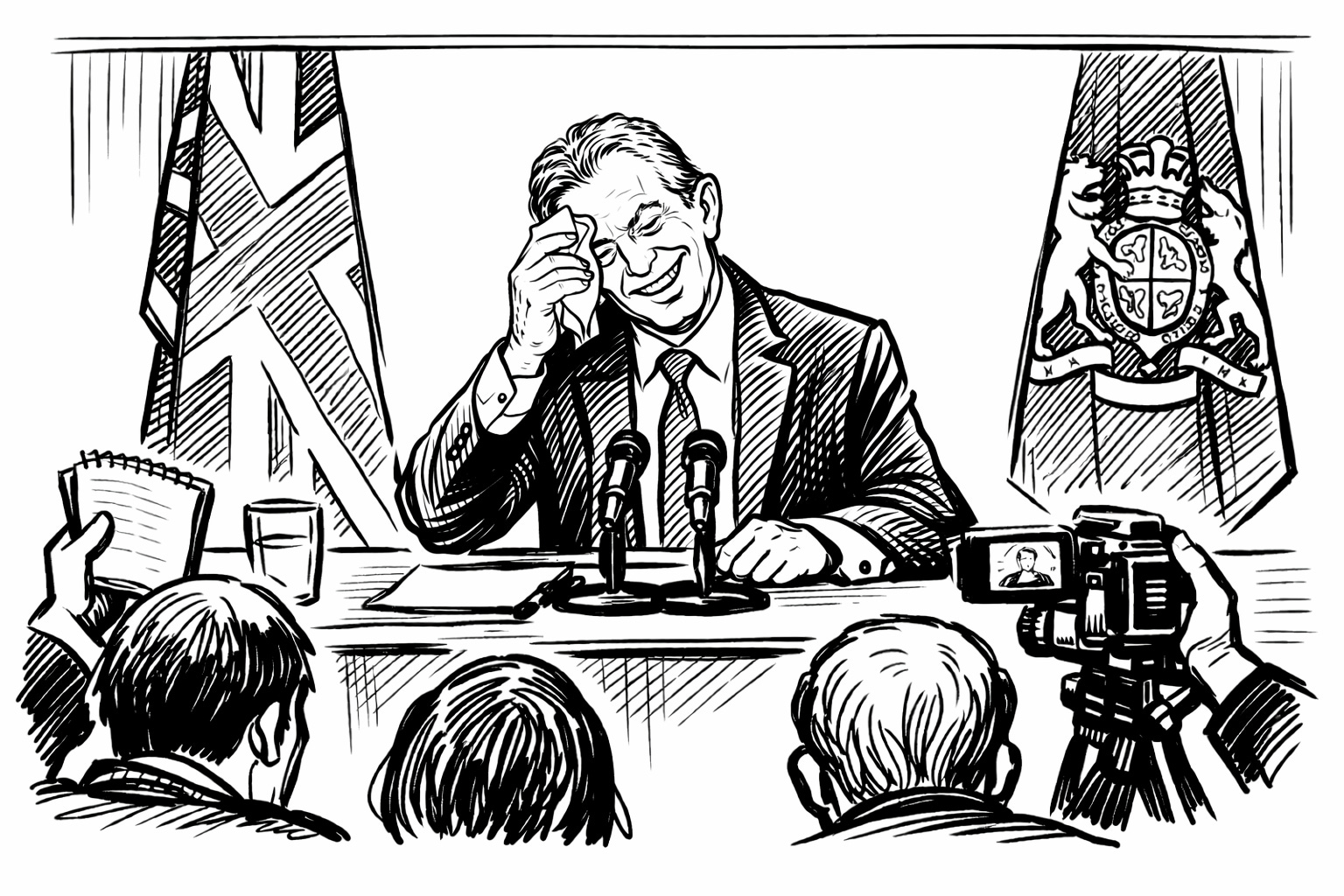
I gave up on liberal interventionism the day the Chilcot Report was published. I was working at a think tank in Westminster, just round the corner from the QEII — a concrete hangar of an events centre, where, that afternoon, Tony Blair was questioned by the press for two hours about the Chilcot Inquiry’s analysis of the UK’s part in the Iraq War. At the think tank, we watched it live on a big TV.
Blair gave a masterful performance: serious, fluent, substantive. It’s hard to think of another contemporary UK politician who could’ve responded in such a manner. The problem, of course, was that the strength of Blair’s performance served to emphasise the report’s conclusion that the case for WMD had been overstated, and that the UK had been pushed into a badly planned and legally unsatisfactory military intervention. He’s such a showman.
But I’ll avoid getting into many details here about Tony Blair. Rather, I want to think about why I changed my mind that day — not only about that particular war, but about liberal interventionism more generally.
After all, many other members of the UK public had been convinced for years that they’d been misled over the invasion and subsequent war in Iraq. Many of them had argued against the war, on both moral and legal grounds, since before it began. And what’s more, most members of the UK public are nowhere near as generally sceptical about state power as I am. Yet I had considered the UK’s part in the war to be justified — beforehand, during, and for years after.
In fact, my support for the war — or for the initial military action, at least — was overdetermined. I supported it mainly because I thought that if we could free the Iraqis from Saddam Hussein’s violent oppression, then we should. But I also supported it because I assumed there must be good evidence that Hussein was close to attaining nuclear capacity. And a nuclear Iraq was something I thought should be prevented, for many reasons.
To generalise a little, my reasoning reflected three key beliefs I held strongly back then: 1) that it can be justifiable to take military action in order to overthrow a violent authoritarian regime; 2) that it can be justifiable to take military action in order to prevent such regimes attaining nuclear weapons; and 3) that the leaders of war-going democratic nations typically have, and act on, crucial information about these matters, which they are unable to share publicly.
On the day of the Chilcot Report, I changed my mind about the relevance of the third belief — about the relevance, that is, of secrets to the justification of military action. I also concluded that while freeing people from authoritarian rule is a good aim, I should accept that military intervention isn’t a feasible method of bringing it about. Since then, I’ve changed my thinking about the second of these matters, but I’ll get to that in a minute. First, I want to talk about the relevance of secrets.
1) Don’t depend on secrecy
I can’t remember a time when I didn’t believe that there must be secret information, known by senior politicians and military leaders, which could strengthen the case for pretty much any instance of military action taken by a democratic nation. I assume this is a relatively standard belief. But on the day of the Chilcot Report, I realised that I should never again rely upon this belief when evaluating whether going to war was justified or not.
Of course, perhaps you’ll tell me that just because the Chilcot Report ‘showed’ that the security services didn’t have the kind of information about WMD that Parliament and the public were led to believe, this doesn’t mean that such information didn’t exist. Perhaps you’ll tell me that this information was so secret that the members of the Chilcot committee deemed it should be kept from the public — or that perhaps it was kept from the committee. Indeed, these are the kinds of things I’m still tempted to say, myself!
But aside from the fact that I found the report generally convincing, I realised that day, while listening to Tony Blair, that the biggest problem wasn’t that he’d led us to believe in secret information that likely never existed. Rather, it was that something as non-substantive as beliefs about secrets had been allowed to play a decisive role in something as morally serious as going to war.
I’ve argued elsewhere that state actors have serious obligations to be transparent about their actions and their reasoning — obligations that correlate with moral rights held by members of the public. Beyond exceptions around relevance, I believe that state actors are justified in withholding such information from the public only when doing so is in line with democratically deliberated and determined public rules. And even then only on a temporary basis.
On my account, therefore, if state actors deem secret information necessary to the case for military action, then that information must be revealed to the public. This isn’t just because I think a necessary condition of legitimate military action is that it is ‘backed by the nation’ through the process of its decision-makers having gained the support of legislators. It’s also because the information that such decision-makers depend upon requires extremely thorough testing. Openly deliberating about these matters brings epistemic advantages, therefore, as well as legitimacy.1
Now, I’m happy to accept that in certain urgent situations — like unfolding terrorist attacks — immediate state action is required, and the temporary withholding of relevant information can be justified on the grounds of the avoidance of harm. But going to war is not a matter for quick decisions! Indeed, instances in which leaders feel the need to take immediate military action — to push the nuclear button before the enemy does, for example — are instances we should be protected against. Justified public rules governing such instances should be set in place during times of peace, to guard against carelessness and against the dangerous idea that legitimacy can be thrown aside in times of seeming urgency.
Haste and secret information have no place, I’ve come to realise, in justifications for going to war. Neither do unevaluated social norms. I mean, just because — as I put it above — “the leaders of war-going democratic nations typically have, and act on, crucial information about these matters, which they are unable to share publicly”, does not automatically mean that this is okay!
2) The goals must be explicit
A further conclusion I’ve reached is that for military action to be justified, its goals must be made explicit in advance. This relates to my claim above that state actors have rights-correlative obligations to be transparent not only about their actions, but also their reasoning. Leaders should be open about their reasons for going to war; the strength of these reasons, alone, cannot suffice.
This points to another failing in my previous position. As I said above, my main reason for supporting the Iraq War was that I thought that if we could free the Iraqis from Saddam Hussein’s violent oppression, then we should. I believed that the people of Iraq had the right to non-authoritarian rule. And I believed they had the right not to suffer violent oppression and torture. I still believe these things; I’m fully convinced they are true things. But I’ve come to accept that the truth of these things does not mean that the people of the UK necessarily held the obligation — or even were morally permitted — to intervene. Justification was still required. It was required for any nation to intervene, and it was required for the UK, in particular, to intervene.
So yes, rights entail correlative obligations, but we must always ask: what are these obligations, and who holds them?
Beyond that, I’ve come to accept that even if the Iraq War had been short, and even if there had been minimal casualties, and even if Iraq were now a flourishing democracy, then this wouldn’t retrospectively justify the failure of UK decision-makers to be open about their reasons for taking military action. If freeing the Iraqi people was the goal — or one goal among several — of taking this action, then that should’ve been made explicit. And as with my point about secret information, openness about this would have brought epistemic benefits as well as a possible route to legitimacy. Whereas, if freeing the Iraqi people was not a goal of taking military action, then neither the goodness of that goal, nor achievement towards it, can be depended upon as a post-hoc justification.
Of course, it is difficult — even with the 2.6 million words of the Chilcot Report — to know enough about the reasons for the UK’s involvement in the war, because what we do know is that the government was not sufficiently transparent. But for my purposes, what matters here is that freeing the Iraqi people was not a publicly stated goal of the UK’s involvement in the war. And it wasn’t treated as such within the formal public deliberation process. Indeed, Blair stated in Parliament that regime change was “not the purpose of our action; our purpose is to disarm Iraq of weapons of mass destruction”. What matters also, however, is whether goals like freeing the Iraqi people can serve as justifiable goals of taking military action. These things matter regardless of whether Hussein had or was likely to obtain WMD, and regardless of what UK decision-makers knew about that.
This brings us full-on to the question of liberal interventionism. That is, these conclusions about explicit reasoning and goals are crucial to evaluating liberal interventionism, because liberal interventionism pertains to particular reasons for going to war. I won’t provide a run-down of alternative conceptions, but when I say ‘liberal interventionism’, I’m referring to military action taken by a democratic nation with the goal of freeing the people of a foreign nation from authoritarian rule.
The arguments I’ve presented so far don’t dismiss liberal interventionism, therefore. Rather, they simply set some limits on it, and on all instances of military action. So I’m now going to discuss the realisation that turned me against liberal interventionism, per se, on the day of the Chilcot Report. This realisation takes the form of an argument about feasibility. Then, I’ll end this piece by telling you about the better argument that convinces me today.
3) Is it feasible?
I’ve never been much into Kant, but on the day of the Chilcot Report, I thought a lot about the Kantian idea that ‘ought implies can’. This is the idea that you can’t have moral obligations that you can’t fulfil. And I came round, that day, to concluding that Iraq was one time too many: that its failings exemplified the way in which military intervention isn’t a feasible route to bringing about liberalisation. Or, at least, not in anywhere near a sufficiently reliable manner.
Indeed, I beat myself up about why it had taken me so long to accept this. Why had it taken the exposure of UK mendacity for me to accept the truths of UK overreach?
The post-WW2-war period has not been kind to liberal interventionism. Think, in particular, of Iraq and Afghanistan. But also go back to Greece and Vietnam and Laos, and all those Latin American countries in between. As above, don’t think about instances where freeing the people from an authoritarian regime was not a central goal — stated or secret — of military action, or instances where different improvements to an intervened-upon nation have taken place.2 Liberal interventionism requires some assurance that military action has the possibility, and ideally the likelihood, of bringing about positive regime change. Yet recent history stands in the way. It seems that even when a liberal regime is put in place during such situations — often at extremely high human cost — it’s hard to make it durable.
Many people who still believe in the goal of liberal interventionism have come to accept this feasibility constraint on its enaction, therefore. And I assume that, for most of these people, the strongest explanation for this feasibility constraint is that lasting liberalisation must be bottom-up: that the people of the nation must lead the charge; that skin in the game, and belief in its rules, is necessary to its long-term success.
Two features of this kind of reasoning have come to concern me, however. My first concern relates to the dismissal of liberal interventionism through reference to a historical pattern. I have various problems with the idea of making historical occurrences into normative grounds, which I won’t go into here. But one problem I have with the ‘historical pattern’ argument, in particular, relates to its specific focus on a collected set of outcomes: on its dependence on things that have happened in the past, on the relations of these things to each other, and on what these relations can tell us about the future.
Now, if you’ve read my writing previously, you might assume that I’m about to start criticising consequentialism. Sometimes, people who know how strongly I oppose consequentialism make fun of me when I point out the moral relevance of a consequence, or of a set of consequences. I usually respond to them by saying that of course consequences are important — they’re just not the only thing that’s important! That is, that when you’re evaluating the moral value or disvalue of an action, or a state of affairs, or a rule, or a law, or a principle — or anything that can be assessed for goodness or rectitude — then one of many relevant considerations is the consequence.
And surely the track record of liberal interventionism involves much more than consequences. I mean, it’s easy to think of instances of bad behaviour within recent such interventions — bad behaviour ranging from the lack of transparency to war crimes — as well as instances of bad decision-making, and so on. Nonetheless, the problem remains that if we’re pushing all of these wars together, as linked elements within a pattern, in order to make assessments about what should be done in the future, then we’re at risk of falling into similar traps to the consequentialists.
A second concern relates to my general uneasiness about depending on predictions within justificatory arguments. Most of this uneasiness pertains to my appreciation for epistemic humility. And in particular, to the fact that some things are much less predictable than others. Certain reliable predictions — like ‘this guy is about to stab me with a massive knife, so if I don’t do something to protect myself, then I’ll probably die’ — seem strongly relevant, for instance, to determining whether someone acted in self defence. And general rules about everyday practices such as financial planning — like ‘it makes sense to have enough liquid wealth to rely upon in moments of illness or other trouble’ — seem reliable general rules of thumb, particularly during what seem like stable times.
But it’s very hard to see how something like regime change could fit into these kinds of buckets, almost by definition. I mean, upheaval clearly breaks reliable patterns and increases the chance of unpredictable unintended consequences. No war is the same as any previous war. How could it be, when wars involve almost uncountable numbers of actions and moments and events? And when wars are generally treated as exceptions, not least within moral theory.
So I find myself increasingly tending towards the conclusion that we cannot put much weight on the track record of liberal interventionism, either to support it or to oppose it. Of course, this isn’t to deny that we can pick out particular things that were good or bad or right or wrong in any particular instance of war — and seek to guard against the recurrence of the bad and wrong ones. And it isn’t to deny that we can come to some general conclusions like ‘attempting regime change in faraway countries comes with particularly serious epistemic and practical difficulties’.
Indeed, one thing that the military interventions of the past eighty years have taught me is that physical distance retains importance. We live in a much more interconnected world than the first of those interventions; countries like Iraq and Iran seem so much closer to us today, in so many ways. But war remains a physical matter — a matter of bombs and shrapnel. Perhaps one day, maybe soon, war will take the form of computer programs fighting computer programs to gain assets. But even then, the outcomes that hit the hardest, in moral terms at least, will relate to our human physicality: reduced access to basic goods like food and shelter; reduced access to urgent care. War is a physical matter, a local matter, so it’s hard to see how distance doesn’t matter.
Nonetheless, dismissing liberal interventionism on the grounds of feasibility — through a dependence on its recent track record, or through reference to particular constraints like distance — seems open to defeat by a single future example in which liberal interventionism works. Or a convincing example from the past. Except, of course, that ‘working’ cannot suffice, at least on my account. What I mean by this is that the method by which we reach the state of ‘working’ must itself also be permissible; the ends cannot justify the means! This is where we come to my current position.
4) Only in defence
One of the biggest changes of opinion I’ve undergone since the day of the Chilcot Report is that I’ve come to believe that physical violence can only be justified for defensive purposes. This conclusion has forced me to rethink my views on various matters that are central to moral and political philosophy, including punishment. I recently wrote here, for instance, about how “my guess and hope is that our descendants will look back in horror, and struggle to believe that we really imprisoned all these non-violent people”. The distinction between locking people up for defensive reasons, and locking people up for punitive reasons, is a distinction that has come to mean a lot to me.
My opposition to non-defensive physical violence has also recently helped me come to the conclusion that it is wrong to treat wartime as a time of moral exception. This piece has been mostly about ‘going to war’, however, rather than ‘times of war’, so I’ll leave my argument against that part of Just War Theory, for another day. But my new position means that when assessing any ‘successful’ outcomes of liberal interventionism, I have additional reason to take into account every violent act that took place along the way.
In other words, I can’t dismiss the harms of war on the grounds that they furthered any ends, and I also can’t dismiss them on the grounds that different moral standards obtain during such times. The suffering of every person who is harmed as a result of military action must be taken seriously, therefore, regardless of any harm they were suffering beforehand, and regardless of whether they’re a civilian or not. And that’s before we turn to the wrongs of war that aren’t covered by discussion of its harms.
Now, perhaps you want to tell me that my approach to determining permissibility during wartime is extremely burdensome — well, good. Bombs and shrapnel are serious matters. Bombs and shrapnel should stand in serious conflict with liberal commitments.
My opposition to liberal interventionism now hinges, therefore, on my belief in the crucial distinction between the following two premises: 1) that it can be justifiable to take military action in order to defend the inhabitants of a foreign nation against the regime that violently oppresses them; and 2) that it can be justifiable to take military action in order to overthrow an oppressive foreign regime and replace it with a liberal alternative. I’ve come to the conclusion that I can — and should — retain my conditional support for the former, while opposing the latter.
Of course, complicated questions remain about what counts here as defence and offence. About whether, for instance, terrorist attacks against Country A that are sanctioned by the government of Country B count as the kind of activity that justifies ‘defensive’ military action. This brings us back to the complicated nature of moral evaluation. It helps me to accept that first-mover war advantages cannot be held by liberals; that the lives of people in foreign nations should never be traded away for future tactical military advantage, no matter the cost to your own forces. And it helps me to accept that the distinction between offence and defence is a starting point, rather than an end.
It’s not easy being a liberal. But it is good.
A further way in which I’ve changed my mind about these matters relates to the relevance of international law. I retain concerns about the power of international law to afford legitimacy — generally, and in its current instantiation. These are concerns that many classical liberals share. But I’ve come to the conclusion that there is important epistemic and practical value in the international deliberation that’s enabled by the institutions of IL, nonetheless. This conclusion, therefore, tracks the distinction I made above between the legitimacy afforded by national democratic deliberation and its epistemic benefits. Moreover, the publicity that comes with formal international deliberation also offers an important opportunity for your opponent to back down. If war should be a last resort, then informing your enemy about your intentions and red lines is essential.
GDP growth, for instance, as a friend tried to persuade me the other day. There are many non-liberal nations with growing GDP, and there are many horrible things that could increase the GDP of a nation!
I appreciate this article. There are a number of concepts you bring out which helped me clarify my own thinking. I'll highlight this one of many "if state actors deem secret information necessary to the case for military action, then that information must be revealed to the public."
Now apply your new beliefs to the 1930's as WW2 approached. Would the caveats you propose have justified action before Poland? I doubt it but earler action could have saved tens of millions of lives.