


When I was young, in England, it was common to denigrate the Americans. They were stupid, crass, and pronounced English incorrectly. Far from every Virginia goose being a swan, every American was a redneck, a vulgarian, or just one of those rich people who know the price of everything and the value of nothing. Brits liked to say that the Americans might have won the war, but they joined it bloody late. George W. Bush became the international symbol for American dim-wittedness. The scene in Four Weddings and a Funeral in which a British character tells a credulous American woman that he can indeed put her in touch with Oscar Wilde was representative of what passed for humour on this subject. “Do you actually know Oscar Wilde?” “Not personally, no. But I do know someone who could get you his fax number. Shall we dance?”
Still, Brits were only too happy to watch American television, read American news, and eat McDonald’s. British novelists were aping their American counterparts: the Martin Amis gang were obsessed with Nabokov, Updike and Bellow. Everyone liked Friends, Bill Clinton, and Jonathan Franzen. American sitcoms ranging from Bewitched and I Love Lucy to Seinfeld, Frasier, and Harry and the Hendersons were all on British television; movies were often American movies; there was a generational obsession with the HBO-type box-set shows. Everyone who works in Westminster has watched The West Wing. In recent years life imitated art and entire political agendas have been imported from the USA to the UK.
In these movies and television shows America was brought to life. From the White House to the Washington woods, from Murder, She Wrote in Maine to Columbo in California, from Tom Cruise movies to Dawson’s Creek, America became less of a monolithic nation and was revealed as a continental culture. Faced with American culture, from the grandness of All the President’s Men to the genre excitement of E.T., no-one cared about the fact that tens of millions of Americans without passports had supposedly never left their own country. We loved to participate voyeuristically in that insularity. Movies like Beethoven, Honey, I Shrunk the Kids, Flubber, the whole catalogue of Disney and Pixar, were selling a look at ordinary, insular American culture. And that American insularity has achieved greatness. From Little House on the Prairie to the new Artemis programme, there is something profound in the American imagination. That is what the Brits who mocked the yanks didn’t quite see.
Ever since I came to America nine months ago, people in England ask what it is like, being there at such a difficult time. They mean Trump, of course, and all the partisanship that has been such a gross and prominent part of American culture. Meanwhile, Reform UK is polling strongly in the UK, despite being run by incompetent people, the Greens are winning votes by appealing to sectarian politics, a fiscal crisis is increasingly inevitable and no-one wishes to address the root causes, and the Prime Minister—the sixth in ten years—is deeply unpopular. What is it like living there at such a difficult time? And yet, just this week, the historian David Edgerton lamented that Keir Starmer wishes to maintain the “special relationship” with the USA.
Indeed, in many ways, England has been left behind. When you leave London and the South East, you quickly find a standard of living that is low by international standards. A recent poll of three thousand people found that more than half of Brits thought the UK would rank as the seventh-richest state if it joined the USA.1 In reality, we would rank fifty-first, with a lower GDP per capita than any of the fifty states. London is competitive with New York, but the North East is not competitive with the American South.
But Britain is in denial: a few years ago, even the FT claimed the US was a poor country with some rich people, but as Noah Smith pointed out, “the median American earns more income than the median resident of almost any other country on the planet.” He went on to explain that Americans considered to be poor would be doing relatively well by British standards.
…someone at around the 18th percentile of income in America in 2019 — a working-class person on the edge of being considered poor — lived in a household making $21,400 a year. That’s about the same as the median income of households in Japan, and about 84% of the median income of households in the UK.
In other words, a working-class American on the edge of poverty makes as much as a middle-class person in some rich countries.
US gas prices might be over $4 a gallon at the national average this spring thanks to the war in Iran, but that is still half of what petrol costs in England thanks to high taxes. The British government is going to ban traditional dryers, which people hardly use because British electricity prices are among the highest in Europe, while Americans have relatively low-cost energy and run their dryers all the time. In London, it is normal to live with wet laundry in the house. The British who are sceptical of America like to ask, why do I need a bigger fridge? without having lived with the joy of a fridge that can actually hold enough food for a hungry family.
The standard of living in Britain has hardly improved since the financial crisis. In 1990, the GDP per capita of the USA was $44,379 and in the UK it was $32,993. By 2024 the numbers were $75,489 and $52,621. (Expressed in international dollars at 2021 prices.) The UK, in other words, is about as rich as the USA was in 1998. And the gap is widening. US GDP is 15% higher than the pre-pandemic level. UK GDP is 6% higher. The IMF predicts GDP growth of over 2% for the USA and of less than 1% for the UK. At the same time, the UK public debt is equivalent to 93.8% of GDP, and the deficit is 4% of GDP. Productivity growth stalled during the financial crisis and never recovered, averaging about 0.6% a year now, compared to 2% in the USA.
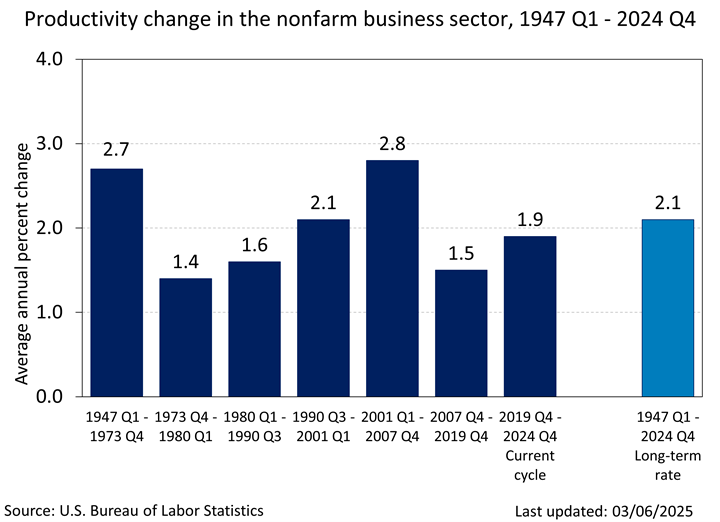
The reasons for Britain’s stagnation are structural. It is not all the fault of Brexit. The numbers all freeze up after the financial crisis. Britain is stagnant because it imposes strict restrictions on housing supply, energy generation, and infrastructure. It takes years and years to add new supply to the national grid or get planning permission for a small tunnel. At the same time, a full 10% of the government budget is spent on debt interest.
And recently the political uncertainty about Keir Starmer sent gilt yields to a 28-year high. Andy Burnham, the main challenger, is left of Keir Starmer. Rather than the deregulation and liberalisation that Britain needs in order to solve its economic stagnation, there will be more proposals for wealth taxes. Billionaires are already leaving Britain, taking their tax revenues with them. And there is discussion about nationalisation. (It is possible that there are no good political routes forward.) The day gets closer and closer when Britain will have run out of time to make the necessary reforms before a fiscal crisis becomes unavoidable. Sooner or later, Brits are going to realise what it means to be less rich than all fifty states.
A certain sort of British Conservative still likes to quote Harold Macmillan, who said that as the British Empire died and the USA took over, we would have to play Greece to their Rome. If Britain was the Greece to America’s Rome, it was a Britain of former times. In a generation, we have gone from feeling smug about the Americans to being so insular we have no idea how poorly we compare to them. We thought their leaders were a laughing stock but we cannot hold on to a Prime Minister. It is easy to see the problem with Trump. But Britain is sleepwalking into unsustainable fiscal commitments on pensions and benefits with no plan. We love to praise the NHS and condemn the US system (which spends at least as much government money as a % of GDP on healthcare) but cannot face up to the reality of worsening outcomes, irresolvable waiting lists, and rising costs. In response to the news that in some London boroughs two fifths of housing is socially rented—and of those people, nearly half are economically inactive—many British elites have denied any problem with this use of the capital’s housing stock. This is happening while London suffers a large and chronic housing shortage. We think we are a free country, but there are thousands of recorded speech offences in the UK which would be unconstitutional in the USA.
When I saw those American movies and sitcoms, I saw something aspirational. I worked with Americans and enjoyed their work ethic, positivity, and, frankly, their well-educated minds. The UK is a wonderful country, full of potential. But the joke is on us now. There is a creeping sense that Britain has lost its wish to be a great country. We have something to learn from those vulgar Americans and their earnestness, their sense of ambition, their intolerance of sub-standard conditions. Let’s hope we learn the lesson ourselves before the bond market forces us to.
The survey respondends “place[d[ the UK 7th among US states, on average, in terms of GDP per capita”
After all the statistics (I’m a former economist) the best summary is Keynes’ “animal spirits.” For better, and sometimes for worse, and depending what animal we may be thinking of, these days America has more animal spirits.
I admire the chutzpah of this piece. The statistics are striking, and the nod to smugness doesn't simply retread NoahPinion's post from a few months back. As a Brit who spent three months in New York this year, I'll grant the London-NYC comparison. Where we part ways is on the solution.
Deregulation caused many of our problems; more of it will not help. Housing — the policy area I know best — is a case in point. Deregulation would not have helped with the cladding scandal, nor with the chronic underinvestment that produced Awaab's Law. On utilities, read Dieter Helm's report on the water industry: deregulation and privatisation caused a near-moratorium on investment, systematic dividend extraction, and mounting debt.
What Britain needs is more care, stricter enforcement of the regulations we already have, and serious investment in the fundamentals — not deregulation and financialisation. And we need an honest conversation with the electorate about what prosperity might actually entail.