

I’m quite liberal about liberalism.
By this, I mean that I think there are many variants of liberalism. I don’t mean that I think anything can count as liberalism, or that all variants of liberalism are equally valuable! Indeed, today I’m going to try to persuade you that variants of liberalism that include a focus on rights are preferable to variants that don’t — as a matter of practical application, as well as theoretical coherence.
The value of rights-focused liberalism will be a key theme here at the Pursuit of Liberalism. So before I try to persuade you over to our side, I’ll set the scene a little by talking more generally about these terms ‘liberalism’ and ‘rights’.
I also want to note that while Henry and I have overlapping views about these things, we also have some points of difference. So you can expect him to argue against some of what I’ll say in this piece — no doubt soon!
What is liberalism?
First, let’s think about liberalism. I recently set out my pluralist moral-realist account of this term, in detail, over on the ends don’t justify the means.
But briefly, I see liberalism as a family of theoretical frameworks for addressing important moral questions of a politico-philosophical nature. Other such families of frameworks include socialism — another term we’re planning on discussing a lot on this Substack!
For now, however, here are a few relatively uncontroversial things I believe about the family of liberal frameworks:
1) Liberal frameworks are tied together by a commitment to freedom as a foundational value. They have various freedom-related features, including a conception of equally-held individual freedom and societal freedom.
2) Liberal frameworks are pluralist. I mean pluralist here both in the sense that: a) liberals stand firm against the kind of political interference that prevents the individual from determining and pursuing their own conception of the good life; and also in the separate sense that: b) liberals eschew the idea that freedom is the only thing of foundational value.
3) Alongside freedom, liberal frameworks also minimally include a foundational commitment to equality. But what kind of equality, you might ask! Well, at least the kind of equality that underpins the principle that all human beings are the bearers of equally-held freedom. This kind of equality is what’s sometimes referred to as ‘basic equality of status’, and I take it as central to all liberal theories, regardless of their differences about other matters of equality.
So, I’ve set a few constraints on what counts as liberalism. But I’ve also left lots of space for differences between its variants. My personal preference, as I discussed in the liberalism piece mentioned above, is for a Lockean type of classical liberalism. But I don’t deny the existence of other quite different kinds of liberalism.
Liberals, in other words, can and do believe a wide range of things. Indeed, you’ve probably noticed that liberals spend a lot of time arguing with other liberals!
Again, however, none of this means that anything goes. Being a liberal doesn’t mean holding whatever commitments you like. Being a liberal — regardless of variant — entails holding some particular commitments, and eschewing some others. It means believing in red lines.
This brings us to rights.
What are rights?
Henry and I didn’t mention rights in our joint first piece here, even though we both think rights are of great moral importance. One reason we didn’t mention them is that there are well-known strands of liberalism that don’t focus on rights.
In fact, some liberals are pretty down on rights. The famous consequentialist liberal Jeremy Bentham even called them “nonsense upon sticks”!
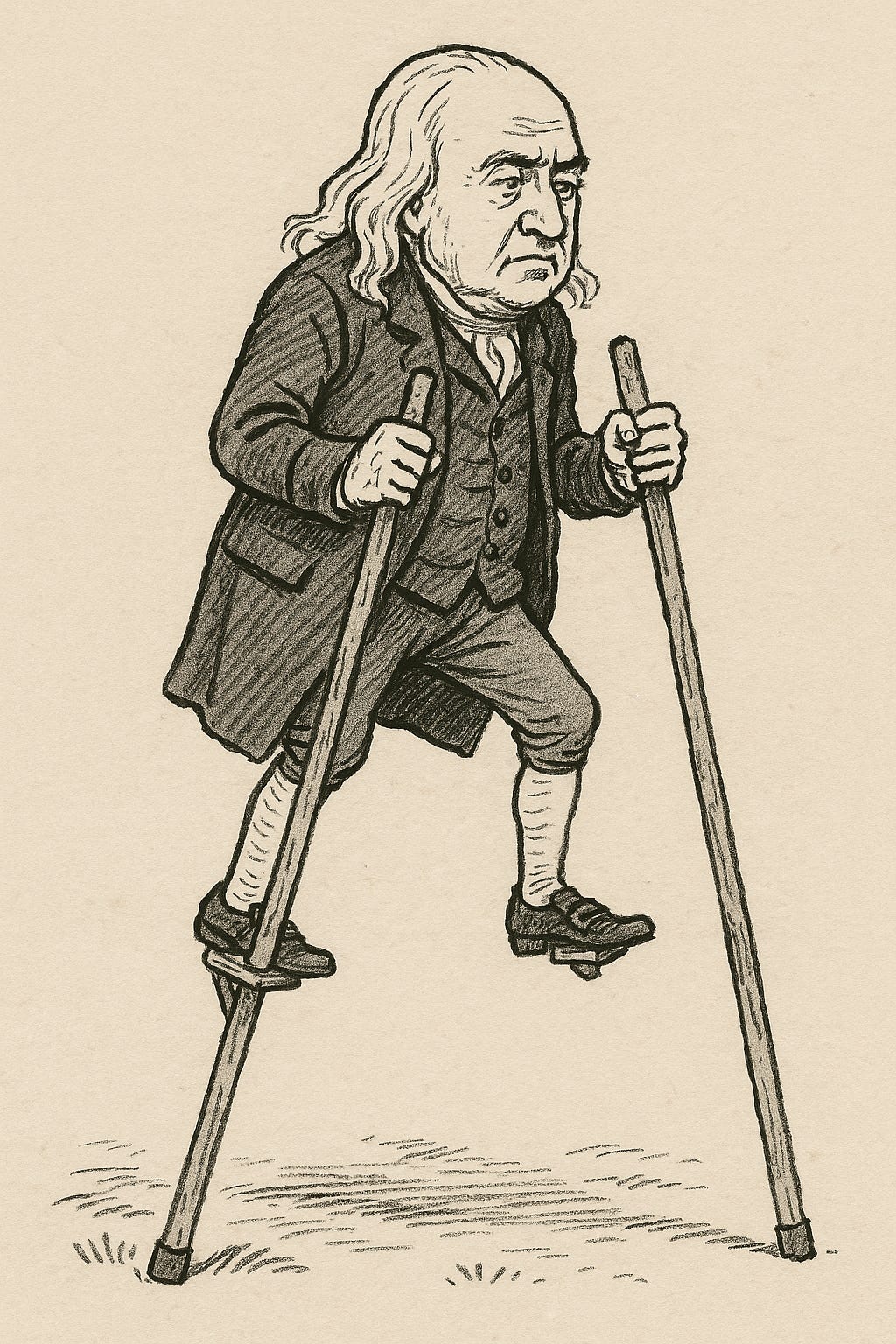
The tension between rights-focused forms of liberalism and consequentialist forms of liberalism persists.
Just think about the difference between a modern-day Lockean-type American liberal who’s focused on the red lines of constitutional rights, and an Effective Altruist-type American liberal who’s focused on maximisation and trade-offs. Think about how each of these liberals might approach some particular political question, and the different answers they might reach. Or how they might reach the same answers, but for very different reasons!
So I’m not denying — at least for now — that consequentialist liberals are liberals. Neither am I claiming that all forms of liberalism must centre on rights, or even that they must all recognise rights as a distinct domain of morality.
Rather, I simply want to persuade you that failing to acknowledge the moral significance of rights will leave you ill-placed to defend the values and principles of liberalism. And that the broad kind of humanistic liberalism we’re calling for here at the Pursuit of Liberalism is greatly strengthened through a focus on rights.
What do I mean by ‘rights’, however?
The distinction between legal rights and moral rights
First, it’s important to note that Bentham wasn’t talking about legal rights. Few liberals rail against the kind of rights that are conferred by man-made law. That is, few liberals rail against legal rights as a concept! Though, of course, many liberals do have serious problems with particular legal rights, and other particular things that have been posited by the man-made law that they, or others, live under.
But Bentham wasn’t talking about rights conferred by man-made law. He was talking about moral rights — as in the kind of rights that simply reflect truths about morality, rather than depending on any kind of human conferral.1 And in particular, Bentham was talking about the kind of moral rights that are typically referred to as ‘natural rights’.
There’s a long tradition of natural-rights thinking within liberalism. I’ll write about this tradition — and interesting questions arising from it, such as ‘what’s the relation between natural rights and natural law?’ — in more detail in the future.
But at least on a Lockean-type account, natural rights are moral rights that are held by people in the pre-political ‘state of nature’, as well as in all other places and times. So natural rights are moral rights, but cannot be legal rights because legal rights don’t exist prior to political society.2
It’s also worth noting that, because on such an account, some moral rights — such as the right to political participation — arise only within the context of political society, then natural rights must be part of a wider set of moral rights. So all natural rights are moral rights, but not all moral rights are natural rights.
One final thing to note about natural rights, and moral rights more broadly, is that even on a Lockean-type account, you don’t have to see such rights as finding their force in God’s command. That is, even though Locke’s arguments often depend on theological premises, you can construct a coherent non-theological Lockean-type case for natural rights grounded in the human good or human reason.
The bottom line of all of this, however, is that if you believe that people can hold rights outside of the force of positive law — if you believe that cavemen and cavewomen held any rights at all, for instance — then you believe in moral rights of some kind.
From now on in this piece, when I say ‘rights’, I’ll mean moral rights.
Rights as one element of morality
Next, I want to turn to the idea that rights are one particular constituent part of morality. If you accept this idea, then committing to the moral importance of rights doesn’t mean reducing all questions of morality down to rights. But it does mean you have to conceive of rights as distinct from other morally-important things — things like interests and preferences.
One reason for recognising the distinctness of these morally-important things relates to the way in which people ordinarily talk about them. That is, when people talk ordinarily about their interests (in the sense of things that are good for them) and their preferences and their rights, they mean distinct things by these terms.
Most people, for instance, would have no problem giving you an example of something that they have a preference for, but no right to (daily ice cream). Or something that would be good for them, but they have no right to (a satisfying sex life). Or something that they don’t have a preference for, but they do have the right to (carrying out acts of violent self-defence). Or that they do have the right to, but wouldn’t be good for them (behaving in an unnecessarily objectionable manner).
In other words, if we blur rights into other morally-important things, then we risk talking past each other. There’s a bigger risk we face here, however, which relates to the particular moral significance of rights.
The moral significance of rights
There’s a big debate within philosophy about the kind of thing rights are, and one answer that’s often given is that rights are special kinds of interests. But if your right is just a special kind of interest, then this implies that someone else’s competing interest might be able to override your right! I mean, what if they have a load of competing interests?
Similar problems arise if rights are reduced to preferences. What if the other person has a load of competing preferences?
These approaches are risky because they sacrifice the special kind of wrongness we refer to when we talk about ‘rights violations’. When someone violates your rights, it’s not just that they’ve prevented you from getting what you wanted, or that they’ve done something against your interests, is it?
Rather, when trying to explain what it is in particular that rights-violators have done, philosophers often say things like, “They’ve offended against justice!”. Indeed, some philosophers, including Locke, pretty much see the domain of justice as the domain of rights. And what they mean by this — which I think is also implied in ordinary talk of rights violation — hinges on the special kind of obligation that rights generate.
Rights generate particularly serious obligations. Rights-correlative obligations are not the kind of it-would-be-good-if-you-did ‘imperfect obligations’ that arise when you see someone struggling in the river and wonder whether you should risk your own life by jumping in. Rather, rights-correlative obligations are the kind of obligations that do things like forbidding us from torturing each other. Rights-correlative obligations are ‘perfect obligations’.
So yes, perhaps you would fail morally by not jumping into the river. But you wouldn’t be violating the struggling person’s rights, would you? You wouldn’t be offending against justice. Whereas, if you tortured someone…
This is the kind of line that rights help us to draw.
Of course, the demands of justice are often ignored or misinterpreted. But moral rights exist regardless of human acknowledgement! And of course, most moral rights are not absolute, in the way in which the right not to be tortured is absolute. It’s never ever okay to torture anyone! Whereas, most rights are held conditionally, in that they obtain only as long as certain conditions are met.
But when rights do obtain, they are the strongest defence we have.
If we conceive of rights as just another thing that can be defeated by stronger claims, therefore, then our access to their special force disappears, and we lose them as a backstop against unjust power. This is something particularly significant to lose, because rights have great breadth as well as great strength.
That is, rights enable you to stand up against people who are physically stronger, or wealthier, or more politically popular than you. They enable you — no matter who you are — to call upon justice, to uphold red lines in your favour.
Some further questions about rights
There are many other important discussions to be had about rights in the context of fighting for liberalism.
We should talk, for instance, about the crazy yet relatively standard idea that people didn’t have rights — and didn’t conceive of anything like rights — until early modern times! We should also talk about further distinctions often drawn between different kinds of rights.
You can often see competing yet overlapping distinctions at work when people talk about ‘economic rights’, for instance. Some people talk about rights like ‘economic rights’ and ‘political rights’ purely in terms of the content of these rights. On this kind of approach, economic rights are rights like property rights, and political rights are rights like the right to vote.
Whereas other people use the term ‘economic rights’ to refer to a subset of ‘new’ economic and social and cultural rights, to get at the idea that, over the twentieth century, rights recognition widened a great deal beyond a focus on civil and political rights. You can see this in the way in which the UDHR includes rights like the right to social security, and the right to participate in the cultural life of the community.
Noting these kinds of nuanced distinctions can help you to see when people are talking across each other, rather than fully disagreeing. It can also help when you get on to the all-important work of considering what actually counts as a right! When you get on to questions like ‘is there a right to social security?’, for instance.
The main point I want to make today, however, is that rights are particular. Rights are particular both in the sense that each right has its own particular content — its own particular correlative perfect obligation/s — and in the sense that rights are different from other morally-important things.
The value of rights-focused liberalism
In the context I’ve just set out, the value of rights to liberalism looms large.
This is not least because it’s hard to see how you can take the principle of equally-held freedom sufficiently seriously without space for rights. And it’s hard to imagine a society where this principle is protected and promoted if there is no space in that society for rights. Without rights recognition, the most powerful person always has priority access to the upper hand.
Rights-focused variants of liberalism are preferable to other variants of liberalism, therefore, because rights are the strongest defence against injustice in the liberal toolbox.
Consequentialist variants of liberalism, for instance, with their alternative focus on aggregate outcomes, lack the bite of rights. Sure, some consequentialists claim to care about rights. But in the end they will always find it permissible, and sometimes even required, to trade them away! Liberal consequentialists, therefore, lack bite at the level of red lines for the equal freedom of each individual.
The broad kind of liberalism that we’re advocating here at the Pursuit of Liberalism is a humanistic liberalism that goes beyond describing economic reality, and also champions the significance of philosophy and the arts. It has heart as well as clarity. But it needs bite, too.
Humanistic liberalism that takes each individual seriously depends on the recognition of rights — the general rights that we all share with each other, as well as the particular rights that subsets of us can hold — as a matter of moral truth.
The American example
I’ll finish by claiming it’s unsurprising that humanistic English liberals like Henry and me gravitate towards America.
This is because America is a land of rights. It is the land of rights-focused liberalism.
You can see this in its founding documents, inspired not least by the thought of Locke. Although, of course, Americans have often failed to follow the principles set out in these documents.
Frederick Douglass exposes the worst of these failures in his 1852 speech What to the Slave Is the Fourth of July?, with his powerful arguments about how slavery offends against America’s political grounding in equal freedom.
Having taken centuries to move beyond this deepest of illiberal failings, America continues today, like most countries, to fail in many ways. Douglass also tells us, however, that while his speech might make us want to turn against the Constitution and its signatories, this would be to find fault in the wrong place.
That is, Douglass didn’t believe that the Constitution supported slavery. Rather, he proclaims it as a “glorious liberty document”, having previously praised the “saving principles” of the Declaration of Independence. The foundations of America are strong, Douglass tells us. But, as he warns, that isn’t enough. We also have to choose to live in line with these foundations.
It’s the same with liberalism. Even rights-focused liberalism cannot give us all the answers, or make us behave well. Liberalism leaves it to us, as equally-free human beings, to make good choices.
Recognising each other’s rights helps us do this in the most important of instances.
Thanks to GPT for the picture of Bentham on stilts.
I’m not denying that legal rights can reflect truths about morality. Rather, I’m claiming that there are rights that reflect truths about morality that are not rights conferred by positive law.
I hope it’s clear that I don’t mean by any of this that natural rights can’t be legislated!
Thanks for writing this! I've always been puzzled by natural rights, so this helps explain why some liberals think they're important. Seems like they're supposed to ground the justification for political institutions and the political rights they confer. But if that's all, they're definitely not the only option, and they introduce several unnecessary theoretical costs.
First, they just seem like the wrong concept to make sense of our pre-theoretical intuition that we have obligations to people who aren't members of our political institutions. Contractualists who ground political rights in facts about the constraints of practical reasoning seem like they've got a much better story here. Liberal political institutions and their political rights are grounded in the obligations we have to one another in virtue of the our shared nature as rational agents.
Second, natural rights just seem kind of metaphysically mysterious? Like how do we come to discover that we bear them? Why do we have some rather than others? What keeps us from arbitrarily multiplying them to suit our contingent whims? And do they end up crowding out or confusing the work that political rights are supposed to do?
Would appreciate any perspective here, genuinely curious how natural/human rights people think about this stuff.
I've very curious to see how you elaborate on this. It's an interesting post, I appreciate seeing you build up the framework but I wasn't always clear how that would be applied.
Reading it I couldn't always tell if my reaction would be, "yes, and . . . " or "yes, but . . ."
Mostly related to the question of how one balances rights with other concerns. I agree that it makes sense to think of rights as a category distinct from preferences or desires, and I think it makes sense to see core applications of rights as non-negotiable and yet, in practice, many cases in which rights are in play are note core to the right and do involve some element of weighing multiple applicable principles. . .