

This is a guest post by Oliver Traldi, a philosopher at the University of Toledo's Institute of American Constitutional Thought and Leadership. Oliver wrote Political Beliefs: A Philosophical Introduction (2024), and has been published in The Wall Street Journal and The Washington Post.
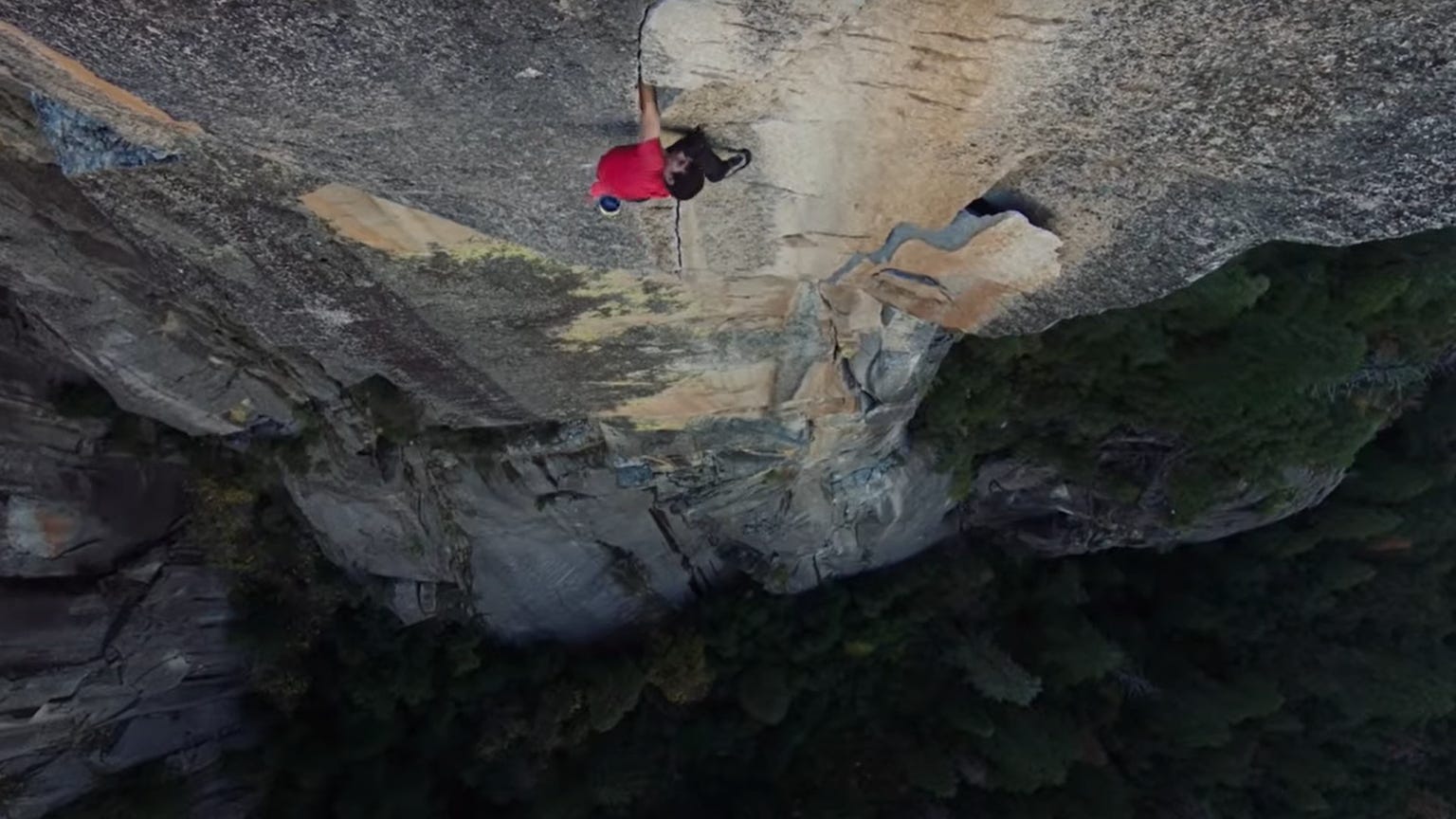
There’s this guy, Alex Honnold, who just climbed a skyscraper in Taipei, the Taipei 101 — so named because it’s 101 stories tall. Honnold’s virtuosic climbs are in the “free solo” style, meaning that he uses no equipment for protection or assistance. He has some sort of special shoes, I think, and in the videos you can see him chalking his hands, which must help somehow. Other than that, it’s just him and the nearly flat surface he’s taken on — a skyscraper, the nearly-bare face of a mountain, whatever. Apparently when the 2018 documentary Free Solo about Honnold was filmed, most of the crew looked away repeatedly during his climbs.
Rebecca and Henry have asked me to write something for this blog about liberal education. What is a liberal education, they ask? Why does the “Great Books” stuff I’ve been doing as a teacher for the past few years, they ask, fit the model? My former Tulsa Honors colleague Dan Walden just came out with an essay about these topics in The Point, too. I largely agree with Dan, but with some differences of emphasis.
I think an appropriate liberal education is one that teaches us to “free solo,” intellectually speaking. The deepest, most difficult questions that arise in our lives stare us down like barren rock walls, unmarked and unscalable, pristine in a precipitous terror of sand. To live thoughtfully, reasonably, and morally is no small task, let alone to do so freely and authentically. Yet this is what our very ability to think and act seems to demand of us – at least to some of us, the way a mountain might demand to a free soloist to be climbed. Through a liberal education, free people grow in their capabilities, their powers, until few things accessible to their reason and will remain foreign to them.
“Liberal education” is so-called not because it emerges from the philosophy of liberalism but because it was, in the ancient world, the sort of education thought to be worthy of, or perhaps required of, a free person. This conception, of course, is somewhat out of step with our more modern, more egalitarian understanding of freedom as something that falls, like rain in the Bible, on the worthy and the unworthy alike. Indeed, education can be a real toughie for liberal philosophers. Why think that some “expert” teacher at the front of the room knows better than the “marketplace of ideas” in the student audience? Why let parents and teachers order children around and discipline them, given the whole freedom-is-like-rain thing?
At the same time, there is obviously something very liberal about emphasizing education. A system that sees the growing power of people’s minds not as a threat to present exclusive rule but as a boon to future mutual rule, which aims to provide tools like reason and rhetoric to a citizenry rather than hoarding them, is exemplary of the liberal-democratic approach to society and governance. Even in contemporary times, the liberal arts are often defended by reference to some goal of being a good or informed citizen — especially in new “civic education” centers and projects like the one I teach at now in Toledo, Ohio.
It’s hard to say just what our civic responsibilities are such that a liberal education would enable us to fulfill them. Because of the specific nature of my research into group epistemology, I tend personally to focus on the ability to maintain one’s independent judgment and in doing so add to an aggregate epistemic enterprise — the so-called marketplace of ideas on a Millian picture, the popular vote on a Condorcet-type picture, and so on. And because I’m a philosopher, I tend to think that the best training of independent judgment develops first-principles reasoning.
It’s great if liberal education has these effects, but I want to contrast this way of thinking with my way of thinking about liberal education. To me, education should be fundamentally concerned with developing student capacities. Of course, these capacities could eventually be put to some sort of public use, but really they are of the most use to the learners themselves. Thus I don’t categorically separate liberal education from training in “skills.” Instead, liberal education develops a wide variety of specifically intellectual (or “mental,” or “cognitive”) capacities, which we can use to take on a wide variety of questions and problems in life. When we come up against life’s big questions, we should have a dizzying array of personal powers at our disposal: art and literature, science and philosophy, history and theology.
I don’t have a great account of just which intellectual skills should be developed in a liberal education. Mathematics and logic, for instance, seem like they fall well inside the ambit. Chess and poker are a bit more questionable, although they might be useful applications or tests of different types of reasoning. Physical fitness seems outside the scope, although I’m not necessarily opposed to the ancient idea of training the mind alongside the body.
What’s crucial and crucially missing in much of modern schooling is the challenge inherent in a genuine liberal education. This challenge shouldn’t be a matter of “viewpoint diversity” or encountering perspectives that might offend one’s sensibilities, but rather a matter of raw difficulty. Our abilities can only be developed through very hard work. This work can occur in many different disciplines, but a liberal education is not an “interdisciplinary” one so much as one in which concepts like subfield and profession take a back seat.
One way in which I think my analogy is truly apt here is that these challenges must be “free” in the sense that free soloing is: free of artificial aids to ascent. In particular, liberal education is not the sort of education that can be assisted by the autocomplete function of a large language model, or through reference to an encyclopedia, or through deference to an expert consensus, or through inspiration from a demagogue. A line of thought in the academic literature on the social epistemology of ethics suggests that moral deference – treating someone else as an expert on right and wrong and doing what they say – is somehow “fishy.” I don’t know if I completely buy this, but deference on big questions does not suffice for a liberal education. That said, familiarity with major theories and historic and religious traditions’ answers to those questions does seem to be a core aspect of liberal learning.
Though our attempts must be “solo,” our learning needn’t. In fact, I think some of the best liberal learning occurs in a certain kind of group, like a good seminar. In my opinion, the best seminars don’t involve anything like group cognition or any sort of consensus-building. That is what happens in a political group, not an intellectual one. Rather, a seminar in the mode of liberal education allows participants to offer their own interpretations of readings, their own understandings of puzzles and problems, and their own answers to questions, training their free solo mindset and skills but while being “spotted,” so to speak, by their co-learners. More than anything, this setting demands of students that they think for themselves.
One specific thing Rebecca and Henry asked me to address is how the Great Books fit into all this. I don’t buy a lot of standard justifications for studying the Great Books. I don’t care that they’re “our” tradition, and I don’t know if it’s important to have a kind of “story of thought” where we figure out where our own ideas came from; actually, I hate those kinds of genealogies. I don’t care about “the ancients and the moderns” or whatever. I don’t buy that they’re things that “every educated person should know” – just try to talk to an average educated person about them. I also don’t share the visceral sense of “greatness” others who do this stuff have. For instance, a friend recently told me that Heidegger is palpably “greater” than, for instance, Rawls or Parfit; I think this is silly. But the Great Books are great didactic tools for a few other reasons.
First, many Great Books model the free solo approach to the life of the mind for students. The Greats include the first philosophers, the first historians, the first poets. They look at the world and look at their minds and think of ways to connect the two together, without having a list of jobs or disciplines to refer to. This opens up questions for us like: What is philosophy, or history, or poetry for, to begin with? Why did someone even start to think of these as activities that were worth doing and that were open to people like us? Non-first Greats have some sort of feeling of firstness about them, of thinking in a fresh or new way. Descartes, for instance, wanted to prove things like the existence of the external world and the existence of God from truly first principles.
The Great Books are models in other ways. Many authors of Great Books found themselves in difficult personal circumstances, which led to unique insights, strategies, or obsessions. The death of Plato’s teacher, the imprisonment of Boethius, the torture of Machiavelli, the civil war facing Hobbes, the assassination of Martin Luther King, Jr.: all of these make it obvious that these writers were not just playing intellectual games with language or logic, as we analytic philosophers are often accused of doing, but figuring out how to live in light of the activity of their intellects.
The Great Books are also challenging. This is part of the advertising of many Great Books programs. Education overall is in a period of horribly declining standards. Teachers tell me their students can’t read more than a paragraph or sit still for more than ten minutes. Everyone uses artificial intelligence to write everything. Great Books programs, by contrast, pile long, difficult, foreign texts in front of their students. This trains them to be powerful thinkers and acquaints them with a wide variety of modes and schools of thought. They do not do so uniquely, and in my opinion should be paired with other difficult academic pursuits, including math, physics, logic, and foreign languages. But they are a rare spot of intentional challenge in the contemporary humanities.
Finally, the diversity of a Great Books syllabus tends to explode student notions that a liberal education will involve giving them final answers to big questions. This can be very unsettling or even disappointing for students trying to navigate the world. But when they see that so many Greats disagree so radically with one another, even when sharing a cultural, political, or religious context, students begin to understand that they will have to make their own assessments and decisions. The inescapability of this challenge is a tough lesson in itself, but one which makes even sweeter the realization that the challenge is, in fact, manageable.
So there you have it: my theory of liberal education. True liberal education provides people with the ability to “free solo” through the sorts of difficult questions and challenges that life presents. It trains us to be free because it demands that we do our own thinking and builds up our abilities to do so through challenge and difficulty and through models of others who have. What we find as we age is that many of the questions and situations raised in Great Books in particular, which seemed so abstract or antiquated or absurd or melodramatic or mythopoetic when we first encountered them, are actually the stuff of life. And life is, though many undergraduates have not reached the point of realizing this, very hard. Liberal education gives us the tools to face it head-on, equipped with the strongest possible form of our native reason and maintaining our integrity, our dignity, and our self-respect. We will almost all fall many times in the attempt.

Excellent post. It gave me a lot to think about. So much so that I wrote about it at the link below. The image may have triggered my acrophobia! Your points forced me to organize my thoughts on the subject, an opportunity for which I am grateful.
https://humanepursuits.substack.com/p/the-skyscraper-and-the-valley-what
Love this, Oliver.