

A new piece by me, on the topic of pluralism, was just published by the Cosmos Institute. The overall argument I make is that various classic criticisms of liberalism depend on a misconception:
that liberals shouldn’t be conceived as supporting “anything goes,” but something more like “many things go,” instead. In other words, that the use of “plural” here does not signal “every” or “any,” but “more than one.” And that it’s not any old “more than one,” either. It’s not just that “many” is smaller than “every” or “any,” that is — it’s that the “many” in question is bounded in a particular, principled way. Indeed, that there are many such “manys” for the liberal to consider!
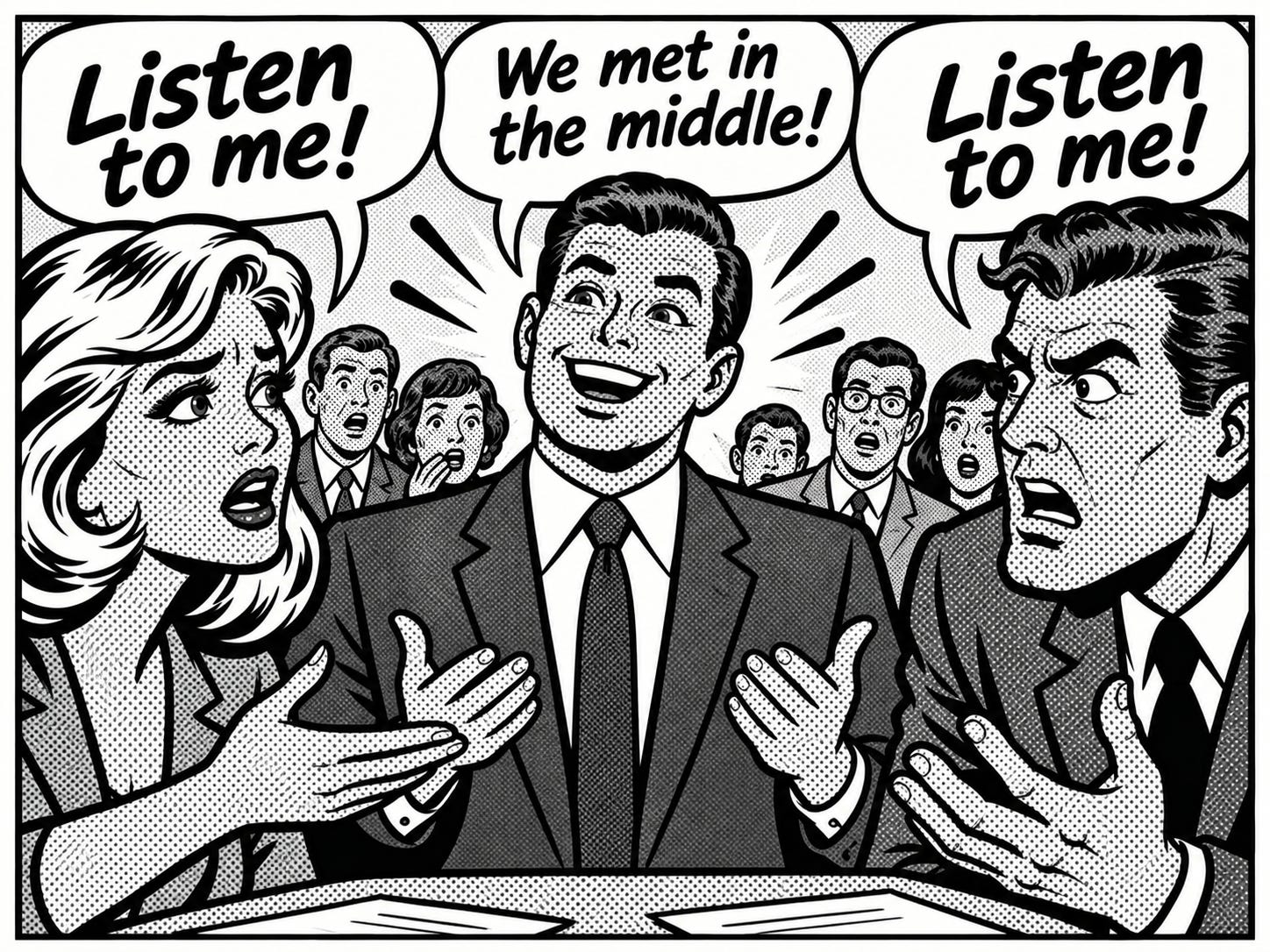
Towards the end, I make an argument against the idea that ‘meeting in the middle’ is the kind of pluralist practice that liberals should embrace. This is an idea that has annoyed me for quite some time, so I was glad to write about it, and wanted to share it with you here:
Regardless, we come back to the classic question of when it is that liberals should give up on tolerance. The more I think about it, however, the more I think this question is badly formulated. I’d prefer to rephrase it in terms of remaining attentive to when it is, and when it isn’t, permissible or obligatory to intervene in the illiberal behavior of one’s fellow societal members. When is it my business? What can I do? Is there anything I must do? What? When? We each have the capacity for good judgment. We each have many opportunities to push back. We can answer these questions for ourselves, and in discussion with each other, when they arise, within the almost infinite but morally bounded set of options we have in front of us. One option, which is often in front of us, is to argue the liberal case. Many liberals, including me, think that democratic institutions offer — or could offer, if better designed — additional options for this, on top of arguing at the individual level.
An alternative option — which is sadly often presented as pluralist, or democratic — is to pursue the middle ground. For some people, “meeting in the middle” represents a commitment to epistemic modesty, or to the value of decision-making by consensus. Just as, for some people, living in the persistent threat of illiberal takeover represents something similar. But, surely, affording each view equal value — and each view-expressor equal respect and input, qua view-expressor — is an instance of “anything goes!”
After all, “meeting in the middle” entails making equal space for illiberal views, when illiberal views are in the mix. If the matter under discussion were the permissibility of slavery, for instance, then “meeting in the middle” would entail making equal space for the view that “slavery is the rightful condition for some people” — if, but only if, someone happened to express it. And then, perhaps, relative to the numbers of people expressing other views. Aside from anything else, this approach rids the competition of reason. It reminds me of the emptiness that H.L.A. Hart is getting at when he concludes that utilitarianism “in effect treat[s] individual persons as of no worth; since not persons for the utilitarian but the experiences of pleasure or satisfaction or happiness which persons have are the sole items of worth or elements of value.”1
There are many liberal arguments against “meeting in the middle.” But the emptiness of an approach on which a view is afforded value simply for having been expressed brings us back to the mistaken idea that “many” means “any,” and “anything goes.” It is harder, of course, to stand your ground and argue your case. But liberalism gives us good reasons to do so.
You can find the whole piece here, on the Cosmos Institute Substack.

Thanks to GPT for the cartoon!
Hart, “Between Utility and Rights,” Colum. L. Rev. 79, no. 5 (Jun. 1979): p. 78.
What’s Mercatus ? I should probably know but I don’t.
Also I am amazed by your face, being a philosopher I mean.🤗