

This is the first in an occasional series of posts by guest authors. Revana Sharfuddin is a labor economist and Research Fellow at the Mercatus Center at George Mason University. She co-authors the Substack Labor Market Matters.
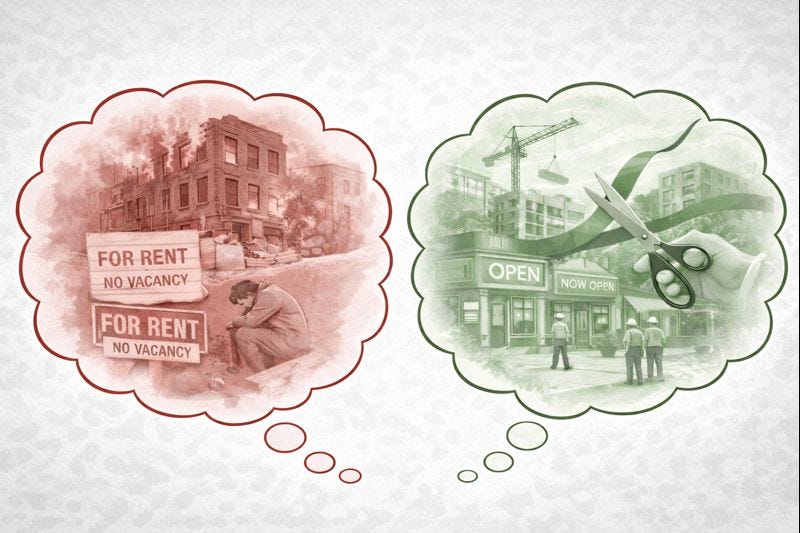
A politician can say “rent freeze” and make every economist across the nation reach for a stress ball. The same politician can also do something that would make housing cheaper and small businesses easier to start. Sadly, as I have recently learned, in my circles only the first fact seems to count.
That mismatch is the puzzle I can’t shake. If you say you care about growth, supply, and competence, why does the policy stop mattering the moment it comes from a political label you oppose?
I’m a fairly standard DC think tank type. I do labor economics research, write papers, attend conferences, and sit through panels where people argue constructively about incentives and trade-offs. I spend my professional life in policy rather than politics, which is a comfortable place to be if you believe evidence can move institutions at the margins.
If I had to label my views, I’d call myself a small l liberal: committed to markets and liberal institutions, skeptical of mass politics, and deeply wary of moral frameworks that treat political disagreement as evidence of moral failure rather than reasonable pluralism. That worldview is not currently trending. Populism is rough terrain for policy wonks and for classical liberals alike. Which is how I’ve ended up here, writing on my philosopher and literary colleagues’ blog, trying to explain not just what I think, but how it feels to watch the ground shift under a set of assumptions I once took for granted.
Here’s one shift I’ve noticed: many Big‑L Liberals—the coalition, the party ecosystem, the people who used to treat “markets” as a suspicious word—have moved toward the middle on a set of practical questions. The “abundance” argument is the cleanest example. Build more housing. Streamline permitting. Let energy projects happen. Fix choke points that keep supply from expanding. A decade ago, some of these ideas were coded as right-of-center. Today, a lot of them are being pushed by people who would never have called themselves free-market advocates.

That should be good news for anyone who has been arguing, for years, that scarcity is often a political choice. It also raises an uncomfortable question for my small-c conservative friends—the people I usually agree with on markets and growth: when parts of the left move toward the center on an abundance agenda, are they meeting that shift with the same openness? Or are they treating politics as a package deal—accept the label or reject the person?
It’s hard to dodge that question in the reaction to Zohran Mamdani, New York City’s newly elected leader. Mamdani ran with a social-democratic identity, and much of the early commentary treated that identity as an existential threat to the city’s economic future. I get the instinct. The first campaign video I remember seeing from him was about a rent freeze. My economist brain did what it always does with price controls: it panicked.
New York is the canonical case study for why rent control backfires. It is taught in undergraduate microeconomics courses precisely because it produced such visible harm, from housing shortages to abandonment and arson in the Bronx. Spatial and temporal myopia are real, and there will never be too many articles or lectures explaining why price controls reliably backfire.

But a second thing also happened when I paid attention. Mixed in with the socialist branding and the genuinely bad ideas were policies that were plainly pro-growth and market-friendly. And my instinct wasn’t to defend the bad ideas. It was to separate them from the good ones—publicly—because reflexive opposition teaches the wrong lesson.
Politics is a repeated interaction. If you want politicians to keep doing the useful things, you have to show that useful things earn support. Constant vetoes don’t build trust. Selective agreement does. It tells people on the other side: “When you move toward better policy, we’ll meet you there.”
I assumed that instinct would be broadly shared among people who also say they want a bigger pro-growth coalition. Instead, I found myself oddly alone—at least publicly—in pointing to the constructive parts of Mamdani’s agenda. In my network, the socialist label ended the conversation before the policy details even got a hearing.
That bundling reflex is exactly the habit we claim to oppose. We complain—often correctly—that progressive politics treats “markets” as a moral stain rather than a tool. But if we respond by treating “socialist” as a conversation-stopper, we’re doing the same thing in reverse. And if this is a moment that calls for coalition-building, it can’t be a coalition where only one side is allowed to cross the bridge.
To be fair, the fear driving this reaction is not imaginary. I recognize it in myself. I grew up in a developing country and studied economics as an undergraduate at George Mason University, then went to graduate school in Germany. In that combination of life experience, the failures of collectivism were not abstract.
So when I hear elite Western students speak fondly about the “warmth of collectivism,” I flinch. Not because they are callous—many are deeply empathetic—but because they have little exposure to how these systems actually functioned when put into practice. The ignorance is both spatial and temporal. Recently, in a café in Bonn, I overheard students say, “Capitalism is the only thing we know. We haven’t really tried anything else.” Germany tried something else within living memory. So did Russia, China, Cuba, and Venezuela. If those examples feel overused, we can talk about Bangladesh in the years leading up to the 1974 famine, or Syria under Ba’athist socialism. The costs of collectivism and central planning recur across contexts, differing in form but not in consequence.
From that perspective, the warnings about rent control and state overreach are not wrong. They’re necessary. Historical amnesia is real, and part of the job is saying, over and over, “We have seen this movie.”
But it’s not the whole job.
Because I also recognize a different reaction in myself: genuine excitement when I see a politician quite literally cutting red tape—scissors in hand—while explaining how they’re reducing regulation to speed up housing construction. And in the weeks after Mamdani’s win his office announced several moves in that vein. They weren’t typical for someone running on socialist vibes. But they also weren’t hidden. He talked about them during the campaign.


What surprised me wasn’t that he followed through. It was how little credit that follow-through earned from people who claim to share the same policy goals.
Below is a simplified list of the kinds of changes his team has highlighted. I’m not doing full urban economics here. I’m making a narrower point about how we respond.
The red items: policies that work like central planning.
A rent freeze is the classic case. Set the price below market and you don’t get a gentler housing market; you get less maintenance, less investment, and a slow-motion decline in the quality and quantity of housing.
Near-free childcare has a similar shape. Set the price at (or near) zero and demand spikes. If supply can’t expand quickly—more slots, more staff, more facilities—scarcity reappears as waitlists, rationing, or quality problems. The bill doesn’t disappear. It moves to taxpayers, and the politics harden because reversing “free” is harder than never promising it.
Fare-free buses follow the same pattern. Eliminating fares creates a large budget hole while increasing demand. Without new revenue, the system absorbs that gap through taxes, service cuts elsewhere, or crowding. Again: the price signal goes away, but scarcity doesn’t.
None of this is obscure. You can critique these ideas loudly and still be right.
The green items: policies that utilize market mechanisms.
Streamlining housing approvals—especially efforts that cut delays, veto points, and discretionary holds—targets the actual driver of high rents: constrained supply. When it’s slow, uncertain, and expensive to build, you get fewer units and higher prices. Speeding the process up is boring, but it’s how you get more housing.
Reducing startup fees and civil penalties is similarly pro-market. Those are fixed costs: barriers that hit new entrants hardest and protect incumbents by making competition expensive. Lower them and you get more experimentation, more small firms, and more pressure on prices.
I’ve run through these quickly because this isn’t an analytical piece about optimal policy design. The point is simpler: why, among small-c conservatives and self-described free-market types, do I see an outpouring of commentary over a stray line praising the “warmth of collectivism,” and so little interest in reforms that would actually make the city richer and more livable?
You should criticize the rhetoric. You should criticize the red policies. I’m asking for symmetry—and for the discipline to react to policy with at least as much intensity as we react to slogans.
Because if we can’t acknowledge good policy when it comes from someone we disagree with, persuasion has already failed. Not persuasion of voters in some abstract sense—persuasion of the politicians themselves. If the only feedback a politician ever gets from the pro-market world is contempt, the rational response is to ignore that world entirely. You’re training them to cater to their base and treat you as unreachable.
Coalition politics requires something harder than opposition: discernment. You don’t have to stop being worried about collectivism to say “yes” to permitting reform.
Big‑L Liberals have been moving toward market-oriented ideas in the name of abundance and growth. If we want that shift to continue—and if we want it to show up in policy rather than just rhetoric—small‑l liberals and small‑c conservatives have to prove the bridge runs both ways. Right now, we need that big tent more than ever.

This was actually a very enjoyable piece. Thanks!
The way I put it when I spoke to a local group of Republican women about 10 years ago, a group that had been enjoying my talk up until then, was, "Judge the policy by the content, not by whether the person proposing it has an R or a D after his name." That seemed obvious to me. But I saw a lot of upset in their faces.