

It’s hard to think of a more obvious assault on your freedom than being locked up. Yet the UK prison population is bordering on 100,000, and almost two million people are currently locked up in American prisons and jails. That’s about one in every 700 people in the UK. And one in every 175 in the USA.1
How often do you think about this?
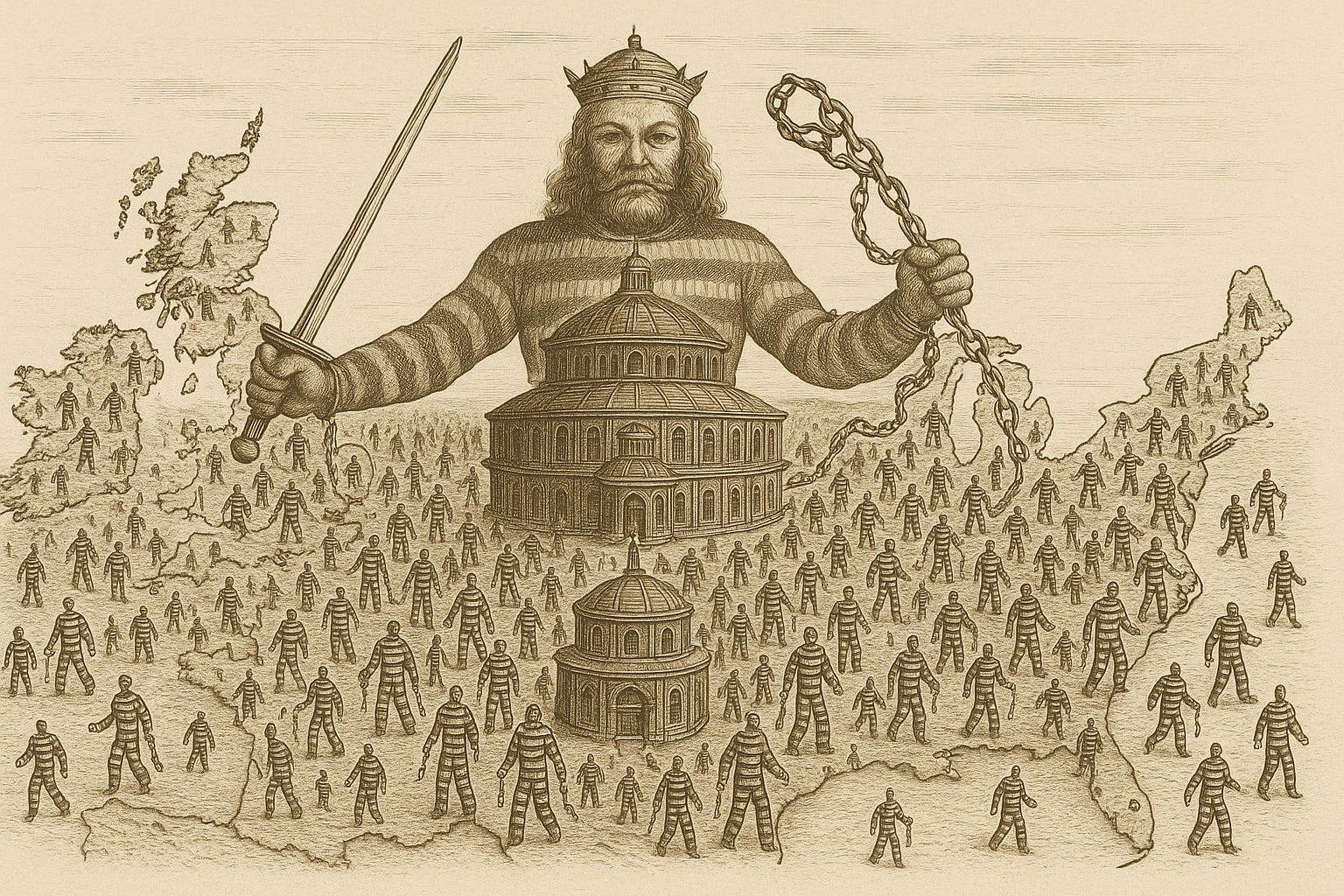
The more you do think about it, the more you realise how extreme it is.
It’s also extreme in a historical context. Over the past century, the number of people in prison has increased by more than four times in the UK, and more than ten times in America, with a particular increase since the 1990s in the UK, and since the 1970s in the USA.2 And beyond numbers, locking people up has only really existed as a response to crime — anywhere — for about 200 years!
This isn’t to deny that other illiberal responses to crime were practiced previously. It’s also not to deny the further illiberal concerns we should attend to when thinking about current and historical imprisonment practices — not least the way in which, in the USA particularly, such practices have often been driven by racism.
But again, the more you think about imprisonment as a practice, per se, the more you realise how extreme it is.
Shut up in a little room for most of each day. Told exactly where to go, and often exactly what to do, when you’re finally allowed to spend time in the other tight spaces down the corridor. Kept in line by the persistent threat of even more intimate kinds of constraint. Yelling! Bright lights! Hard surfaces! Chains! Batons! Hands!
And these are just the basic expectations. I mean, all of this is before we get on to the terrible things that aren’t supposed to happen in prisons, but obviously do.
This is the life being led by millions of people in our supposedly advanced modern societies — and we should think about it more.3 Particularly those of us who are committed to liberalism.
Minimally, liberals should be concerned about imprisonment because it offends against the following three core liberal values: free agency, wellbeing, and equality of moral status.
Imprisonment violates free agency
First, liberals should be concerned about imprisonment because locking someone up violates their free agency.
I’ve written on Substack before about how free agency — in the sense of being able to act on your reasoned decisions — is both a distinctive quality of being human, and a morally significant one. Free agency is morally significant because it affords us responsibility as well as power.
Free agency is such a central part of being human that it’s easy to argue that, generally, it’s bad when humans are prevented from exercising their free agency. And that if one human deliberately interferes with another human’s free agency, then generally that’s both bad and wrong.
This doesn’t mean that all instances of interference in free agency are equally bad and wrong. Or even that they’re all impermissible — otherwise, we’d have to avoid anaesthesia!
Rather, I want to emphasise that the way in which imprisonment is aimed at comprehensively constraining this thing of deep human value presents a serious moral problem. And that we should acknowledge that the comprehensive constraint of imprisonment lies not only in its nature — in the persistence of its controlling imposition — but in many of its effects.
Think, for instance, about how prisoners can become institutionalised: how they often struggle to return to normal life outside the top-down directions of the prison estate. Think also about how difficult it can be for them to become re-accepted as full members of society. And how some even develop unhealthy attachments to their captors. All of these effects of imprisonment degrade the capacity for free agency.
Imprisonment is damaging to wellbeing
Second, liberals should be concerned about imprisonment because locking someone up is damaging to their wellbeing.
Not all prisoners suffer direct harmful violence, like forcible drugging, shackling, or being made to undertake hard labour. Nonetheless, I’d argue that all people who are imprisoned suffer some physical and psychological harm as a result.
At heart, this argument trades on the importance of free agency. If free agency is a matter of bodily capacity as well as mental capacity, then comprehensive constraints on free agency can count as instances of both physical and psychological harm.
Beyond this, however, are concerns about the many bad things that prisoners routinely experience that you might not want to count as instances of harm. These range from being made fun of, to lacking access to outdoor space. They are found in the denial of a person’s access to the goods and services that are necessary to human physical and mental wellbeing — something that goes beyond the avoidance of harm.
Imprisonment breaches equality of moral status
Third, liberals should be concerned about imprisonment because locking someone up breaches their equality of moral status.
By ‘equality of moral status’, I’m referring to two foundational liberal ideas. First, the idea that all human beings, regardless of circumstance, share a fundamental equal status, as a matter of moral truth. This kind of equality is grounded in features particular to being human, including the capacity for free agency.
Second is the idea that there’s a different but overlapping basic moral status held by all members of a legitimate political society. This second idea depends on the first, but comes with additional demands to behave towards each other in certain ways. It overlaps with the discussions of ‘relational equality’ you can find in the work of Elizabeth Anderson.
Imprisonment offends against these two foundational liberal ideas in part, again, because of the way in which imprisonment constrains free agency. But also because it’s hard to square imprisonment with the culture of non-domination required in political societies that are committed to respecting this equality of basic moral status.
Of course, crime is also bad
At this point, however, I want to stop and acknowledge that it’s not just imprisonment that’s bad. Crime is also bad!
There’s a chapter I like by Jonathan Wolff, in which he focuses on arguing that crime is bad.4 Now, on some level, it’s funny that Wolff felt the need to write this chapter, because it’s really very obvious that crime is bad. But unfortunately, his chapter is also much needed. This is not least because some of the people who make the loudest arguments against current responses to crime also sadly underplay the badness of crime itself. This is a serious mistake.
Wolff tells us that crime is bad not only because the victims of crime suffer physical harms such as broken arms, and psychological harms such as debilitating fear, but also because crime, as a representation of contempt, brings about damaging inequalities in societal standing. He’s clearly right. Crime is bad for its victims, its perpetrators, the wider public, and in itself.
Good societies don’t put up with crime. And societies that fail to attend to violent crime are particularly negligent.
When is imprisonment necessary?
Most people believe that imprisonment is necessary for preventing at least some violent crimes. Let’s consider an easy example. Imagine Mr X, who openly and reliably admits his desire to continue his ongoing campaign of killing as many people as possible.
Now, if we take imprisonment off the table, then our options for preventing Mr X are limited. Indeed, it seems likely that other fully preventative options — such as killing Mr X, or chemically changing his desires — will count as even more problematic than imprisonment, when assessed against liberal principles.
I’ll discuss some other alternatives briefly below. But for now, we seem to face the conflict that not only: 1) imprisonment is generally bad and wrong on a liberal account; but also 2) at least some instances of imprisonment are required in a liberal society. And we’re left where we began.
Or are we?
Well, you can surely accept both of the premises above — that imprisonment is generally bad and wrong, and also that at least some instances of imprisonment are required — without concluding that millions of people need to be locked up!
I mean, what percentage of those millions pose a clear violent threat? I’m sure there are excellent studies on this, but even if the answer were as high as 90 per cent, then that would still leave hundreds of thousands of non-violent people unnecessarily locked up.
My guess and hope is that our descendants will look back in horror, and struggle to believe that we really imprisoned all these non-violent people. And that’s before we consider the human-rights-violating standards of many contemporary prisons.
What about punishment?
But perhaps you’re annoyed that I haven’t talked about punishment yet. Perhaps you think punishment is the elephant in the room — that there’s a simple reason why so many people are in prison, and this reason is punishment!
Punishment is a hard topic for liberals, however.
What I mean by this is that people who are particularly committed to the value of freedom often feel discomfort — and, I think, should feel discomfort! — about the idea of punishment, itself. I’ll write about this in more detail some other time. But, broadly, this discomfort is related to the way in which justifications for punishment typically depend on either retribution or deterrence.
Retribution arguments tell us things like: ‘punishing someone in order to wreak vengeance on them for committing a crime is permissible’ and ‘you can rely on vengeance as a justification for punishment’. These arguments often make liberals anxious, not least because they depend on the idea that it can be a good thing — the right thing, even — to intentionally do something bad to someone who’s under your control.
Meanwhile, deterrence arguments tell us things like: ‘punishing someone in order to deter further crime is permissible’ and ‘you can rely on deterrence as a justification for punishment’.5 These arguments should make liberals anxious, too. I mean, okay, these arguments might work if you think that only consequences matter when evaluating right and wrong. But, as I wrote here recently, consequentialist reasoning leaves liberal principles and values at risk. And punishing wrongdoers in order to try to prevent future crime involves treating them as a means to an end.
Of course, these are simplistic descriptions of the arguments at hand. And many liberals find ways to reconcile the problem of punishment. But now I’m going to propose a different way forward, at least in the case of imprisonment.
A proposal for defensive imprisonment
My proposal takes punishment out of the equation. That is, if we only locked up the people who posed a clear violent threat, then we wouldn’t have to rely on punitive justifications at all. Rather, on such an approach, we could see prison not as punishment, but as defence.
Now, I accept that this might seem like a conceptually confusing move — mainly because many people take punishment to be part of what prison does, by definition. Tommie Shelby, for instance, tells us that prison is an “incarceration facility that functions to impose punishment”.6 Indeed, throughout his recent comprehensive book on prison reform and abolition, Shelby accepts that prison is punitive, and that this is non-controversial.
That’s fine! If you want to keep a punitive element within the concept of prison, then all you have to do is imagine a second kind of institution called ‘shmison’. Shmison is just like prison, except it’s not a place for punishment. Nobody gets sent to shmison for punitive reasons! People are only locked up in shmison for defensive reasons.
If this seems weird, then remember that people are already often locked up for non-punitive reasons. Consider here the differences between being locked up because you are: 1) infectious with a dangerous new contagious disease; 2) an immediate danger to yourself; 3) an immediate danger to other people; and 4) have committed a crime. Even if these experiences looked and felt very similar, the differences in reasoning would persist.
Now, let’s return to shmison, where people are locked up only if they pose a danger to the public.
Of course, it wouldn’t always be easy to work out if someone posed a sufficient danger to be admitted to shmison. And, as is currently the case, some of those dangerous people would be better suited to psychiatric hospitals. But there will be many easy cases that we can rule out immediately. People who are currently in prison for having committed non-violent crimes, and who have made no violent threats throughout their time within the criminal justice system, count as easy cases, for instance.
Those people have no place in shmison!
Two big payoffs
Beyond the moral imperative for putting an end to imprisoning non-violent criminals, there are two big payoffs that would come from imprisoning people only on the grounds of defence.
First, doing so would seriously reduce the prison population. This would allow for a reduction in prison spending, and a reallocation of prison resources. The reduction in prison spending could either enable a reduction in taxes, or increased spend on alternative justice measures. And prison resources — including land, buildings, and equipment — could be clearly used for many other purposes.
Second, using prison for defence rather than punishment would lead to improved conditions for prisoners. I don’t really mean by this that decreasing the prison population would make prisons less crowded, improve the ratio of guards to prisoners, and enable increased spend per prisoner. Sure, those things would likely happen, at least at first. But resource reallocation might change this over time.
Rather, I want to emphasise that removing punitive reasoning from the equation gives reason in itself to improve prison conditions.
I mean, think about how, whenever there’s a news story about a prison that has unusually good conditions, someone will respond, “But hey, prisoners aren’t supposed to have nice things! They’re supposed to be in prison to be punished!” This kind of response aligns with both the retribution and the deterrence accounts of punishment. On the former, prisoners deserve bad conditions. And on the latter, bad conditions provide a disincentive to commit crime.
But if prison — sorry, shmison — is no longer punitive, then those reasons no longer stand, and we can focus on ensuring good conditions for the inshmisoned. Shmison, indeed, should be a place in which not only the rights of the shmisoners are respected and their basic needs are met, but all the fundamental goods of human life can be accessed, from knowledge to work to love.
A few objections
Now, there are some obvious objections you might make to my shmisons proposal. For a start, perhaps you simply don’t share my moral concern with prison as punishment. So you want to continue pushing the position that we need prisons in order to wreak vengeance, or to deter future crime. Okay! I will continue to try to dissuade you.
Or perhaps you’re concerned with feasibility and practical upshots. In particular, maybe you’re worried about the effects of suddenly releasing a large proportion of the prison population. Where would these people go? What would they do? Well, these are questions that already exist in relation to current prisoner-release procedures — questions that often aren’t answered adequately. Sadly, some former prisoners end up homeless, for instance. But that’s hardly a reason to keep them locked up!
Moreover, if the main concern you have with the idea of suddenly releasing a large number of prisoners is less to do with their needs, and more to do with the risk they might pose to members of the public, then remember the condition on which these particular prisoners would be released. They must not pose a clear violent threat!
Perhaps, however, you think that these former prisoners would pose some other threat. Perhaps you think they would continue to swindle people, or steal things, or do whatever it was they were locked up for doing in the first place. And yes, perhaps these released prisoners would indeed pose those threats. But if prison were reserved for people who posed a violent threat, then we would have to find other ways to deal with non-violent threats! And this could include, if you wanted, other means of punishment — which, again, I’m not ruling out, for now.
Rather, all I’m arguing is that there are many people who are currently in prison who would pose exactly the same physical risk to the public, if they were outside of prison — and that therefore these people should be released.
That said, if releasing these non-violent people really were too much for you, then of course we could start instead by refraining from locking up any more of them. And if even that felt like too much, then I suppose we could expand our focus beyond violent threat. I mean, sure, keep the swindlers locked up, if you really can’t find another way to deal with them! Why not put them in the cells alongside the granny who sends offensive tweets, if you really think she also needs the same constraints as Mr X.
Just don’t call yourself a liberal!
Whatever details you insist upon, however, it seems undeniable that shifting to a model on which we only imprisoned people who posed a clear threat, would lead to the imprisonment of thousands — if not hundreds of thousands — of fewer people.
I want to end by emphasising that obviously we should also think much harder about alternatives to prison. That is, even if we accept that some people do need to be kept away from the public for defensive reasons, then we should ask whether this must be done by collectively housing them in a panopticon.
Solutions to this problem that involve emerging technologies should be considered alongside classic alternatives. These solutions range from banishment, to house arrest, to various kinds of invasive surveillance, to combinations of the above, and things we haven’t conceived of yet. Of course, as already mentioned, some of these solutions could prove more problematic than prison on liberal grounds — particularly when prison is shmison!
But again, we should think much harder.
A simple starting point
It’s often assumed that extreme problems require radical responses — responses that not only enable structural changes to the status quo, but also require a vast amount of resource commitment, alongside the serious shifting of societal norms.
What I’ve tried to persuade you here, however, is that there’s something that could be done to address the extreme problem of imprisonment that not only doesn’t require too much shifting of social norms — it would actually free up valuable resources! Shmison makes sense and shmison comes cheap.
Of course, it’s not these kinds of considerations that should primarily lead us to releasing non-threatening prisoners. It’s the moral horror of the fact that they’re currently locked up.
People who care about freedom should lead the charge on changing this.
----
Thanks to GPT for the panopticon leviathan picture.
Thanks to GPT 5.2 for checking these commonly reported stats for me.
Ditto.
There are some obvious reasons why prisons remain relatively low on the public agenda. For a start, it’s not exactly easy for prisoners to form a lobby group. Moreover, as a group prisoners lie well below the median in terms of educational attainment, and typically lack the other kinds of social capital that are valuable to influencing policy matters. For related reasons, prison is an unpopular area of focus for politicians. Pushing for reform comes with few benefits. And although prisons are extremely costly on many counts, spending on prisons is a small percentage of the UK and USA’s budgets. In the UK at least, therefore, prison policy is largely a matter for small specific projects pushing at tiny margins, and larger generalist sinecure projects pushing at very little. Within academia, calls for radical change to prison policy are dominated by the ‘critical’ post-modern left. Tommie Shelby’s recent book The Idea of Prison Abolition is notable for the charitable way in which he — a political philosopher in the liberal analytic tradition of Rawls — engages with the work of leading ‘critical’ thinkers. But even in the light of Shelby’s exegetical refinements, the work of those thinkers comes across, at best, as niche and complex. Unsurprisingly, some libertarian thinkers are seriously concerned about prisons, and incarceration more generally. But sadly their work doesn’t get much attention beyond libertarian circles. So there are good explanations why societal discussion of prison is limited. But explanations do not serve to justify! At least, they shouldn’t for us liberals, who are supposed to care about the pursuit of moral truth. Yet many liberals behave as if it’s okay that such large numbers of people are locked away. And some so-called liberals even look to El Salvador — with its recent mass-incarceration-driven reduction in crime — with envy!
Jonathan Wolff, ‘Crime and Punishment’, Chapter 6 of Ethics and Public Policy.
A third type of argument about punishment, which is sometimes advanced, focuses on punishment as incapacitation. But this approach offers us no neat examples of justificatory conclusions. That is, we could combine ‘punishment as incapacitation’ with a deterrent or retributivist justification, and conclude something like 1) ‘punishing someone, by incapacitating them, in order to deter them from committing crime, is permissible’, or 2) ‘you can rely on vengeance as a justification for punishing someone by incapacitating them’. In other words, incapacitation is something that happens to the captive, not the possible reason for that thing being permissible.
Tommie Shelby, The Idea of Prison Abolition (2022). If you’re interested in reading good analytic political philosophy on the topic of prisons, then I recommend you read this book. But Shelby’s previous book Dark Ghettos (2018) is, I think, one of the best political philosophy books of the past decade.
Thanks for the piece. It made me think. And I concluded that I come at things quite differently. Arbitary, unaccountable imprisonment is illiberal, which I'm sure all liberals would agree upon, but imprisonment within a structured, accountable, rules based system is not, because the decision to commit a crime and suffer the known consequences of imprisonment is a choice of free agency. It is extremley easy not to commit a crime worthy of prison.
Therefore no infringement of their free agency has taken place, when they have freely chosen to relinquish it.
My liberal concerns about prison are of effectiveness - is it a deterrent? Does it reduce reoffending? Does it keep the public safe from certain people? And on those questions, I share your concern about wellbeing because I value rehabilitation rather than punishment as my guiding principle. And prison is probably not the best environment for rehabilitation.
Prison is for the purpose of retribution and restitution. We are all born to equal status but it can be forfeited. Ideally, prison would be a lot harder, and, indeed, required forced labour. And I'm with Locke and Kant - big time liberals - in favouring the death penalty too.