


In Legally Blonde, Elle Woods marches into a trailer park to help her manicurist, Paulette, retrieve the dog her ex has withheld. “Due to habeas corpus,” she announces, “you and Ms. Bonafonté had a common-law marriage, which, heretofore, entitles her to what is legally referred to as equitable division of the assets!”
For the uninitiated, habeas corpus in Latin means “you shall have the body.” It is a writ (think of it as a court order) that calls upon a jailer, or whoever confines another person, to bring that person before the court and justify the confinement. If the jailer cannot show lawful authority to hold him, the court orders the release of the detainee. When a young man who had served his time remained in a London prison five days after he was due to be released in February 2026, his lawyers filed for habeas, and he walked out less than 19 hours later.
At the heart of this is the principle, at least as old as clause 39 of Magna Carta, that the state cannot hold you without cause. Even when it has cause, it cannot hold you under faulty procedure, and it cannot hold you for a minute longer than the law allows. That is true before a court has convicted you, after it has, where no trial is contemplated at all, or where an official believes that you would be a danger if left free. None of it gives the state unrestricted authority to keep you confined.
This is because the right to life and liberty is at stake, the very claim that “over his own body and mind, the individual is sovereign.” But how does a claim so “sacred”, so “carefully guarded by the common law”, bind the state from the moment it confines you? Only if you can enforce it while you are still in custody. Habeas corpus is that recourse, which is why the writ is celebrated as the ultimate defender of liberty in the common-law world.
In India, the Crown’s former jewel, you will find a habeas filed by an activist who was detained on an official’s suspicion that his actions might cause unrest. There was no charge, no trial, and no conviction. But the Supreme Court listed his habeas case about 26 times over five months, only to close the petition because the government released him before it had decided whether his detention was lawful. And in Elle’s homeland and King George III’s former “favorite subject”,1 an alien with no criminal record, whom the government itself had released on immigration parole more than three years earlier, was taken back into custody without notice and filed a habeas of his own. He waited 81 days for a court to find that officials had violated his rights and order his release.
If all these instances count as habeas, I have more questions than answers about what it really means. Where does it work, when does it work, and how quickly must it work to have any salience? Does it require the jailer to produce the body only before the person is charged, or after? And given all the inconsistency in its usage, what does it mean for the personal, bodily liberty—the “independence of the arbitrary will of another”—it is supposed to secure?
So as a 1-L at Harvard Law in a Hollywood movie, Elle can be forgiven for getting habeas wrong. Because outside Hollywood too, what habeas can actually do is not nearly as settled as its reputation suggests. In fact, two years before Elle appeared on our screens, a judge in England, the very country where the writ originated, argued that habeas had outlived its purpose and should give way to other procedures to examine confinement.
London
Jayden Gambrah was 17 when he was remanded into youth detention in January 2025 and was moved to an adult prison when he turned 18 that summer. When a judge at the Inner London Crown Court sentenced him on Friday, 20 February 2026, the time he had already spent in custody counted toward his sentence, which meant he should have walked free that afternoon. At 7:40 that evening, the court emailed the prison that “the sentence is deemed served” and “the defendant can be released.” But Gambrah stayed inside through the weekend.
Gambrah’s solicitors went back and forth with the court and the prison, to no avail. Finally, on Wednesday at 9:13 p.m., his solicitors filed a habeas corpus petition. 59 minutes later, a judge heard the application over Microsoft Teams and ordered the prison to file a written explanation of its authority to hold Gambrah by noon the next day, with another hearing scheduled for 2 p.m.
The prison did not file any explanation by noon, and when the 2 p.m. hearing began, no one represented it. A lawyer joined partway through and said Gambrah was expected to be released shortly. The judge pushed the hearing to 4:15 p.m. When it resumed, both sides confirmed that he had left prison at 3:47 p.m., 18 hours and 34 minutes after his solicitors filed for habeas.
The court nonetheless required the prison to explain the delay and its failure to respond. The prison subsequently agreed to pay £5,000 in damages and £5,500 in costs, in a settlement approved by the court. The judge still published a judgment recounting the entire episode, down to the minute, and ruling that keeping Gambrah inside for almost six additional days had been unlawful.
***
Gambrah had already been convicted and sentenced; what he challenged through habeas was the prison keeping him locked up after he was due for release. In medieval England, habeas was more like a summons to bring people into court, sometimes by having them arrested, or by transferring prisoners between courts (literally, bring the body). By the late 16th and early 17th centuries, habeas had become an instrument for challenging imprisonment: the jailer had to produce the prisoner and explain why he was holding him.
But jailers could drag out their answers or evade the writ by moving prisoners. The English Habeas Corpus Act of 1679 gave them three, 10 or 20 days after receiving the writ to produce prisoners,2 depending on the prison’s distance from the court. Disobeying the writ could cost a jailer £100 (roughly £19,000 today) the first time, £200 (roughly £37,000 today) and his job the second. Even a judge who improperly refused the writ during court vacation could owe the prisoner £500 (roughly £93,000 today).3 The Act also restricted transfers between prisons and imprisonment overseas.
Judges, jurists, and philosophers worth their salt have, in the centuries since and in every courtroom the English left behind them, called it “the most celebrated writ in the English law”, “the great and efficacious writ in all manner of illegal confinement”, “the fundamental instrument for safeguarding individual freedom against arbitrary and lawless state action”, “the first security of civil liberty”, “a precious and undeniable feature of the rule of law”, “a great security against oppression”,4 and I will stop there.5
Through centuries of amendments, repeals and new laws, habeas took on new forms in England. Judicial review allows a court to examine whether a public authority acted lawfully, including when detaining someone, and set an unlawful action aside. Under the Immigration Act 2016, immigration detainees can seek release by applying for bail before a specialist tribunal, without first having to prove through habeas that the detention was unlawful.
Under the current habeas rules, a judge can consider an application on paper or hear it directly in court, and order release without first issuing the writ. But habeas can also be used to bring a prisoner to court to give evidence, without challenging the detention at all. For applications challenging confinement, the rules set no universal deadline for a decision, but the European Convention on Human Rights requires a court to decide the lawfulness of detention “speedily.”
Gambrah looks like a shining example of what habeas can do. But for Yunus Rahmatullah, who also turned to the English courts, obtaining habeas did not mean getting out of detention. British forces had captured him in Iraq in 2004 and handed him to the American forces, who moved him to Afghanistan. Britain had retained the right to request his return, but the United States refused to hand him back. In 2012, a majority of the UK Supreme Court found strong evidence of unlawful detention yet accepted that Britain could not secure his return. Rahmatullah remained in US custody in Afghanistan until 2014. So, did habeas really do its job?
Ladakh
In September 2025, Sonam Wangchuk, an educator and activist, began a hunger strike in Leh, Ladakh’s largest city. Ladakh has been a union territory, governed by India’s union (you may read that as federal) government in New Delhi, since Parliament split the erstwhile state of Jammu and Kashmir (J&K) into two union territories, J&K and Ladakh. Unlike J&K, Ladakh has no legislature of its own, so people led by Wangchuk have demanded statehood for the region.
The protests turned violent, and Wangchuk ended his fast and appealed for calm. But the government accused him of encouraging the unrest and detained him under the National Security Act, 1980, citing a threat to public order. Instead of keeping him in Leh, officials moved him to a jail in Jodhpur, in the state of Rajasthan.
***
In ordinary criminal cases, the police must produce an arrested person before a magistrate within 24 hours. Depending on the offense and the circumstances, the person can be released on bail while the prosecution proceeds. But modern India borrowed not just criminal procedure, but also preventive detention from its colonial predecessor: laws that allow the government to put someone in jail to prevent conduct it considers a threat to public order, state security or another interest named in the law. You read that right: no criminal charge has to be brought, no offense proved. A person can be detained for what an official believes he may do.
And India has at least 22 such laws: four central laws and eighteen at the state or union-territory level. The National Security Act (NSA), one of the central laws, permits detention for up to a year without a criminal charge or trial. The order rests on the detaining official’s “satisfaction” that detention is necessary. What checks does the law place on such discretionary “satisfaction”? Under the NSA, the official must give the detainee the grounds and a chance to oppose the order in writing to the government. A government-appointed advisory board examines those grounds and the detainee’s representation (if he can actually make it). The board must report within seven weeks of detention (yes, he is already in jail) whether there is sufficient cause to keep him detained. If it finds none, the government must revoke the order and then release him. In Wangchuk’s case, the board rejected his representation.
Is the government’s own board validating another governmental authority’s detention power the final word? Is there no recourse to a court? Would Wangchuk just have to wait it out? Voilà: the hallowed habeas, first used in India in 1775, while America went to war with the Crown on the other side of the world.
A small historical detour, if you will indulge me: Calcutta judges issued the writ to release a revenue collector whom the East India Company had imprisoned over unpaid dues, much to the Company’s displeasure. Eventually, in 1818, the Company’s government in Bengal gave itself the authority to imprison people without trial for “reasons of State”, setting the stage for preventative detentions in India, which the Crown carried forward after 1858. When the Indian founding fathers had a chance to start afresh, they gave both a place in the Indian Constitution: the right to challenge unlawful detention through habeas and the government’s power to detain without trial. For a person in India held under a preventive-detention law, habeas may be his first—and likely only—opportunity to challenge his detention before a court.
But how does a court review detention meant to prevent an act that has not occurred? It cannot hold a trial to establish whether the detainee would have committed a wrong that the official suspected. Instead, it asks whether the official relied on “relevant material” and followed the prescribed procedure. Did the detainee receive the reasons and documents, on time, and in a language he understood? Could he use those materials to make a case against his detention? Skip a relevant check, and the court can quash the detention.
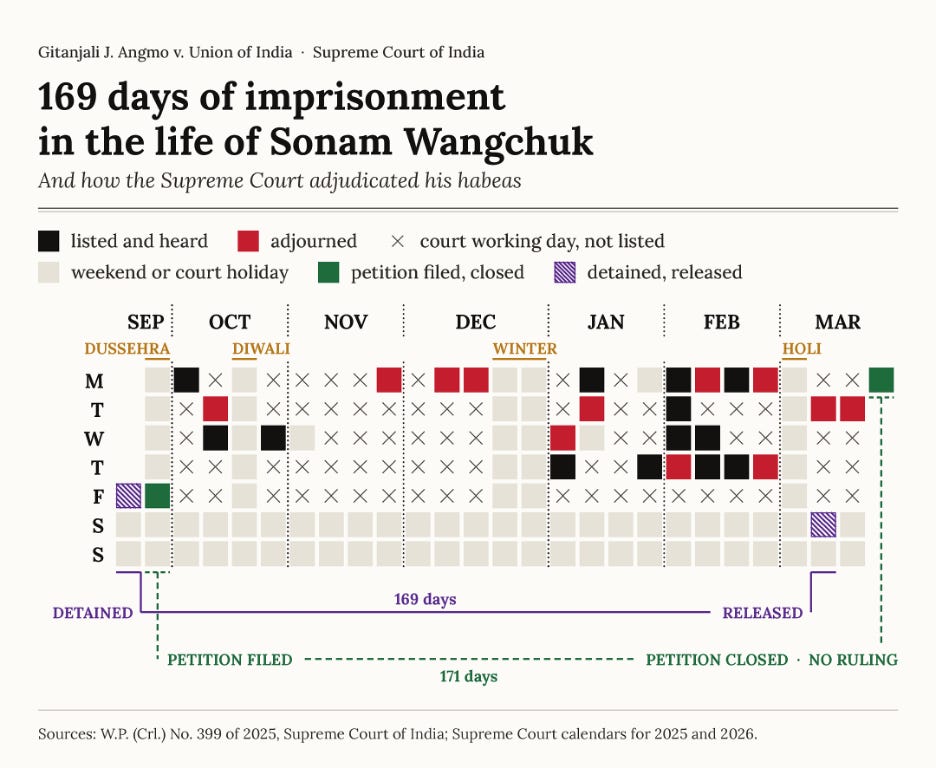
Wangchuk’s wife, Gitanjali Angmo, had only two routes for challenging the detention on his behalf: a High Court with jurisdiction or the Supreme Court. Lower courts cannot issue the writ. She could have approached the High Court of Jammu and Kashmir and Ladakh. And if she had, she would have been promised a quick decision, at least on paper. Per the court’s rules, a habeas petition “shall invariably be disposed of within a period of fifteen days.”
And if Angmo had access to my ongoing research on habeas in Indian High Courts (apologies for the plug but I’m trying to make a point), she would have found that more than half of the petitions challenging state detentions at the J&K High Court proved that the detentions were illegal.6 Promising, but this could have meant waiting for 209 days to get that decision.7 Worse, she could have waited longer only for the court to close her petition as infructuous because Wangchuk had been released, or his detention order revoked or expired. She would get no ruling on whether his detention was lawful.
Angmo instead went directly to the Supreme Court and filed a habeas petition within a week of her husband’s detention, with Kapil Sibal, one of India’s well-known senior advocates and a former cabinet minister, arguing the case. While the Supreme Court sets no fixed deadline for deciding habeas petitions, its procedure requires expediting them.
But would going straight to the Supreme Court spare her that wait? A study of reported preventive-detention judgments between 2000 and 2019 found that proceedings lasted a median of 197 days at the Supreme Court alone. In more than a third of the cases, habeas proceedings there lasted longer than the maximum detention permitted by the relevant statute.8
Angmo’s petition was listed 24 times over five months before the government revoked the detention order on 14 March 2026. Wangchuk was released before the court decided whether the government had lawfully detained him. The court listed it two more times after that before closing the case.
Nonetheless, on 23 March, Sibal asked the Supreme Court to keep the petition pending (to see whether the government had legally detained him). The government’s lawyer, the Solicitor General, argued, “I would request Mr. Sibal, let it be.” Unlike Gambrah’s judge, who examined the legality of his almost six extra days in jail after his release, the Indian Supreme Court said, “No, what is left (to decide)?” and closed Wangchuk’s petition as infructuous.
Louisiana
In April 2026, an American immigration officer re-arrested Anmoldeep Singh without notice, and he was held at Winn Correctional Center in Louisiana. Singh, an Indian citizen, had been detained once before, when he entered the US in December 2022. However, that time he was released the same day on immigration parole, a situation that allowed him to live in the country if he complied with certain conditions while his case proceeded. For more than three years, he stayed on the up-and-up and had no criminal history.
But many, like Singh, who had been released earlier, were being re-arrested and lined up for deportation. And since 2025, immigration authorities have denied bond hearings before immigration judges (who are Justice Department officials) to people who entered without inspection and were never lawfully admitted, regardless of how many years they have lived in the US or even if they were released earlier. With the bond-hearing route closed (the hearing at which an immigration judge decides whether to let a detainee out on bond while his case proceeds), Singh’s only option was to file a habeas petition before a federal judge.
On 1 May 2026, he filed his petition, but the court sent it back five days later to be refiled on approved forms. In June, the court allowed the government 28 days to respond, which it did on 6 July. A week later, while his habeas was still pending, an immigration judge ordered Singh’s deportation. On 21 July, 81 days after he first filed his habeas, the federal judge ordered his immediate release because re-detaining a man without notice or a chance to object violated the Fifth Amendment’s guarantee of due process. And nothing suggested he had broken a condition of his earlier parole.
***
Immigration detainees filed 105 habeas petitions in federal courts in March 2025 and 9,059 in March 2026. Among cases filed since January 2025 and closed by 25 August 2026, the median time from filing to closure was 89 days across Louisiana’s federal courts, 92 in Southern Mississippi, 63 in Western Oklahoma, and 12 in Minnesota. Singh’s habeas, taking 81 days, is typical for Louisiana.
Habeas corpus in the US is not only for people like Singh. While it can challenge custody before trial in the classic sense, it can also be used by people already tried and convicted. Although criminal appeals exist, habeas offers a separate way to challenge constitutional violations in a conviction or sentence. Death-row prisoners, too, use it to challenge their convictions or death sentences. In these cases, habeas can also lead to a new trial or a different sentence, rather than simply an urgent hearing to challenge the jailer’s authority.
A prisoner convicted in a federal court usually asks the court that sentenced him to set aside or correct the conviction or sentence. Someone convicted in a state court can approach a federal court, generally after pursuing the claim through the state courts. For such state prisoners, Congress throttled the route to federal courts in 1996, generally giving them one year after their conviction becomes final to file. The general federal habeas statute sets no fixed deadline for the final judgment, although federal law requires habeas proceedings to be expedited. State courts have their own procedures and timelines.
And in immigration cases, habeas has also found use among those who have already been ordered deported but whom the government cannot find a country to take, so it continues holding them while it tries. But for how long? The Supreme Court regards six months as “presumptively reasonable”, and after that habeas can secure release if deportation is no longer reasonably foreseeable.
Britania Uriostegui Rios was also held at the Winn Correctional Center. A Mexican citizen, she came to the US in 2003 and became a lawful permanent resident in 2011. In 2023, she pleaded guilty to assault with a deadly weapon, which cost her that status, and in April 2024, ICE took her into custody from a jail in Las Vegas. In March 2025, an immigration judge ordered her deportation but barred her removal to Mexico, finding that she was likely to face torture there as a transgender woman. The government then had to find another country willing to take her. Four countries refused, and six others never responded. In the middle of all this, she was wrongly sent to Mexico and then brought back.
She filed a habeas petition in September 2025, six months after her removal order. In January 2026, Judge Edwards, who would decide Singh’s case months later, refused to release her because the government was still trying to deport her. On 24 March, he reconsidered and ordered her release under supervision.
Rios had been convicted of a serious crime, and deportation would ordinarily follow. But the government could not deport her, nor would it release her, and then it deported her anyway, to the one country the immigration judge had ruled out, before bringing her back. The court ordered her release 197 days after she filed her habeas. Singh, on the other hand, had no criminal record and had broken no condition of his parole. And he waited 81 days, in the same jail, for the same judge to let him out.
Did habeas work for both? Or only for Singh, because he got out sooner, or because his detention was unlawful from the moment it began, while hers became possibly unlawful only with time? Or is that immaterial, since both were released? Should the answer differ for someone awaiting trial, someone awaiting deportation, or someone on death row? And how do we figure out where those limits lie?
Liberty?
Across jurisdictions, there are so many iterations of habeas, each with its own procedures. I can interpret this as a commitment by these systems to preserve some version of liberty, giving people (citizens and noncitizens alike) in confinement of all sorts a chance at freedom. Or I can quibble that some of these uses of habeas resemble criminal appeals, revision applications, or retrials so closely that they are habeas only in name. But if each counts as habeas, what makes it a distinct safeguard of liberty? What should it guarantee to anyone confined?
One answer is that we get this entire premise wrong because we foisted the wrong expectation on to habeas. Historical accounts argue that the king’s judges in England used the writ to assert authority over those who imprisoned people. What they demanded was an explanation of the jailer’s power over his detainees; release or continued custody were the outcomes of that scrutiny. Essentially, one governmental power constraining another. Recent scholarship, in the American context, has further argued that habeas lets the people supervise, through courts, whether officials have stayed within the power to imprison entrusted to them. Securing individual liberty is not its principal purpose.
Be that as it may, someone imprisoned and affronted in his bodily liberty is not filing habeas so that the judiciary has another occasion to flex its muscle. He has, understandably, bought into the “mythology” of habeas as the vanguard of liberty and is seeking his release from state coercion. More so, when the state has countless and creative ways to kidnap a person in the name of national security or public order, without bringing him to trial.
How quickly the court examines that custody is also part of the expectation. This is not to say that the court can’t uphold the detention. But the longer a person stays inside without a decision, the longer he remains away from his life outside. Especially if the court eventually finds his detention illegal, those days of confinement are a loss he can never recover.
And sure, courts have only so many judges, staff, and hours in a working day. A US federal judge candidly called his court’s immigration habeas caseload — since the government kept denying ‘aliens’ bond hearings — an “administrative judicial emergency”. In India, judicial vacancies and backlogs are familiar problems. But should workload become a reason to water down the urgency of habeas?
Even assuming our courts have enough judges and staff, how should we set the bright lines? Should the law prescribe a deadline for deciding habeas, or should courts bind themselves to one? The 1679 Act gave the jailer more time to bring the prisoner to court according to the prison’s distance. Would a 15-day promise, like J&K’s, apply to everyone, from those picked up without a charge to undertrials, convicts and death-row prisoners? Or should a court get an extra two months for a convict’s petition?
I have argued, elsewhere at length, that the means we use to secure liberty must themselves guard against arbitrary power and treat people equally. A deadline must bind the court’s own discretion. By that date, it must decide whether the custody is lawful. If it has not, the person ought to be released. That should apply even where the person was earlier convicted. A judge granting the government another month to answer must also explain why the detainee should spend that month in jail.
Wangchuk spent months inside asking the Supreme Court to scrutinize his detention, then left without a ruling on whether the government had been entitled to hold him. A system that repeatedly closes these challenges as infructuous makes the process the punishment. If that sounds trite, how comfortable have we become with the situation? The court should still decide the legality of detention after release, as Gambrah’s judge did. And if the confinement proves unlawful, the state should pay damages. Indian courts have already done both, so this is not for a lack of precedent.
Even in Rahmatullah’s case, Britain excused itself because it could not secure his body as the Americans kept him in Afghanistan and refused Britain’s request for his return. The minority of the UK Supreme Court was unwilling to accept that answer, asserting that “the strength of habeas corpus is its simplicity” and would have required Britain to demand his return again.
I want that kind of insistence in how courts enforce habeas. We have made it too easy to detain first and explain later, or rather, explain when convenient. An official who detains someone should have to reckon with prompt scrutiny and damages for unlawful confinement (even if he releases the person before the court decides). Our commitment, and certainly the judiciary’s commitment, to liberty has to survive the inconvenience of enforcing it.
25 years ago, Elle may have spoken gibberish (she was doing it to confuse the other side, as all clever lawyers do!), but she was clear on the outcome she wanted: Paulette got her dog back before the scene was over, and nobody asked for an adjournment, nor did we have to wait for the sequel. If that is not the pace at which personal liberty ought to be secured, then what is?
The Hamilton version.
For criminal allegations of felony and treason, prisoners could seek bail or discharge if they were not tried in time. Habeas was available for other criminal allegations.
Adjusted for inflation as of September 2026 using the Bank of England’s inflation calculator.
Adam Smith, Lectures on Jurisprudence, Report of 1762–63, lecture of 9 March 1763. Smith was referring specifically to the Habeas Corpus Act of 1679.
Bear with me; citing endless authority is an occupational hazard.
4,383 habeas corpus petitions were filed between 2015 and 2023 at the J&K High Court. Of these, 2,914 are identified as challenges to state detention. In 1,620 petitions, the court found the detentions illegal, with a median duration of 209 days. Another 355 (12%) ended as infructuous; cases with usable dates took a median of 413 days from filing to closure. The waiting periods measure the days between the dates of filing and decision, not the actual days of custody.
1,227 petitions could not be classified because final orders were unavailable.
Time at the Supreme Court could be measured in 63 cases; in 23, it exceeded the statutory maximum. These intervals do not establish continuous custody or that every such case ended as infructuous.
Hmm…good article but how many innocent Americans were held in prison after Jan 6th, without trial. None of these cases made your list?
Very interesting article. And thank you for using "infructuous".