

Seinfeld Trump?
Have you seen the video of Trump with Seinfeld music in the background? It works pretty well. He’s a bit more like George’s father, Frank Costanza, than Jerry, but his little riff about paper straws really is like a Seinfeld bit.

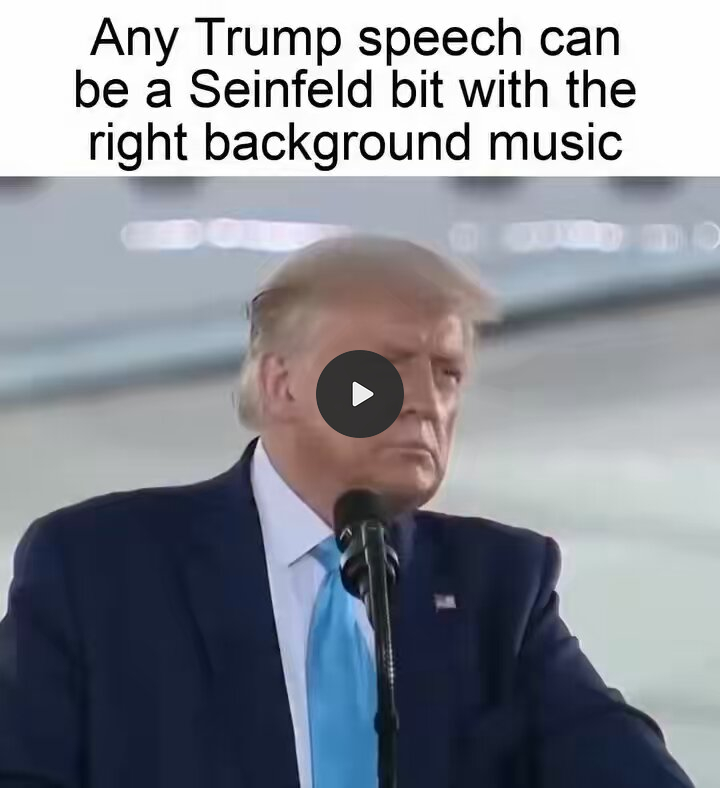
Trump really does have the rhetoric of a stand-up comedian. (Although this whole idea means we really are in Bizarro land.) You might not find him funny yourself, but he speaks from an alternative reality where the things he says are acceptable because some people think he is funny. A lot of his rhetorical credibility comes from the tones, patterns, and habits of a stand-up comedian.
What once was said for laughs, Trump now says for votes.
Trump’s Comedic Rhetoric
Trump ought to be a stand-up comedian’s dream. Telling minor anecdotes about his visit to a factory can get a good laugh. Even Pete Hegseth does a Trump impression. But you can rarely do better than to impersonate Trump using his own words. Often, rather than watching a comedian impersonate Trump, it is funnier simply to watch him, such as in the widely shared video that shows him and Obama announcing the death of terrorists.
Obama is serious and stately. Trump is ridiculous. But the internet chuckles.
Trump’s comedic-rhetoric is why his tweets get so much attention.
I would like to wish everyone, including all haters and losers (of which, sadly, there are many) a truly happy and enjoyable Memorial Day!
Trump’s ability to react to events can make him harmlessly funny, such as when his podium wobbles and he says, “It’s drifting left, like too many other things.” But very often, the humorous quality of Trump’s affect is that it is both offensive and compelling, vulgar and amusing. This is why he is so polarizing. While some people are outraged, others are making YouTube compilations of his funny moments.
Trump’s style comes out of the sort of offensive humour we associate with the comics of the 1960s and 1970s. Of those comedians, the one Trump most resembles is Don Rickles, who was famous for his Hey Dummy! style of comedy.
Three resemblances: monologue, offense, control
The first resemblance is the rambling monologue. It was Don Rickles’ standard approach when appearing on a talk show to dominate the whole proceeding. The host—be they Johnny Carson or Dick Cavett or Frank Sinatra or Joan Rivers—hardly got a word in, while Rickles proceeded on his unstoppable, not-quite-incoherent medley. Incoherent, but funny. Just like Trump, Rickles would bounce from one thing to the next. It seems like a bunch of non-sequiturs but it all made sense as a matter of mood and temperament. Even the moment when Jack Nicholson called Rickles a “very dignified maniac” has a Trumpian tone to it—the very stable genius.
The second resemblance is offense. Rickles was funny by being offensive. His jokes were largely based on race, class, and sex. It is no coincidence that these are the core concerns of Trump’s opponents. He made the calculation that forceful humour, of the sort no longer deemed acceptable, would be a more effective response to their arguments. It was standard for Rickles, even late in the twentieth century, to not only make racially insensitive jokes, but to perform racist stereotypes. He had a standard range of jokes about his wife, things like: “they are always in heat when you are not ready”. Rickles was also vulgar. When Carson corrected his pronunciation of someone’s name, in front of a silent audience, Rickles drawled: “Wonderful. Look at how the crowd got excited. Look at that: two guys in that row dropped their pants and fired a rocket.” Trump does the same. He’s happy to stereotype.
The third resemblance is their ability to retain control of the monologue. Trump never quite seems to be answering questions. He treats reporters almost like his audience, giving him set-ups for his act. When a reporter began a question with “As you know…” and started talking about his son, Trump jumped in: “How would I know? How would I know that?” Then he turned to some people on the other side of the room, gestured to the reporter and said, “I don’t even know who this guy is. That’s all right.”
Rickles was a master of this domination. If a talk show host asked him a personal detail—about his war service, his wife’s name—he snapped back: “What are you, a detective!?” Given half-a-second, he would jump in and say, “Admit it. It’s over.” During anecdotes, any mention of someone’s wife or family would prompt an aside, about how he has two wonderful sons, plus one in the Philippines, or about how on his wedding night, his wife went: “NO!” Whatever it took to prolong the monologue.
Compare Trump responding to reporters by saying “What a stupid question.” When a reporter from Yahoo! news asked Trump about comparative rates of vaccination between the USA and South Korea, Trump had someone read out the figures and then said, “Are you going to apologize Yahoo? That’s why you’re Yahoo. Nobody knows who you are, including me.” This is a pure Rickles play. As it was when a reporter mentioned Elizabeth Warren and Trump said, “Who, Pocahontas?” (referring to her claims to Native American ancestry.) When a reporter called back, “That’s very offensive,” Trump eyeballed her and said, “Oh really? I’m sorry about that.” It was reminiscent of Rickles, who, after he told a joke so offensive it made the audience groan, would snap, “For the money you people are paying that’s a funny joke!” When he was asked if he regretted calling Warren Pocahontas, Trump said, “I do regret calling her Pocahontas because it’s a tremendous insult to Pocahontas.” (All of those can be seen on this compilation.)
On the Charlie Rose show in 1992, in a rather dull interview about his comeback, Trump had a flash of the comedian “I love getting even with people.” Rose cracked up. “Slow up. You love getting even with people?” “Oh absolutely,” Trump replies, “You don’t believe in the eye-for-an-eye? You do—I know you well enough.” It’s a moment when Trump realizes his ability to play the guy across the table. The delivery wasn’t quite right, but it was a little touch of Rickles early in Trump’s career.
Bravado
For Rickles, though, it was all an act. The conceit was that Rickles doesn’t really mean it. (And, indeed, his friends attested that he was a lovely man off-stage, unrecognizable on-stage.) On the Dick Cavett show, the whole thing is obviously a game. Cavett introduces him as Dan Rickles. When he apologizes, Rickles says it doesn’t matter, “no-one sees this show.” Rickles got laughs by saying, in response to Cavett saying he didn’t picture Rickles as the sort of person who got laryngitis, “I really don’t care what you picture, Dick.” And so on. It’s a game of bravado.
Compare this Trump last year introducing J.D. Vance at a ceremony honoring US Navy sailors. Vance had recently said on live television “we borrow money from Chinese peasants to buy the things those Chinese peasants manufacture”, and Trump roasted him by saying:
We’re thrilled to be joined by a proud Marine Corps Vice President J.D. Vance… JD? Where is JD? What the hell happened to JD? He was just here. He must’ve gotten a call from … China
Listen to Trump’s delivery and you can hear the comic inflections more familiar to stand-up than the stump. It’s like Rickles making jokes about Sinatra. But the joke really matters now: it’s part of how Trump remains dominant.
It’s a roast, but he means it
Rickles’ never-ending medley was part of a larger culture of offensive humour. These comics often did their best work at a roast. In one sense, all of their work was a roast. They were good at picking on each other. “Dean, I say this from my heart, really. I’ve never liked you.” Bob Newhart, Rickles’ best friend, wasn’t much of a roaster. It wasn’t in his character. But for the Johnny Carson culture, almost all comedy was a form of roasting. When Rickles was the one hosting the Tonight Show, Lee Marvin Rickled Rickles, refusing to answer questions, turning to talk to the other guests, and undermining the whole attempt to interview him.
Trump took that game into politics and he made it serious. When he roasts a reporter it does sometimes raise a chuckle from the aides in the room (and many of the viewers at home, no doubt) but it is brutal. He is using patterns of comedic speech in a bullying manner. It’s Rickles’ style stripped of its intention to make the recipient smile.
In an appearance on Letterman late in life, Rickles spent the whole interview mocking Letterman. When Letterman uh’d or ah’d, Rickles imitated him and said, “That’s Alzheimers Dave!” If Letterman pointed his finger, Rickles snapped, “Why are you pointing at me!? I’m right here!”
Trump does this much more harshly to reporters all the time. “CNN should be ashamed of itself having you work for them.” If Rickles said that on a late-night show, it would be funny. When Trump says it to a CNN reporter, the humor has a much sharper edge. It makes the punch line a lot punchier.
So many of Trump’s most famous lines could have been spoken by Rickles, such as when it was put to Trump that he called women “fat pigs and dogs,” and he deadpanned, “Only Rosie O’Donnell.”
Yesterday’s man?
Some people believe that this sort of comedy doesn’t happen now. A discussion between John Stamos and Bill Maher about Rickles earlier this year focussed on how Rickles couldn’t make those sorts of jokes today. Maher saw him live in 1995 and thought he was already out of kilter with the times. By then, a new generation of comedians had taken over.
After Rickles, Robin Williams’s endless monologues involved impersonations of gay people, routine use of foreign accents, and elaborate routines about sex all seemed friendlier than Rickles, but were a continuation of the old tradition.
Williams really exemplifies the Rickles manner—Hispanic voices, thanking a woman for “getting into that dress”, sign language about sexual matters, and an Irish joke, all in two minutes. It’s the sort of comedy that Ricky Gervais uses, most famously when he hosts the Golden Globes.1
But the bluntness, the blatant offensiveness, the racism and the sexism, that does seem to have died away. It is notable that Williams’s 2009 tour was much more political, and had far fewer impersonations of minorities.
Until it was reborn in Donald Trump’s rhetorical style.
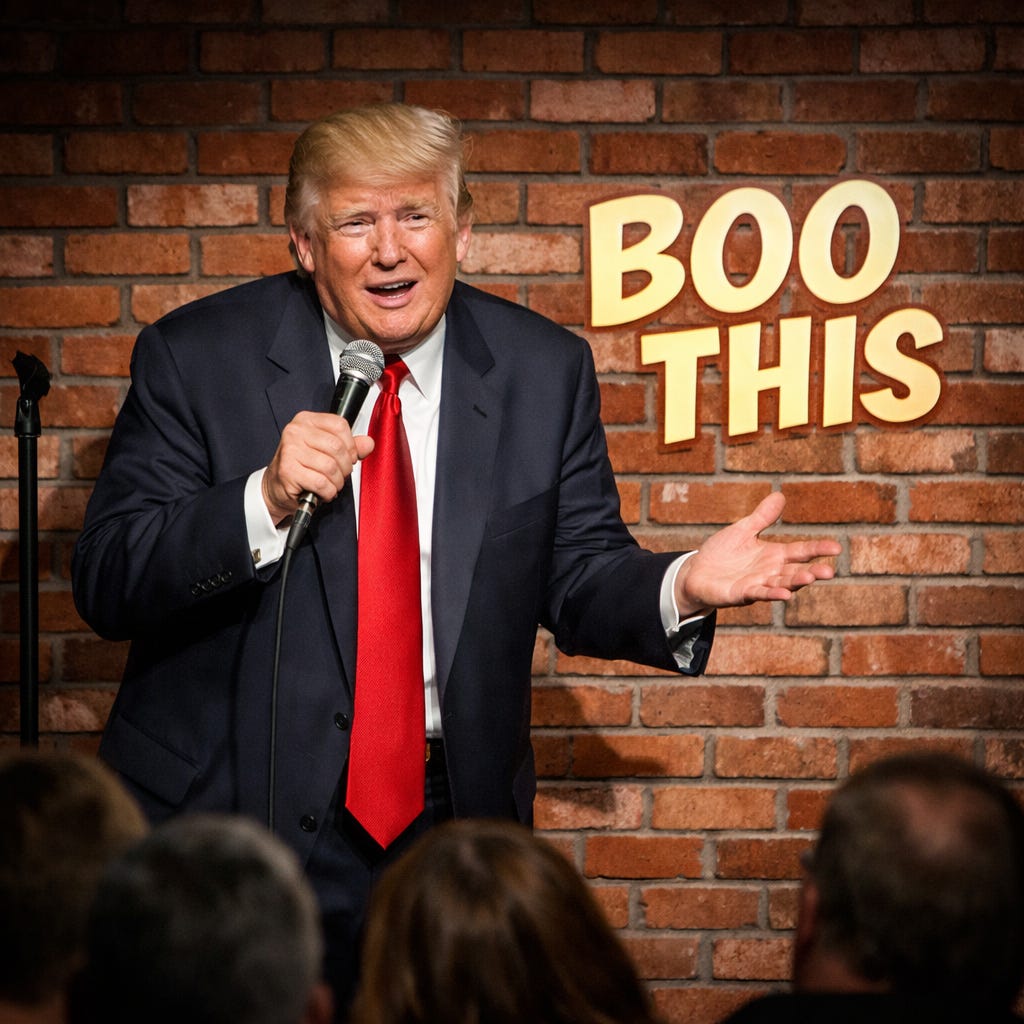
Boo this.
When Jeb Bush tried to get a word in during a debate, Trump said, “More energy tonight, I like that.” That is classic Rickles, who was forever turning to the other guests on talk shows and saying, “Are you still awake Charlie? You’re staying up late tonight. Very good.” Rickles even made that joke when he performed for Reagan’s second inauguration. After a series of cracks about Charlton Heston and Elizabeth Taylor, he turned round and went: “Is this too fast Ronnie?”
There is a continuity between this and the more demeaning approach Trump takes with reporters. Telling Jeb Bush “Oh you’re a tough guy Jeb, I know” was exactly what Rickles would have said.
When Trump called Joe Biden Sleepy Joe, that was a Rickles moment. So it was during the debate when he responded to Biden’s comments by saying, “I really don’t know what he said at the end of that and I don’t think he knows either.” When he told reporters about people saying he closed his eyes during a three-hour Cabinet Meeting, “Look, it got pretty boring,” that was a Rickles move.
Trump, like Rickles, loves to roast people. “I mentioned food stamps and that guy who is seriously overweight went crazy.”
In the 2024 election he got laughs by imitating Biden looking confused, just like Rickles joking about Letterman having Alzheimer’s. When he told a woman reporter, “I know you’re not thinking: you never do,” that was pure Rickles. This is why there’s a whole genre of YouTube videos where people compile Trump roasting and insulting people.
Sometimes he gets booed, like when he told Jeb Bush to be quiet. And then he snaps back like Rickles. “That’s all his donors out there. Boo this.” That is a classic Rickles mode. His jokes often crossed the line, and when they did, and the audience hissed a little, he actually said, “Boo this.”
Trump knows what Rickles knew—when you are playing the game, you have to snap back. That’s what keeps people entertained. But if Rickles’ act was all a game, Trump’s is not.
Reagan had quite an opposite style. He knew how to pause for effect. His jokes were about ideas, not people. He was ideologically consistent. His delivery was even-tempered and charming. Reagan was a friendly uncle. Trump is a nasty uncle.
Something all of us would like to do if we had no class
In response to the idea that he was offensive, Rickles said “all I do is laugh at ourselves.” He thought the “offbeat words” people disliked in his act were “in the eyes of the beholder.” In an entirely serious moment on the Cavett show he compared his father’s ability to hug a woman without it being dirty to many other men, who, if they hugged a woman, would make them uncomfortable. “It’s the way you do something.” This is a typical analogy for Rickles. But it cuts to the heart of the issue. Of course, he concluded this moment by saying, “And I tell you Dick, from the bottom of my heart: I never liked you.”
“You see,” Cavett laughed, “you can’t be serious.” Cavett then continued,
I think people don’t admit that deep down inside that you do something on the stage that all of us would like to do if we had no class.
This is what Trump represents. For some people, it is always offensive to say these things. For others, Rickles was a sort of pretense that acted like a valve. Donald Trump is now that valve. He says things people want to be able to say, however unacceptable or offensive they might be.
Libidinal liberalism?
It’s a longstanding point of progressive liberal politics that speech can be violence, or that nasty words can have real world consequences. In a world where micro-aggressions are problematic, Trump is macro-aggressive. Another variation of liberalism, as argued by Oliver Traldi, believes that these speech vices might act as a sort-of safety valve.
Traldi posits that “libidinal liberalism”
is the idea that many of the behaviors governments try to restrict are driven by basic, urgent, perhaps irrepressible human drives. The specific behaviors that are restricted, on this view, are merely the outlets for these fundamental drives, and the restriction is said to “bottle them up.” The idea of “bottling up” is that the drive is just made more intense by being contained, and that its inevitable expression will be more extreme, dangerous, or violent than it would otherwise have been.
Libidinal liberalism argues that pornography might reduce violence towards women “by providing a safe outlet for male sexual desire” or that legalised abortion allows those abortions that would already happen to happen safely.
Some liberals believe in the perfectibility of human society. They think we can overcome the offensive humour of Don Rickles. The libidinal liberalism thesis would say it’s little wonder that so much offensive speech appears on Twitter or in the President’s rhetoric when we took away the safety valve of offensive stand-up comedy. Without people like Don Rickles, the human urge to say offensive things—or to hear offensive things being said—is bottled-up until it cannot be contained.
And, in this case, it re-emerged in the political rhetoric of the President. Classical liberals and libertarians are often guilty of valuing freedom so highly that they don’t take enough account of the real costs and harms of things like drugs, pornography, and online radicalization. The rejoinder, which Traldi discusses, is the idea that pornography is not merely a safety valve but something that creates new, darker desires. On this view, Trump’s rhetoric is not merely a re-emergence of Rickles’ humour, but a dangerous replacement of it. What is funny in the comedy hall becomes scary at the political podium.
Either way, what Traldi says about Trump and his removal from social media platforms might in turn apply to the emergence of political correctness that saw Rickles’ style of humour become unacceptable.
…the libidinal line of reasoning says that Trump and his fans are bad for America and the world, that they’re probably genuinely evil or even white supremacists, but says further: If you ban them, they’ll have to go somewhere; they can’t be extinguished; they are something we have to control and channel.
Rickles was not a white supremacist, but his offensive remarks made people laugh for a reason, and they did go somewhere. The White House.
The imperfectability of man
I think of this not as libidinal but tragic liberalism. Tragic liberalism accepts that while human flourishing, progress, and improvement are central to the liberal project, humans are not perfectible. Human society cannot attain utopian goals. Some darkness always remains.
There is a scene in Coriolanus when the great war hero comes to dinner with his former enemies. Having been exiled from Rome, Coriolanus has come to Rome’s nemesis to discuss an invasion. Shakespeare’s genius is to not show us the discussion between the war-like generals, but instead to have it relayed second-hand by the servingmen. One of them comes rushing in to the kitchen, full of the exciting news that war is being discussed. Rather than reacting with despair, the servingmen are excited. One of them says,
Why, then we shall have a stirring world again. This peace is nothing, but to rust iron, increase tailors, and breed ballad-makers.
And another,
Let me have war, say I; it exceeds peace as far as day does night; it’s spritely, waking, audible, and full of vent. Peace is a very apoplexy, lethargy; mulled, deaf, sleepy, insensible; a getter of more bastard children than war’s a destroyer of men.
Aren’t these the sort of sentiments we heard from Rickles and Trump? Can’t you just hear Rickles saying to the audience, “You sir, what do you do? Ballad maker. Of course you are.” And isn’t that phrase “it’s spritely, waking, audible, and full of vent” exactly what people want from Trump? He really is audible and full of vent.
In retrospect, while Rickles was distasteful and unkind, we might wonder if his approach to comedy was more liberal than what we have now with Trump’s rhetoric. In the setting of a stage, offensive humour can be regulated—Rickles went out of date, he was booed, people had to pay—or not pay—to hear him. Society moved away, on the whole, from that sort of material. But now, Trump is audible and full of vent and we all have to listen. It is no longer merely a joke in bad taste, it is a mode of governance. Rickles was a vulgar ballad-maker; Trump is a maker of wars.
Rickles said, “I make fun of the President. I make fun of everyone. That’s America.” Well, now it is the President making fun of everyone—and the joke is on us.
There’s still a strain of this sort of comedy today. When Julie Walters was asked where she met her husband, she used the Rickles-esque reply: “Mind your own business.” When she did tell the story, it involved her husband fixing her washing machine. “He told me I needed a pump. I misunderstood him.” It’s pure Rickles.
Very interesting and reflective.
It also reminds me of the say that - we used to laugh at comedians and listen to politicians, now we laugh at politicians and listen to comedians
Spot on.