

Britain stands at the edge of a crisis. Andy Burnham’s plans for tax rises, water nationalisation, and a seeming indifference to the realities of economic growth put him at risk of being Labour’s answer to Liz Truss. The bond markets are watching and will not keep forgiving the UK her foibles. The world is what it is, and no amount of repeating the phrase “fiscal rules” will change that.
The UK is fiscally constrained. There is simply no more room to borrow without rates or taxes (or both) going up. Economic growth is weak. Charts comparing G7 growth numbers are pointless. The UK’s growth rate is not high enough to support the spending to which it is committed. France’s growth rate won’t change that. More pertinent is the fact that UK government ten-year-bond yields are some of the highest among all advanced economies.
It is easy to forget how bad things are in Britain. The facts must speak for themselves. Tens of thousands of people die on an NHS waiting list every year. 13.5% of all 16-24 year olds are not in education, employment, or training. According to the IFS: “once you adjust for inflation, the average working person in Britain earned a lower wage in 2022 than the average working person in 2008.” Meanwhile, a full 10% of the government’s budget is spent on debt interest. And every time the bond market gets scared, that number rises.
Meanwhile, the British voters think they are entitled to all this spending. No other country uses the NHS model, but it is unthinkable to reform the system. Pensioners who own their homes and have a steady income (with large capital reserves) insist that they are owed their government pension because they “paid in”—they never paid in for the triple lock system, of course. They are simply the beneficiaries of a political system that pays its voters. The situation is dire: the government spends more on welfare than it receives in income tax. (This includes pensions. Yes, pensions are welfare.) According to the IFS, the triple lock costs the government £12 billion more per year than it would have done if pensions had been uprated in line with average earnings since 2011. But no-one can tell the pensioners of the Home Counties they won’t be getting their above inflation increase this year.
Something has to give. And soon it will. If Burnham raises taxes too high he’ll get the same result as Rachel Reeves—rising unemployment. If he has too much of a chilling effect on business more people will leave the country. Even the talk of an exit tax will start productive tax-payers packing their bags. All of this will only give the bond markets more reason to push gilt yields higher. It is a vicious circle and if Britain is not careful she will find that she has caught a tiger by the tail.
The voters refuse to allow anything to be built. We desperately need reservoirs, houses, roads, rails, and energy generation. But someone, somewhere can always veto the build. Ever since Tony Blair, the UK has amassed rules and regulations—the Human Rights Act, judicial review, environmental review, and on and on—that stop people doing things. Britain has lost its national confidence in the ability of the country to look after itself.
When planning reform is debated, politicians claim that it is no good liberalising the market as there is no capacity to produce more bricks. Since when did we need Parliament to decide how many bricks the market could produce? Is this the attitude that built Great Britain? Is this how we created London and the Royal Navy? Is this how we started the Industrial Revolution, built the City, or won the war? Are we really foundering on the rock of such pathetic intransigence? We need to rediscover the confidence not to have to approve and predict everything and let the country go to work again.
The trouble is, no argument is worth anything. Britain does not want to change. Strong feeling cannot be persuaded by cold logic. Once Burnham takes over, Britain will have tried a PM from all corners of Parliament: Boris’s populism, Cameron’s middle-of-the-road liberal Toryism, May’s Home Office attitudes, Starmer’s centre-leftism, and Truss’s whatever-that-was-ism. All that’s left is the left. It is a fiction that there is a political solution to this economic problem. Either we make the reforms we know we need to make, or Britain continues to decline. That no politician has managed to pass these reforms shows the depth of the problem. It is a national pastime to blame politicians. But the voters refuse to pay them enough to attract proper talent. We are stuck with the second-raters we have.
We cannot go on thinking this is because of Brexit or Boris or the Tories or Starmer or whatever else. The problems are structural. Some of them go back to Attlee. Some of them have been festering for my whole life. 2008 exposed these problems. Change will require sacrifice. We will have to tell people that their house prices won’t keep rising thanks to the socialist Town and Country Planning Act and that their triple lock pension has to stop. We will need to accept cuts to welfare. As Fraser Nelson wrote recently: “recent trends have been consigning people on to Universal Credit sickness benefit at the rate of 5,000 every working day.” We just can’t do that over the long term.
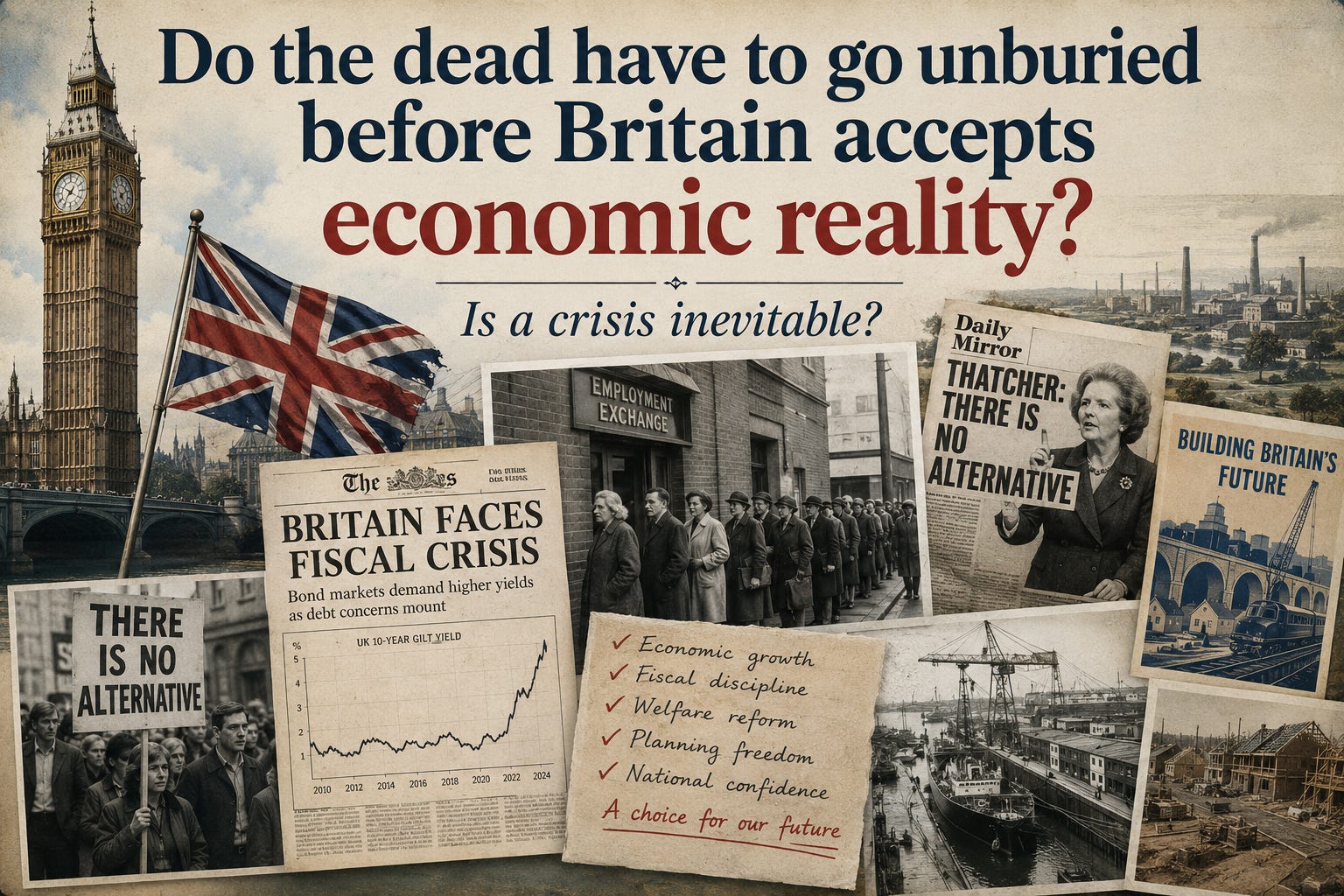
The last time things got this bad, it took an intervention by the IMF, a fiscal crisis, and the dead going unburied to force a revolution. It is easy to hate Mrs. Thatcher and her brimstone-and-vinegar attitudes. But she was right that “there is no alternative.” Soon enough, Britain is going to have to remember that motto. And unless we remember it soon, it will take another crisis to wake us up.
This time, of course, the world is different. We are behind on AI, entering a demographic decline, and resistant to the solution of immigration. America is less and less reliable. The EU is busy ignoring the future. We have had two lost decades. Can we afford a third?
If the crisis doesn’t come soon, it might come too late.
I'm pretty sure you're right that some vested interests need to be confronted (the pensioners) and some people need to be forced back into work - but where are the jobs? I don't understand why we can't make bricks - we always have, historically. We can make drones too. Why doesn't someone set up a factory for those, if that's what we need?
Hello Henry, very interesting post. I am a naive english 25 year old literature lover. In a spirit of friendly engagement, could I ask some questions? A) Given that half the growth of the past 20 years has gone to the richest 1%, how will more growth be the solution? Plus no mention of climate change and planetary boundaries, also a concern with AI. B) No mention of a wealth tax, redistribution, or the fact that the rich are inflating asset prices: how could a propertied democracy exist if the property is all owned by billionaires? C) Completely agree that there’s a lack of courage, selflessness, ambition etc etc, but isn’t that because many of the things we must do: energy independence via nuclear and renewables, building eco-houses that thermoregulate themselves, thereby shredding utility bills, going mostly plant-based to restore the beauty & ecosystems of the UK & free up land for nature & better human infrastructure; focusing on public luxury and private sufficiency rather than pushing everyone to feel like resentful, dissatisfied Steinbeckian "temporally embarrassed millionaires… are portrayed as uneconomic idealistic fantasies, but aren’t they actually the hard-nosed realities we need to face? No more pandering to a public told every consumer want (e.g. meat every day) is their right, damn the ethical, economic, and ecological consequences, no more allowing corpos to sell us Ultra processed foods and an ultra processed "social” media etc. Would appreciate your thoughts. Thanks!