


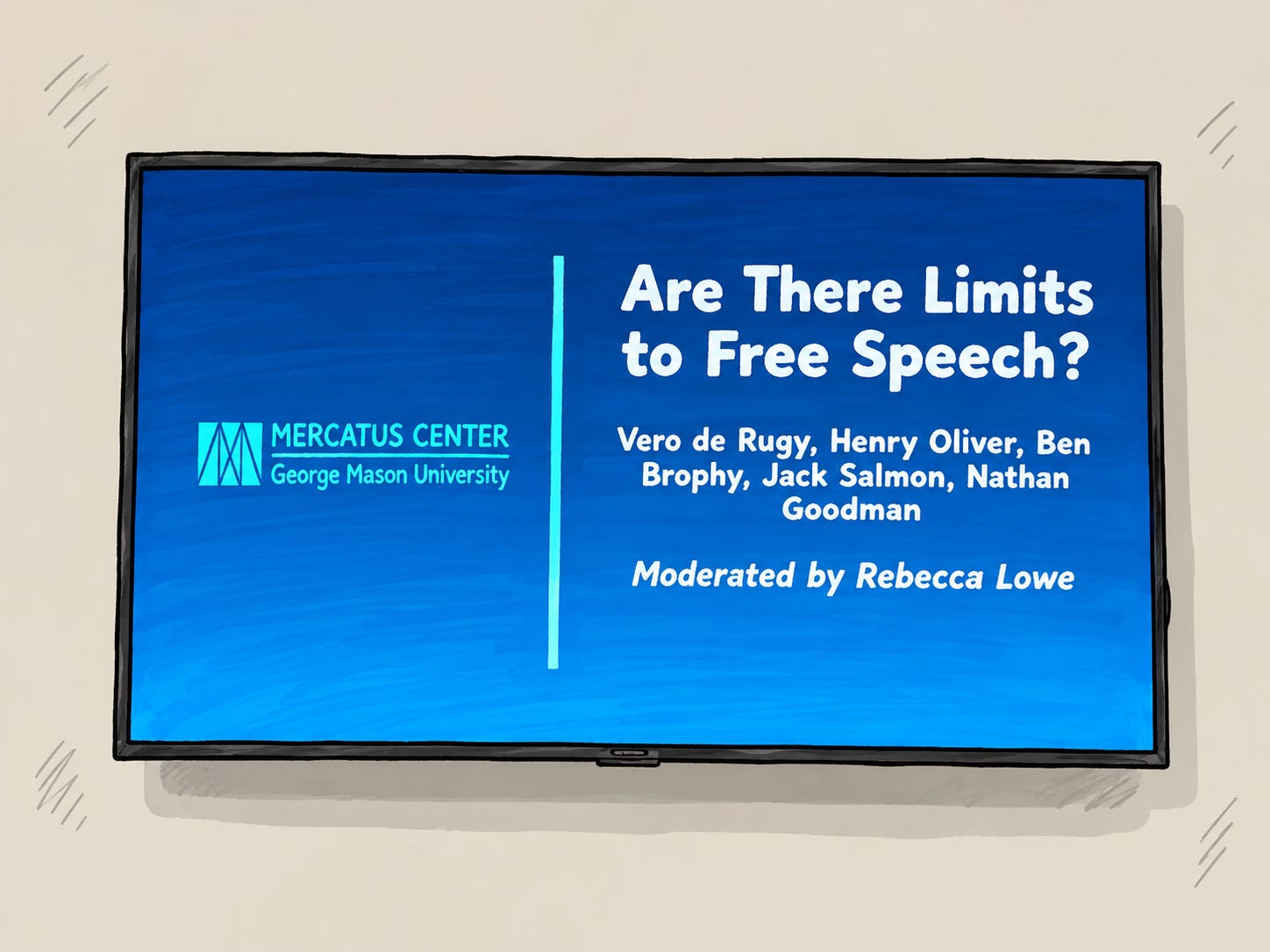
In response to demand, here are the opening statements from our recent Mercatus debate on free speech. We’ve each checked, and in some cases lightly edited, the following transcript.1
INTRODUCTION
Rebecca Lowe: Hello and welcome to today’s open session of the Philosophy Working Group. As you know, Philosophy Working Group is every Wednesday at this time. If you’re a philosopher and you want to come join Philosophy Working Group, you’re always welcome. To be a philosopher, all you’ve got to do is make an argument that you’re a philosopher.
Today, I’m delighted to have some of my very favorite people on this panel. We have Vero de Rugy, we have Ben Brophy, we have Jack Salmon, we have Nathan Goodman, and we have Henry Oliver. When I asked one of them, I won’t reveal who, if they wanted to take part in this debate, they said, “What’s the point? Who am I gonna argue with? We all agree on this!”
Veronique de Rugy: I think it was me!
Rebecca: Yeah, it was you! And you were the first person I asked as well, and I was like, man, this is going really well. She’s supposed to be my best friend here, and she’s like, I’m not taking part in your thing!
Vero: I’m here!
Rebecca: And yet she’s here! But that said, the joke is, of course, we can always find things to argue about. It was also before I revealed the specific question we would debate. So, this question — ‘are there limits to free speech?’ — is great from the point of view of a philosopher, because it can be interpreted in so many different ways.
If you’re a lawyer, you might go straight to thinking: are there legal limits in some particular jurisdiction? Let us compare them with the limits in some other place. Or maybe you might think: is this a question of personal regulation? Like, are there things that I shouldn’t say to other people? There are these many ways in which this can be interpreted.
So, I’ve made this panel purposefully broad, in terms of people’s disciplinary expertise. We have everything from philosophy to literature to theology to economics: we have a broad range. We also have people, you’ll have noticed, from a broad range of countries of origin. And the country that is really really sliding on this stuff is overly represented on this panel: the goal is to destroy Great Britain today! Or at least to warn you what happens if you follow down our route.
OPENING COMMENTS
I’m going to start by answering the question myself, because I’m going to give an answer that I think few people would give. I’m going try and give the deepest answer to this question, because why else would you have a philosopher on staff? And that answer is something like: what’s going on? That is, when somebody is limited from speaking freely, what’s going on?
I’m going give you a quick little list of instances which I came up with, and my guess is you would agree, in all of these instances, or at least in most of them, that, in some sense, somebody’s free speech is being limited, constrained, but in quite different ways.
I’ve got a swollen, broken jaw, and literally can’t utter words. A bandana is tied tightly around my face. I’m locked in a cupboard in the cellar, and okay I can utter words, but there’s nobody there to hear them. I’m in a coma. I’m in a forest far away from anyone else, and I have no communication devices. I’ve lost the key to the clubhouse where I’m supposed to be speaking on a panel. Somebody’s disinvited me from speaking at the panel in the clubhouse. I’m on a mountain pass above a school among signs that say, “Speech will cause avalanches!”. The government of the place I’m living in is fining inhabitants a million dollars if they say certain words. A robber’s holding a gun to my head. And then, a couple of ones just for the philosophers in the room. All the things that I do have been determined since before I was born. And the second one: an evil demon controls the content of all of the things I think and say.
Now, my guess is that you’d probably agree, in most of these instances, if not all of them, that my free speech is limited. But quite clearly, many different things are going on. If you want to be really bored, you can come to me afterwards and hear my complex taxonomy, in which I come up with three categories, to deal with this. I think this work is very important and groundbreaking! But, for now, I’m just going to tell you two very simple distinctions you can apply to these instances.
The first is that, in some of these instances, you don’t have the basic capacity to speak freely. For instance, if all of the things have been determined since before you were born, it’s just never going to be the case that you speak freely. Whereas, in some of them, you have the capacity to speak freely — in the sense of uttering words and determining their content — but you’re being prevented from exercising that capacity. The one where the bandana’s tied around my mouth, for instance. So, we have a capacity/exercise distinction going on.
And then the second distinction is that there are examples where it’s not possible for you to speak freely — whether that’s because you don’t have the capacity, or you can’t exercise it. And there are ones where you do have the possibility, but you choose not to, because of some expected consequence. So, you can speak freely if someone holds the gun to your head. I mean, that’s why they’re holding the gun to your head, right? If you couldn’t, what’s the point of holding the gun to your head? But you choose not to, because you don’t want your brains blown out. So, there’s a possibility / impossibility distinction going on.
These two distinctions seem important to me. Now, maybe it’s just nitty-gritty philosophy stuff, but I think working out what’s going on is important when we come to things like, ‘What should there be laws about?’ and ‘What are our moral obligations?’ These kinds of questions.
So, that’s my attempt to address this question from a very fundamental philosopher’s point of view. I’m now keen to hear what the others want to say. And since I persuaded Vero to come, after all of this argument between us, I’m going to turn to her now. Vero, are there limits to free speech?
I’m not a lawyer, I’m not a philosopher. I just have not much to say about it, so I’m gonna delegate my thinking to FIRE [Foundation for Individual Rights and Expression]. Basically, I agree with them. The limits: you can’t threaten people. You can’t whip up a crowd into burning down a building, right now. That kind of a thing I would be okay restricting. You can’t knowingly lie to ruin your neighbors. Your politicians you can, I’m fine with that. And you can’t commit fraud. That’s the whole list, and it’s short — and each time I hear people want to actually add things to this list, it makes me really nervous. If you started to grill me about a particular example, I may have to think about this — but overall, that’s kind of my list.
And one of the reasons why I really want that list to be incredibly short is because I come from France, which has a completely different approach to freedom of speech, freedom of religion. For instance, freedom of religion in France — it’s not like here, where you actually have freedom of religion; in France, it’s the absence of religious signs in public space. And that leads to all sorts of really demented situations.
Anyway, so let me give you some examples of, in France, what happens, and who gets arrested, fined. So — do you guys know Brigitte Bardot? If you’re too young — just Google it, pictures of Brigitte Bardot. She used to be extremely hot. She happens to hate Muslims and immigrants, and so this national icon has been convicted five or six times, the last time in 2021, for writing an anti-Muslim letter. Her spokesperson got fined $4,000 for sending the letter to the newspapers — as she was hired to do. They’re horrible opinions, but in France, you can actually be convicted for stuff like this.
Now, it doesn’t just happen to cranky right-wing celebrities. In 2009, 11 activists went into a supermarket — that sounds like the beginning of a joke— and they started distributing leaflets to try to convince French people in the supermarket not to buy Jewish-linked products. They got convicted for inciting discrimination. That’s an actual thing in France. It took 11 years and the European Court of Human Rights to tell France they couldn’t do that.
Three days after October 7th, a union official in France published a leaflet that blamed the occupation of Gaza for the attack — well, it’s a terrible take, but he got one year in prison, suspended, for glorifying terrorism. Two and a half years later, the appeals court thankfully overturned it.
There are a bunch of others, like literally Holocaust denial, which is a really stupid idea, but it’s illegal in France. The famous case here is Jean-Marie Le Pen, who is the father of the person who may be the next president of France, Marine Le Pen. I mean, she’s not like her dad though she’s all sorts of wrong, but not like her dad. He was indicted and convicted for describing the Holocaust as a “detail” of history. Again, just a horrible take. And there’s a comedian, Dieudonné [M’bala M’bala], whose shows were canceled in France for making antisemitic jokes. Again, horrible, but should it be illegal?
Here’s my favorite case: a guy, during COVID, put up a billboard of Emmanuel Macron, the president of France, as Hitler, to protest the COVID passports and restrictions. I think it’s pretty awesome. Sure, I hate comparing anything to Hitler — but it’s kind of awesome still, right? The guy literally ordered, printed, a billboard. But he got fined 10,000 euros, and it took 3 years for the highest court to finally decide it was satire after all.
The worst part of all of this is that instead of saying “free speech is the norm, and there are just a few very short exceptions,” France started by saying, “here are all the things you can’t say” — all the categories. It started in 1881. They keep adding to it since. What ends up happening is the culture itself doesn’t understand — there’s no conception of — real free speech. Most French people think this is totally fine. They think you shouldn’t have a right to express something as horrific as denying the Holocaust, or simply saying something really mean and disparaging about a politician. And that is the problem.
I would rather live with the morons who say things that they shouldn’t be saying (including me, sometimes), rather than live in France.
Ben Brophy:
My instinct was similar to Vero’s — I want to take a look at what are the actual legal limitations on speech in the US, and she mentioned all of those. The one that she didn’t is that there can be constraints on speech when it relates to construction and noise, restrictions on labor during the day. In Alexandria, you can’t do yard work before 7 AM — which just made me think that the NIMBYs are everywhere, even in speech, which is good to know.
But why are there so few restrictions on speech in the United States? It’s because of the First Amendment. And it’s important to note that the First Amendment restricts government from infringing on our speech. This is why we love the First Amendment — we have something tangible that our free speech is based on (unlike in Great Britain, where it seems to be based on vibes over the past 800 years, which is no bulwark against infringing upon speech now). I’m grateful for that.
Though I do think, after we limit the government’s ability to restrict speech (as we should), after that, it’s up to us. There aren’t legally many constraints on free speech, but morally, there are many constraints on our free speech. What we say has an impact, has meaning, has value. We need to figure out where those moral lines are, and we ought to encourage one another to pursue more moral speech.
Of course, a natural question might be, well, why not legislate that morality? Why not legislate these moral limits? The temptation for administrators everywhere, through all time. Because a ‘moral ought’ is far different from ‘a magistrate will punish you if you say this’. There are different jurisdictions in operation here. The government’s doing one thing; the obligations we have to each other morally are an entirely different thing. These jurisdictions are the state and the individual conscience of a human being.
And I think matters of conscience are far too important to be handed over to a government. It’s not something we should outsource. It’s something we need to figure out with ourselves, within the communities we are a part of, with one another. Roger Williams believed that civil magistrates are not competent or authorized to use coercion to settle “soul matters,” which is a loose reference to the idea of conscience.
So, why is this important? Why is it important to have these protections for speech, while at the same time saying that there are moral implications to our speech? Well, ironically, or perhaps paradoxically, having free speech allows us to work out the moral implications of speech together. If I make a moral claim, and I’m constrained by the government from making that claim, then I don’t get the opportunity to find out that I’m wrong.
This is a huge and important thing. I need the people around me to help me figure out, “okay, you’re not quite seeing that right,” or I need to persuade all of you that I’m right, and you ought to come over to my side. And if a magistrate who has no idea about these things gets involved, it constrains our ability to have an honest conversation.
Speech is an extension of conscience. And conscience is fundamentally part of what it means to be a human being — this idea of moral reasoning, thinking about what’s right and wrong. Human beings have a fuller-developed sense of this than any other living creature on the planet. And so, for us to be fully human, we have to have the freedom to work out what our conscience dictates, and free speech is required to do that. So: are there constraints on free speech legally? Not many. But morally, there are countless restrictions on free speech. It’s up to us to figure out what those are.
I figured you’re all going to agree, so I was going to advocate for a Ministry of Truth. No — I think it’s difficult to disagree with everything that’s already been said. I think you both nicely outlined the legal restraints that exist. I’ve tried to approach this from an economist’s perspective, and it’s difficult.
Mill says that opinion is never fully the whole truth, and to get close to the truth you have to have what he calls a “collision of adverse sentiments.” So, that means we have to have open dialogue in order to challenge each other’s bad ideas, to get as close to the truth as we can.
But there’s also a Hayekian perspective on this — that having open, free dialogue allows for a discovery process, similar to Mill’s argument. And when government intervenes and dictates what is good speech, what is bad speech, what is dangerous speech, we don’t have that discovery process. We can’t get to the root of what truly is dangerous versus merely offensive speech, for example.
There’s also a Madisonian argument to be made — that you have to have open dialogue and free speech in order to have a well-informed public. Especially for a well-functioning republic, you have to have a well-informed public, and free speech allows for that. Unfortunately, in more recent years, we’ve been seeing a move toward the idea that speech itself is violence, and offensive speech in particular is a form of violence, so we have to have restriction and censorship on these particular types of speech.
This is particularly dangerous — we’ve heard examples about France, and we’ll hear a lot today about examples in the UK, but there’s actually some empirical literature on this. There was a research paper a few years ago that looked at more than 100 different countries and different levels of free speech, and the different levels of social conflict in those places, and they found that, actually, the more free speech you have, the less social conflict there is. Speech isn’t violence — speech leads to less violence. When people are allowed to vent, it acts as a kind of safety valve. Think about all the uncomfortable conversations, protests, debates, and journalist stories we had leading up to the Civil Rights Movement — it was these uncomfortable conversations that shifted public opinion and got us to that point.
To give an example: in 1944, 44% of Americans believed that black Americans should have equal opportunity to work as white Americans. By 1966, that was 87%. That huge shift in public opinion didn’t happen by the stroke of a pen — it happened because we were having these uncomfortable discussions publicly that shifted policy in that direction.
I have to talk about the UK, because it’s just so egregious. There was a report by Big Brother Watch — a think tank in London that keeps an eye on violations of free speech. They filed an FOIA request with police departments and found that, over a five-year period, there were over 62,000 arrests of people who had posted offensive things online, under the Communications Act — one of the most egregious laws that violates free speech in the UK.
Of those 62,000 people who had been arrested, around 12,000 were eventually convicted. In other words, four in five of those people were never convicted at all, but they would have gone through these processes — they could have been interviewed by police officers, had their phones confiscated. It’s not just the alleged crime itself, but the process that punishes people for things they haven’t even done.
I broadly agree with the legal limitations that exist. I don’t know how many legal scholars there are in the audience — I’m not one, but maybe Alden [Abbott] knows — the Brandenburg v. Ohio Supreme Court case is kind of the default on this now, legally speaking. Inciting imminent violence is the strongest ground to restrict speech. I broadly agree with that definition.
So, as my excellent co-panelists have already argued today, free speech serves at least two key values. As Ben eloquently told us, free speech is important for freedom of conscience and for our capacity as individuals to develop ourselves. As Jack just illustrated for us in a Hayekian sense, freedom of speech is important for creating a society that can learn, adjust, and develop. Scientific progress has always resulted from scientists developing theories that dissent from prevailing theories. Likewise, political and moral dissent has been vital to moral progress on a whole range of issues — the Civil Rights Movement is just one example. Now, one important thing that’s closely related to this is that suppressing speech insulates the powerful from criticism and contestation.
And powerful people like being protected from dissent, criticism, and contestation. They like holding unaccountable power. This means that wherever the appropriate limits of free speech are, and wherever the legal lines are drawn, those who hold power have incentives to try to push those boundaries, to try to expand what falls within, and is classified as falling within, whatever exceptions we draw for free speech. We should always expect political leaders to push for censorship and repression that’s impermissible.
Our task as liberals is to push back against political leaders when they do this. And what I want to argue here is that there’s plenty for us to push back on in the United States today, despite the important protections offered by our First Amendment.
So, one set of examples: in Minneapolis and St. Paul, Minnesota, earlier this year, as well as at the end of last year, thousands of ICE and Customs and Border Protection agents occupied the city.
They carried out deportations against immigrants, but also, in the process, brutalized and even killed US citizens in the vicinity. Minnesota residents organized in opposition, as is their First Amendment right. They organized Know Your Rights trainings, held protests in the streets, watched and monitored ICE and Border Patrol agents (you do have a First Amendment right to watch and record law enforcement and agents of the state). Now, the federal government spied on these Minnesota residents, sending undercover agents to Know Your Rights trainings, protest planning meetings, churches, and other First Amendment–protected events.
This surveillance operation was called Operation Puppet Master. They have since brought federal conspiracy charges against 15 people allegedly involved in these protest movements. The indictment, and federal statements about the indictment, classify the defendants as tied to Antifa, short for anti-fascist. Under a federal directive called National Security Presidential Memo 7, or NSPM-7, beliefs such as “anti-fascism, anti-Americanism, anti-capitalism, and anti-Christianity” are to be treated as a priority for federal counterterrorism efforts and investigations. These ideological commitments are treated as tied to terrorism. I’m not going to argue to you that people who hold these beliefs are incapable of committing crimes of terrorism: people with all sorts of beliefs can commit violent acts, or acts of property destruction, that are not First Amendment protected.
But when the government singles out particular groups of people for special scrutiny because they hold political beliefs the administration disagrees with, that poses a problem. As Adam Goldstein, an attorney with the Foundation for Individual Rights and Expression (which Vero helpfully quoted from earlier) points out, “the administration outlined a plan linking viewpoints it doesn’t like with domestic terrorism, and a plan to investigate people with those viewpoints. […] That is, functionally, a disincentive to freedom of expression and freedom of belief”.
Now, last month, the administration escalated their use of federal counterterrorism law against those they disagree with politically. The State Department designated an Italian tech collective called Autistici/Inventati as a “specially designated global terrorist”, and the Treasury Department subjected them to sanctions.
This organization operated an encrypted email service, a blogging platform called NoBlogs, and various other free-at-point-of-service technological services for groups and individuals who hold anti-fascist, anti-militarist, anarchist, and anti-capitalist political views. Now, the State Department, in their statement classifying them this way, did identify some users of these services who they allege have committed crimes, including terrorism and sabotage. But while some users of the services committed or praised crimes, there were also users who simply distributed political literature, organized protests, ran anarchist book fairs (where various people distribute literature, sell patches and zines, and so on), operated an academic journal (Anarchist Studies, which until recently had its blog on the NoBlogs platform), or put out political podcasts, such as The Final Straw Radio.
Due to federal sanctions, PayPal shut down Autistici/Inventati’s PayPal account, Banca Etica (the Italian bank they had an account with) closed their bank account, and the organization has now shut down. All of this occurred with no charges ever needing to be filed in any court of law against Autistici/Inventati. No trial, no due process, no warrant. The executive branch claims the power to unilaterally impose these types of sanctions on any foreign group.
The “specially designated global terrorist” classification traces back to an executive order signed by President George W. Bush in September 2001, after the September 11th attacks — a horrible tragedy. That crisis was used as the occasion for the Bush administration to set up a classification under the IEEPA, the International Emergency Economic Powers Act, which some of you might recall is also what the Trump administration used — unsuccessfully — to try to implement tariffs without going through any legislative action. The IEEPA was used, in a much more genuine crisis, to create a category that the State Department can unilaterally apply to any foreign group it deems terrorist.
At first, they applied this to groups where I wouldn’t dispute the classification — Al-Qaeda is a terrorist organization, doing things that I would say are not First Amendment protected. But some of the other groups this is being applied to — again, with no charges, no due process, no court proceedings, and no clear way to contest it in any US court of law (especially because you would need to, in order to even hire the services of a lawyer or acquire funds to hire a lawyer, potentially overcome some of the relevant sanctions on anyone transacting with you). This makes it all too easy for the executive branch to clamp down on foreign groups it doesn’t like, thereby making them radioactive, and preventing both mutually beneficial exchange and speech acts that implicate or connect people to these organizations. I’d say that’s pretty dangerous. The costs for speakers associated with the designated group can be severe. The administration functionally has the power to unilaterally impose serious costs on its political opponents.
Now, I don’t want to be too alarmist here. As Ben pointed out, the First Amendment provides relatively strong free speech protections compared to most constitutions worldwide. I don’t think we’re doing quite as poorly as the UK or France yet. But even in America, free speech is threatened by the power of the executive branch, especially when it is bolstered by powers acquired over decades in the name of national security and counterterrorism. To truly protect free speech, we need more than just a set of good court rulings under the First Amendment — we need to rein in executive power. Otherwise, the executive branch will continue using surveillance, sanctions powers, criminal prosecutions, militarized police, and more to chill and stifle dissent. Thank you.
It’s three of you, and until now, you haven’t dumped on England as much as I have done. Don’t worry, I can redress that balance. I’ve done France as well.
We had, on the last day of the intern program, a big discussion with most of them, and we played a game where you have to say your most controversial opinion — which has to be a real controversial opinion, you can’t just be like, “Oh, I’m pro-life.” It has to be something that, if you said it in polite society in most places, you would be asked to get out. It was really good. ‘Same-sex incest should be morally acceptable’ was the winner. Yes, your facial expressions are telling me that you would have had fun at this game.
But what happened was: the group primarily had the sort of opinions you would expect a group of young people to have, and a very small number of them were right-wing in a kind of retrograde manner. And there were times when all the self-professed liberal, progressive, cuddly types would almost actually hiss when one of the young men would say something admittedly stupid. And they would rush in and be like, “Really? You’re… how… can you… can you…” and it’s like, just let him speak. He does sound pretty bad, but you have to give him a couple of minutes to tell you what he’s actually saying.
And I think the biggest limit on free speech, usually, is happening in that way. It’s to do with customs and manners, it’s to do with the way in which we are prepared to let each other behave. Everyone in this room has had their speech limited quite strictly by their parents as a child, right? We all know: “I don’t want to hear that.” “Who taught you that word?” “Don’t tell your mother I taught you that word.” And the point of growing up is that you’re able to exercise your free speech in a way that is broadly acceptable to the people you are with.
No one has really used their opportunity on this panel to say something outrageous — obviously Vero came pretty close with the Brigitte Bardot comment. But there’s no actual sense that anyone in this room is going to violate some norm of speech, even though we are, I would guess, more comfortable with each other saying terrible things than in a lot of other organizations.
What goes wrong in a country like England is that the prevailing feeling of what you are allowed to say changes. It’s not fundamentally that we don’t have the First Amendment, right — that would be great, and we should have it. But the problem really is that we have reached a place, culturally, where we think it’s such a big deal that immigrants are taking over, and English culture is dying, that the only way people feel they can save it is to just start putting restrictions on what people can say.
Now, that’s obviously morally wrong, but it’s also not going to work. If you want to preserve some kind of lost culture, it’s not going to work by just telling people they can’t say stuff from a new culture — at that point, you’ve already lost, right? There’s a kind of desperation built into what’s going on. Which makes the politics of it incredibly difficult.
Some of the time, when I think about what happens when a large group of people in a country want to restrict speech, it’s because the political system has persistently refused to do what the voters have asked for. It basically is the case that, for most of my life, there has been a majority vote at the general election for less immigration, and we’ve ended up with a lot more immigration. I’m fine with immigration — I think it’s been great. But you have to accept that the voters will find some other way of trying to get the restriction they want.
Since we don’t have a First Amendment, it’s easier to get the speech restriction — the people who passed the Online Safety Act really gave those voters an opportunity to enforce that. And so even if we passed, by some kind of weird magic, a First Amendment in England, you would still have this problem: an awful lot of people in the country just don’t think certain things should be sayable, because it is threatening the cultural fabric of the nation, or whatever.
I hear this at conferences. This isn’t like if you go to the pub in a Lincolnshire village (actually, they’re all quite nice in Lincolnshire, but they’re sort of famous for being racist), and all the right-wing farmers are sitting around talking. You will hear this at a conference of people who work in Westminster, who are supposed to be on the right, supposed to basically be in favor of limited government, and they will have self-organized conference sessions to talk about the problems — the problems of immigration and free speech, and the sorts of restrictions that need to be put on what can be said.
So, in the room where you’d expect people to be talking about John Milton and John Stuart Mill and the good old days, what you’re getting is: “Well, we need to tell people that they can’t say this about Islam, because that’s not the kind of country we are.” So, that is a kind of cultural problem that you can’t solve, I don’t think, within the space of a generation. So, I think one of the basic limits on free speech that I worry about most is just: if I don’t want you to say that, I can find lots of ways to make you feel uncomfortable.
Thanks to Greta Dieck for her help with this!
A good time was had by all