

This is my response to Rebecca’s recent piece about whether Smith is a philosopher or economist. The rules of the debate were that you have to choose one. I refuse the terms of this debate! But I am a good sport (also, she’s my boss), so I decided to argue for philosopher.
Only a philosopher could argue that despite the fact he was the only one to condemn slavery, Adam Smith is not a great philosopher, as Rebecca Lowe did recently.1 This is why Rebecca is wrong to dismiss The Theory of Moral Sentiments — it contains some of Smith’s most powerful writing about slavery. In a discussion about “savages”, Smith says that savages experience “extremities of hunger” and are “habituated … to every sort of distress” and is unable to give in to the passions excited by this distress. Discipline is necessary for survival. This is part of the difference between the civilized and the savage: “Before we can feel much for others, we must in some measure be at ease ourselves.”
This self-control is seen most severely in preparation for death. “Every savage is said to prepare himself from his earliest youth for this dreadful end.” Smith recounts an idea that savages learn a song of death, which is to be sung after a savage has been captured and tortured—it is full of insults to the tormentors. In his account of this “contempt of death”, Smith makes a powerful statement about slaves and their masters.
The same contempt of death and torture prevails among all other savage nations. There is not a negro from the coast of Africa who does not, in this respect, possess a degree of magnanimity which the soul of his sordid master is too often scarce capable of conceiving. Fortune never exerted more cruelly her empire over mankind, than when she subjected those nations of heroes to the refuse of the jails of Europe, to wretches who possess the virtues neither of the countries which they come from, nor of those which they go to, and whose levity, brutality, and baseness, so justly expose them to the contempt of the vanquished. (V.ii)
Here we see Smith showing the supposedly civilized slave masters as lacking sympathy and the African slaves—who were so freely traded in Smith’s day—as the ones full of magnanimity. Smith is praising the slaves for their self-command, a virtue he prizes above all others. He goes on to contrast this with the emotional nature of modern European civilization, which is much more weepy than ancient Rome.
Shortly afterwards, in one of the most unforgettable sections of The Theory of Moral Sentiments, Smith argues that it is custom which accommodates men to such evils as slavery. In ancient Greece, infanticide was allowed. Smith says this must have begun in barbaric times and survived into the era of civilization because
Uninterrupted custom had by this time so thoroughly authorized the practice, that not only the loose maxims of the world tolerated this barbarous prerogative, but even the doctrine of philosophers, which ought to have been more just and accurate, was led away by the established custom… (V.ii)
It is characteristic of Smith to make these barbed remarks about philosophers. In The Wealth of Nations, he quotes Cicero to the effect that no idea is so stupid that some philosopher will not entertain it. It is sometimes said that The Wealth of Nations condemns slavery on economic grounds, but makes no mention of injustice. This is not quite right.
The pride of man makes him love to domineer, and nothing mortifies him so much as to be obliged to condescend to persuade his inferiors. Wherever the law allows it, and the nature of the work can afford it, therefore, he will generally prefer the service of slaves to that of freemen. The planting of sugar and tobacco can afford the expense of slave cultivation. The raising of corn, it seems, in the present times, cannot. (III.ii.10)
The pride of man makes him love to domineer… perhaps this is not an outright condemnation of slavery on the grounds of abstract justice, but it is a clear statement of the moral corruption which slavery involves. Dan Klein documents how Smith’s writing in Theory of Moral Sentiments was the inspiration to later abolitionists. (He also notes that Smith was not the only Glasgow philosopher to condemn slavery.) Smith’s paragraph about the magnanimity of the Africans inspired the 1764 pamphlet An Essay In Vindication Of The Continental Colonies Of America, from A Censure of Mr. Adam Smith, in his Theory of Moral Sentiments, later quoted by Clarkson. (Wilberforce quoted Smith, too.)2
Smith may not have had a great influence on the discipline of philosophy, and Theory is more of a work of observation than philosophy, but he had a not inconsiderable part in the argument for abolition. Philosophers are fussy about the question of how arguments are made, and rightly so, but perhaps Smith is a standing caution to their discipline. He is dismissive in Book V of The Wealth of Nations about the inadequate teaching of philosophy in the English universities of his day, writing “if subtleties and sophisms composed the greater part of the metaphysics or pneumatics of the schools, they composed the whole of this cobweb science of ontology, which was likewise sometimes called metaphysics.” Maybe he was up to something that philosophy could learn from…
Smith argued against the poor philosophy professors of the time, not the discipline itself, but his criticism is important. Too much inwardness can make philosophy a self-defeating subject. Smith preferred to work from a “foundation in nature”, criticizing thinkers like Wollstonecraft and Mandeville for not accounting properly for people’s full range of feelings. The morally formative nature of social life is his subject. In his understanding of economics as being institutional, social, depending on “rivalship and emulation”, he was not a scientific economist but a humanistic one.
The Wealth of Nations is not merely a work of the division of labour: it is about how a nation organises itself, the question of spontaneous order, the rights and duties of the sovereign, standing armies, national defence, churches, public education, and the inner life of the citizens. Smith is no mere technician, no mere describer of supply and demand equilibria: he sees how status, incentives, desires, and rivalries organise the whole of a society as if guided by an invisible hand. That metaphor is perhaps his single most important idea. Rather than being creatures led by gods, souls, or daimons, we are “led by an invisible hand to promote an end which was no part of his intention.” The invisible hand, of course, originates in The Theory of Moral Sentiments. Smith’s metaphor explains more about how life works than whole books of philosophy.
Tyler Cowen has argued that “Smith’s account of how a modern commercial society can hold together and overcome some of the most basic deficiencies of human nature” in Book V is what makes The Wealth of Nations cohere as a treatise of society, competing with Plato. The invisible hand is the answer to many old philosophical problems. Tyler writes:
We now can see a new way that Wealth of Nations and Smith’s earlier Theory of Moral Sentiments hold together. Both are concerned with individuals being excessively narrow, short-sighted, and obsessed with local information at the expense of global information. Smith, by putting his alienation discussion into his treatment of education, showed he understood that all of life and all of work is an education of some sort, just as school and religion are. The real social problem is about the fundamental shaping of individual character.3
The mere existence of The Wealth of Nations ought to give philosophers pause. Why is it after so many centuries, treatises, arguments, and disputes that it took a man no longer considered to be a “proper” philosopher—despite the title of his chair at Glasgow university—to explain something so fundamental about what makes society work? Rather than arguing that Smith is no major part of their profession, I would think the philosophers might want to learn from his accomplishments.
Like I said, I don’t want to have to pick philosopher or economist, but if I have to choose, I’ll defend Smith as a philosopher. He taught us to see the way society isn’t just divided by division of labour, but uses that as a means of co-operation. Philosophy and economics might not be such distinct disciplines as they appear…
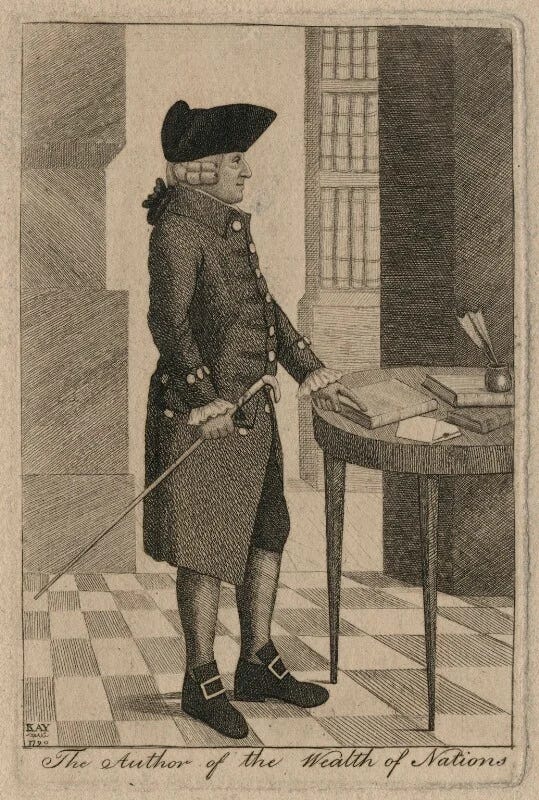
(In fact, he was not “pretty much the only philosopher before about 1900 who condemned slavery”, as we shall see.)
It is telling, to my mind, that in 1850 Carlyle argued against economics as a “dismal science” in his defence of slavery or servitude for Blacks, and J.S. Mill in his rebuke referred to justice. Mill was a Smithian in many ways. He annotated The Wealth of Nations to show what had been learned since Smith wrote when he was twelve years old. His ability to argue the case not merely as an economist but as a moral philosopher was part of his Smithian inheritance.
I must first set my anti-philanthropic opponent right on a matter of fact. He entirely misunderstands the great national revolt of the conscience of this country against slavery and the slave-trade, if he supposes it to have been an affair of sentiment. It depended no more on humane feelings than any cause which so irresistibly appealed to them must necessarily do. Its first victories were gained while the lash yet ruled uncontested in the barrack-yard and the rod in schools, and while men were still hanged by dozens for stealing to the value of forty shillings. It triumphed because it was the cause of justice; and, in the estimation of the great majority of its supporters, of religion. Its originators and leaders were persons of a stern sense of moral obligation, who, in the spirit of the religion of their time, seldom spoke much of benevolence and philanthropy, but often of duty, crime, and sin. For nearly two centuries had negroes, many thousands annually, been seized by force or treachery and carried off to the West Indies to be worked to death, literally to death; for it was the received maxim, the acknowledged dictate of good economy, to wear them out quickly and import more. In this fact every other possible cruelty, tyranny, and wanton oppression was by implication included. And the motive on the part of the slave-owners was the love of gold; or, to speak more truly, of vulgar and puerile ostentation. I have yet to learn that anything more detestable than this has been done by human beings towards human beings in any part of the earth.
This is why Smith was so interested in the novelists (particularly Swift and Richardson) and they were so interested in him (especially Austen). Smith thinks about life in a broad context, not a narrow abstraction.
A fun back-and-forth, and I would add to the conversation (Economist) Brad DeLong's thoughts -- https://braddelong.substack.com/p/hoisted-from-e-archives-two-months
On why Smith was a philosopher, even in The Wealth Of Nations:
"The Wealth of Nations, Tribe said, could not be a book of economics because a book of economics had to be about the economy. And there was no such thing as the economy in 1776 for a book of economics to be about. What was there? . . .
...
And I became convinced that Tribe and Foucault were right. It was, indeed, only with Ricardo that the operation of what we now say is the economy—the production, exchange, and distribution of goods and services all mediated through market exchange—was seen as something that was important enough, or separate enough, or coherent enough to be something that it made sense to write books about, and, indeed, something that it made sense to be an expert in. David Ricardo was a political economist. Adam Smith was a moral philosopher. To try—as somebody like Joseph Schumpeter was—to grade Adam Smith as if he were engaged in the same intellectual project as Schumpeter was somewhat absurd."
* * *
On why Smith was an economist
"But Tribe's (and Foucault's) methodology collapses when we work back to Books II and I of the Wealth of Nations. For Adam Smith is not the prisoner of the discursive formation of Political Oeconomy. He is not the simple bearer of currents of thought and ideas that he recombines as other authors do in more-or-less standard and repeated ways.
Adam Smith is a genius.
He is the prophet and the master of a new discipline.
He is the founder of economics.
Adam Smith is the founder of economics because he has a great and extraordinary insight: that the competitive market system is a remarkably powerful social calculating and organizing mechanism, and that the sophisticated division of labor to which a competitive market system backed up by secure and honest enforcement of property rights give rise is the key to the wealth of nations."
Anyone want to argue he was actually a Sociologist?