

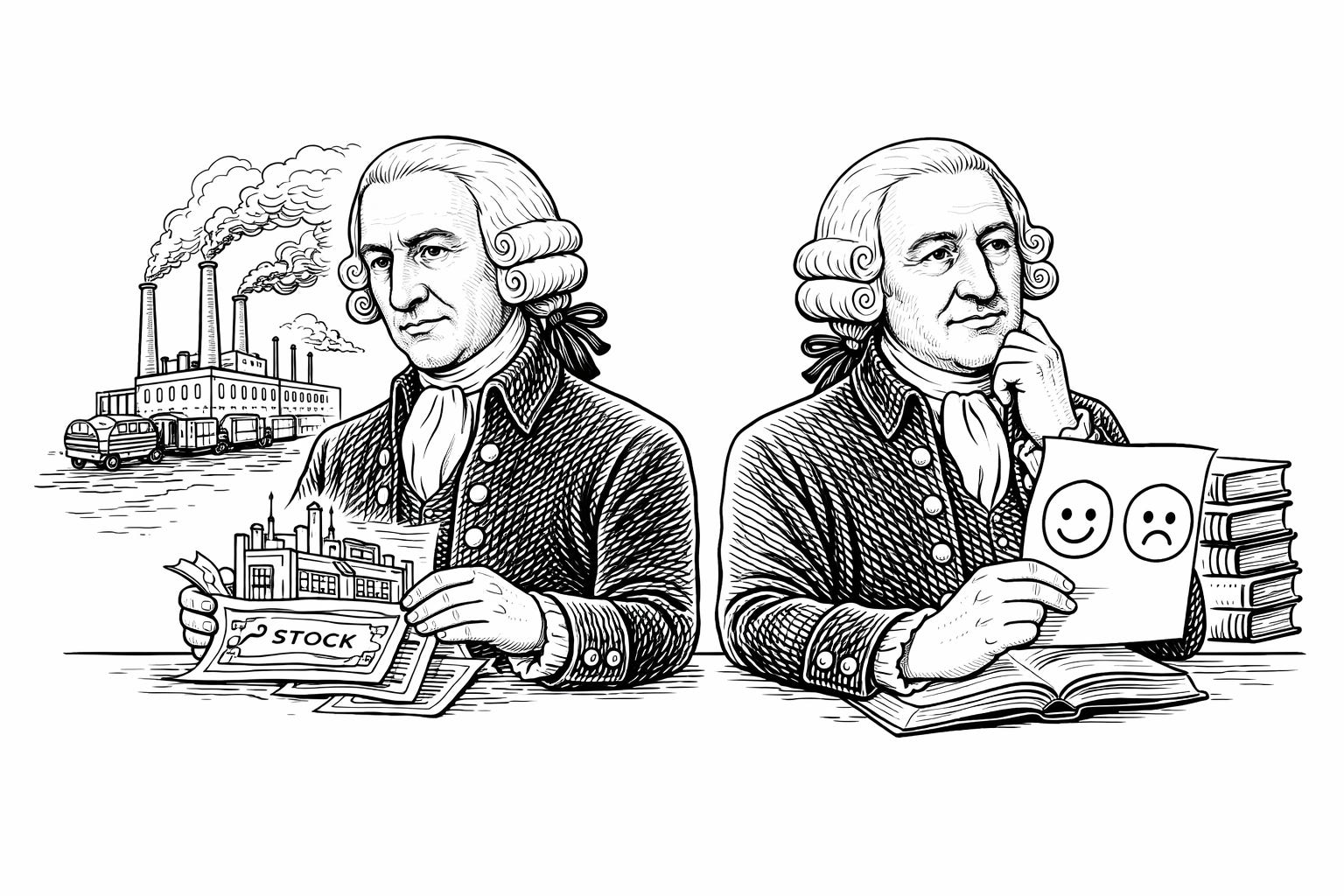
One of things I enjoy the most about my job at Mercatus is moderating in-house philosophical debates. I organise these occasional debates as special sessions of the Philosophy Working Group I run every Wednesday.
Today, in honour of the recent 250th birthday of Adam Smith’s The Wealth of Nations, I moderated a debate on the topic ‘Adam Smith: Economist or Philosopher?’. We also ate a delicious cake featuring a picture of a (not really) invisible hand.
Since I’ve been meaning to write about Adam Smith this month, here follows a non-verbatim version of my opening remarks. You may notice a little hyperbole.
Adam Smith: Economist or Philosopher?
I’m going to break with the tradition of these debates, and give a quick answer to the question at hand(!), myself. I’m doing this partly because I think it’s funny that, as a philosopher, I’m firmly on the side of ‘Adam Smith Economist’.
But I also wanted to kick off the debate in this way because ‘Adam Smith Economist’ is clearly the obvious and only correct answer. So I thought I should take one for the team by admitting my norminess, to let everyone else make clever but wrong arguments.
My main reason for being on the ‘Adam Smith Economist’ side comes down to the stark difference in quality between The Wealth of Nations (WoN), which is Adam Smith’s great economics book, and The Theory of Moral Sentiments (TMS), his supposedly great philosophy book.
WoN is one of the greatest economics books of all time. Probably the greatest. It covers everything from land to labour to money to metals to interest to imports to teaching to taxes. It does all this coherently, and mostly convincingly — even on some things that weren’t formally worked out until over a hundred years later!
WoN is also incredibly readable. I started rereading the last section of it at 3am this morning, and I couldn’t stop. Why did I start at 3am, you wonder? Because I’d been reading The Theory of Moral Sentiments, and I needed a break! I needed to read something good! This is because TMS is really a very annoying, quite subpar, torturously written philosophy book.
Stylistically, TMS reminds me of the worst of Kierkegaard. This is not a good thing! If you’re ever tempted to read his Works of Love, then don’t say I didn’t warn you. All of these overly complicated little anecdotes with their clever wordy sub-headings.
If you’ll allow me an English person digression, they remind me a little of the mid-20th-century English children’s novelist Enid Blyton. Blyton breaks her stories up with silly stylised chapter titles, like ‘After a lovely day rambling in the sunny hills, the five children return home to the caravan and a nasty surprise!’.
This is exactly what Smith does in TMS. And it points up the way this book is full of bad narrative continental-philosophy-type storybook rambling, rather than the brilliant ice-cool analytic-philosophy-type argumentation I love!
Then, substance-wise, 90 per cent of TMS is Smith finding yet another way to say ‘if you feel a bit bad when something bad happens to someone else, then that’s normal, so it’s good!’.
And of course almost all of it is just mediocre takes on David Hume. I should admit that I don’t like Hume much, for his writing or for his positions. But he and many of his arguments — when you can work out what they’re about! — are undeniably great. It’s thanks to Hume that I don’t spend every minute of my waking life lost in a morass of skepticism. Only about half of them, which isn’t bad.
All that said, the one thing we philosophers should be extremely grateful to Smith for is that he’s pretty much the only philosopher before about 1900 who condemned slavery. Which is a seriously dreadful reflection of our discipline — more dreadful than I have time to discuss today.
Indeed, by far Smith’s best philosophical position, on many grounds, is his radical egalitarianism about the universality of the capacity for judgement. Smith believes that whether you’re rich or poor, and no matter which country you’re from, you have the capacity for great judgment, given the right education and conditions. He even thinks this about English people! Even though he was perhaps the original Scottish hater of the English...
Smith was a proper egalitarian, relative to his time, and much more generally. And I will always love him for that.
However, it’s worth noting that the relevant arguments he makes — arguments about the badness of slavery, and about the shared human capacity for judgement — are mostly much more explicitly and clearly made in WoN and in the Lectures on Jurisprudence, than in TMS!
This reminds us that the supposed WoN/TMS split is vastly overstated. The two books overlap substantively, and they both contain a lot of philosophy. The difference of course, however, is that WoN contains a lot of economics. A lot of really, really great economics! And it helps, again, that it’s also such a good read — no wonder people find it hard to believe they’re by the same guy! It’s one of the best-written books of any academic discipline.
If you were only going to read one economics book ever, then surely it would be WoN. And my guess is that it will take a long, long time for this to change.
Adam Smith is one of the great economists of all time. Likely the greatest. So far, and my bet is, for way into the future. Whereas, as a philosopher, he doesn’t make it into the top 40. Or 50. Maybe even 100.
You’ve got to hand(!) it to him, however, one out of the two is pretty great.

> the one thing we philosophers should be extremely grateful to Smith for is that he’s pretty much the only philosopher before about 1900 who condemned slavery.
Jeremy Bentham??