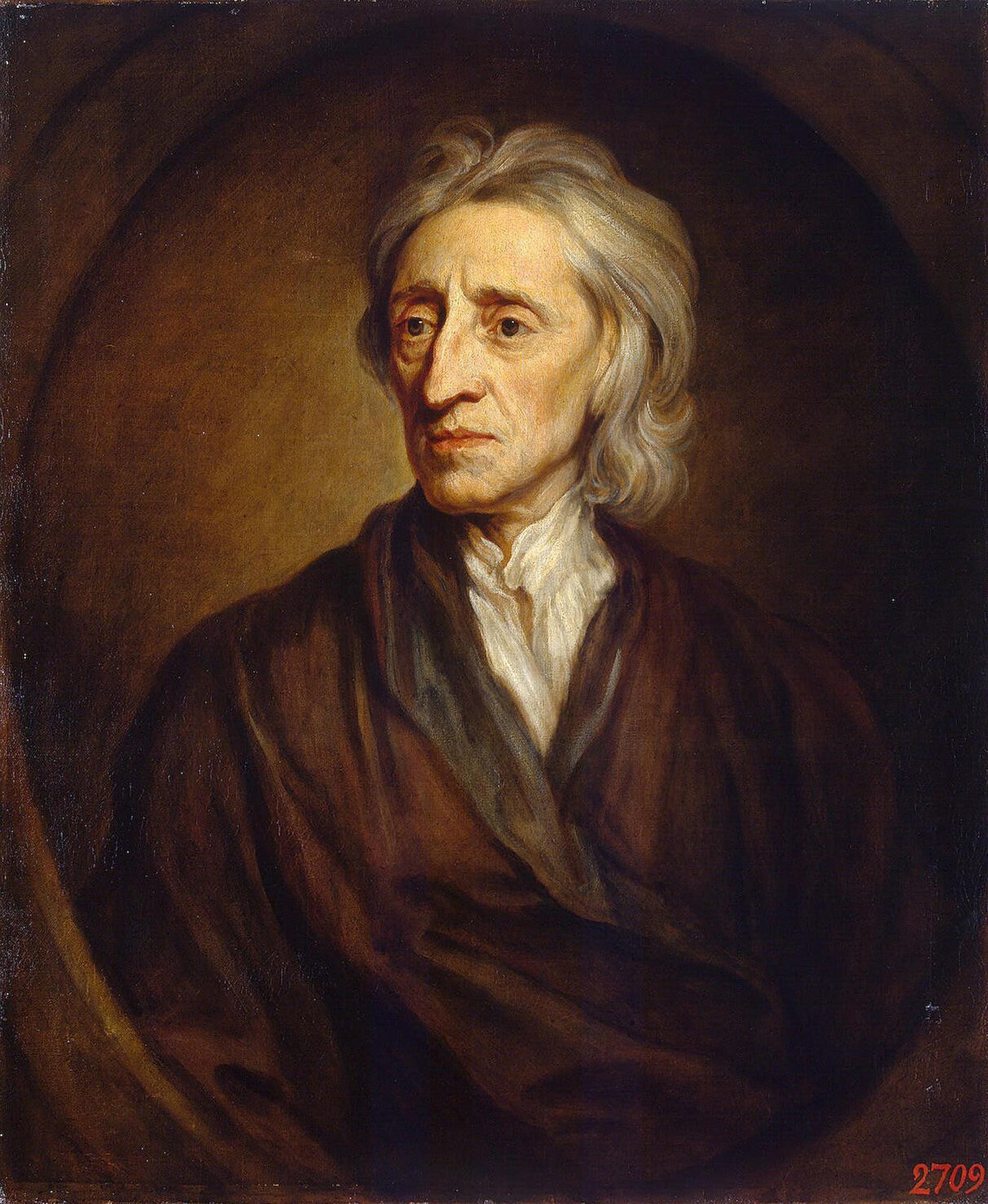
Over at Liberty Fund, Rebecca Lowe, Henry Oliver, Galen Strawson, and Oliver Traldi have each contributed an essay about John Locke’s 1690 work An Essay Concerning Human Understanding. These essays concern questions of personal identity, epistemology, language, politics, and free will. Locke’s Essay is one of the great works of English philosophy, but it gets less attention than his Second Treatise, so we were especially delighted to be able to produce this forum with Liberty Fund.
First, Henry Oliver wrote about Locke as a playful philosopher.
One day, when my son was three years old, he stuck his finger into a candle. We were sitting at the table before dinner and he touched the flame without warning. When his sister asked him why he had done it, he told her he just wanted to know what the flame was like. I remembered this when I was reading Locke’s Essay Concerning Human Understanding, in the section when Locke discusses how certainly we can know the world beyond ourselves, and he writes: “he that sees a candle burning, and hath experimented the force of its flame by putting his finger in it, will little doubt that this is something existing without him.” (IV.xi.8) This is how the love of philosophy begins: in a curiosity of the world and a willingness not just to question it, but to test it directly. It illustrates Locke’s larger point about man’s capacity to reason without the use of formal logic. “God has not been so sparing to men to make them barely two-legged creatures, and left it to Aristotle to make them rational.” (IV.xvii.4) We become philosophical as we become interested in knowing the qualities and limits of the world and ourselves. And that begins in childhood.
Second, Oliver Traldi wrote about whether Locke’s epistemology can sustain his liberalism.
So Lockean thought leads naturally, though not inevitably, to a contemporary illiberal concern: that liberals, despite or even within their epistemologies of toleration, skepticism, sensitivity to reasonable disagreement, and so on, have a hidden dogmatism, necessary for the moralism of liberalism itself. We might add to the pile one of the more famous examples of this sort of tension in Locke: the contrast, in the Letter Concerning Toleration, of his view of the intellectual difficulty of discovering religious truth (“In the variety and contradiction of opinions in religion, . . . the princes of the world are as much divided as in their secular interests”) with his contempt for atheism (“Lastly, those are not at all to be tolerated who deny the being of a God. Promises, covenants, and oaths, which are the bonds of human society, can have no hold upon an atheist. The taking away of God, though but even in thought, dissolves all”).
Third, Rebecca Lowe argues for the importance of free will to liberal ideas.
I’m going to focus almost entirely on Section Five of Chapter XXI of Book II of The Essay, because this section includes one of the most important statements in the liberal canon. I know this reasoning is controversial! Mainly because most people wouldn’t see The Essay as part of the liberal canon, at all. The Second Treatise? Of course. Almost certainly the Letter Concerning Toleration, too. But The Essay?
The relevance of The Essay
It’s in The Essay, in Chapter XXI of Book II, where we find Locke’s deepest theory of freedom, presented most clearly. Here, Locke goes beyond addressing those classic Second Treatise questions, such as ‘what kinds of social conditions should humans, as naturally free and equal things, choose to live in?’, and ‘how should we treat each other, as naturally free and equal things?’. Here, he offers comprehensive answers to upstream metaphysical questions: questions about agency and free will; questions that broadly reduce to ‘what does it mean to be free, in the first place?’.
And fourth, Galen Strawson offers an revisionist interpretation of Locke’s ideas about personal identity.
‘What makes a person the same person through time?’ This is the philosophical question of personal identity.
There seems to be an obvious answer: same body (same original zygote), or same soul (if you believe in such a thing). But this isn’t Locke’s answer. In his great Essay concerning Human Understanding, he argues that you can be the same person today as a person who existed twenty years ago even if you have a completely different body; and even if you have a completely different soul substance. For him, the question of personal identity is ‘Which of your past doings are you now morally and legally responsible for’? His answer is that you’re only responsible for those to which you now stand in a certain relation: the relation of being conscious of them.
What does he mean by consciousness? I’ll try to explain.
There will also be four short rejoinders published, two of which are already up. Here, for instance, is Oliver Traldi responding to Henry Oliver.
Oliver’s account of the relationship between play and philosophy might have more radical implications than he quite develops. (Or maybe they are precisely the ones he meant to develop.) For if all our dealings with the baffling external world are, in fact, “in the game”, it’s hard to know what reasoning we can use that circles back outside of it to confirm something that stands outside of us. It’s not clear to me that Locke really articulates a cogent argument against skepticism. But perhaps Oliver’s idea in bringing up play is more therapeutic: we shouldn’t worry so much about this, because we can handle the same inside/outside dynamic in many other contexts.
You can read all the contributions here.